
The chargers that suit Ireland are decided address by address, not by a national spec sheet: where the car parks relative to the supply, what supply reaches that parking spot — confirmed per site, in writing — and which connector family the cars your buyers serve carry. Sort stock by dwelling class first.
Key Takeaways
- Suitability is a per-address answer: parking position, confirmed supply, connector family.
- Sort stock by dwelling class first — each class forces a different form.
- Phase supply and socket class are installer confirmations, never market assumptions.
- Grant positions change; check the current explainer, not a quoted figure.
Start With the Dwelling Class, Not the Charger
Each dwelling class forces a different first question:
| Dwelling class | Where the car parks | The supply question to confirm | Form that fits, once confirmed |
|---|---|---|---|
| Terraced street home | On the street, or a short front plot | Is there a supply point within cable reach of the parking spot, and what arrangement does the installer confirm? | A portable used at a confirmed supply point — or charging away from home |
| Suburban semi or detached with driveway | On a private driveway beside the house | Single-phase or three-phase at the board, plus spare capacity — installer-confirmed, per address | Fixed wallbox, or a portable on a confirmed socket |
| Rural detached with outbuildings | Yard, garage or outbuilding — not always beside the house meter | Which building carries which supply; outbuildings are confirmed separately from the house | A portable that moves between buildings, or a wallbox at the main parking building |
| Apartment or shared car park | A shared bay, often far from any one dwelling’s meter | Whose supply feeds the bay, and who approves a shared installation — management and installer together | Shared station hardware on a confirmed shared supply |
The parking question comes first: it can remove the home charger from the sale entirely. If the car never parks beside a confirmed supply point, the honest answer is workplace or shared charging — not a longer cable.

Then Confirm the Supply at That Address
With the dwelling class fixed, read the nameplate against the supply the installer confirms at that address: rated input window, phase count, and input connection form. Our explainer on single-phase vs three-phase charging sets out what each supply supports; which one a given home has is a per-address confirmation, not a market assumption. Plug forms follow the same discipline: a portable stating a CEE plug fits only where that socket class exists — our CEE plug guide teaches buyers to identify the class by sight before ordering.
The Connector Question Is a Survey You Run
The third match is the car. Count the inlets on the cars your customers serve — home buyers, workplace fleets and shared-bay users may not drive the same mix — and stock the family the survey supports. Our comparison of Type 2, J1772 and NACS connectors by market works through the families; the Irish answer comes from your survey.
The EVDANCE Forms, Sorted for Irish Buyers
In the Type 2 family, the EV-ACS3210E is the single-phase portable (about 7 kW, Type 2, IP66) for confirmed single-phase supply points. The ACS1605PE (11 kW, CEE 5-pin) and EV-ACS3205PE (22 kW, CEE 32A plug) are the three-phase portables for outbuildings and workshops with that socket class confirmed. The EV-ACT3204PE is the fixed 22 kW three-phase wallbox for driveway installs. Home-charging support changes over time — check the current position in our Ireland grant explainer rather than pricing any figure into a quote.
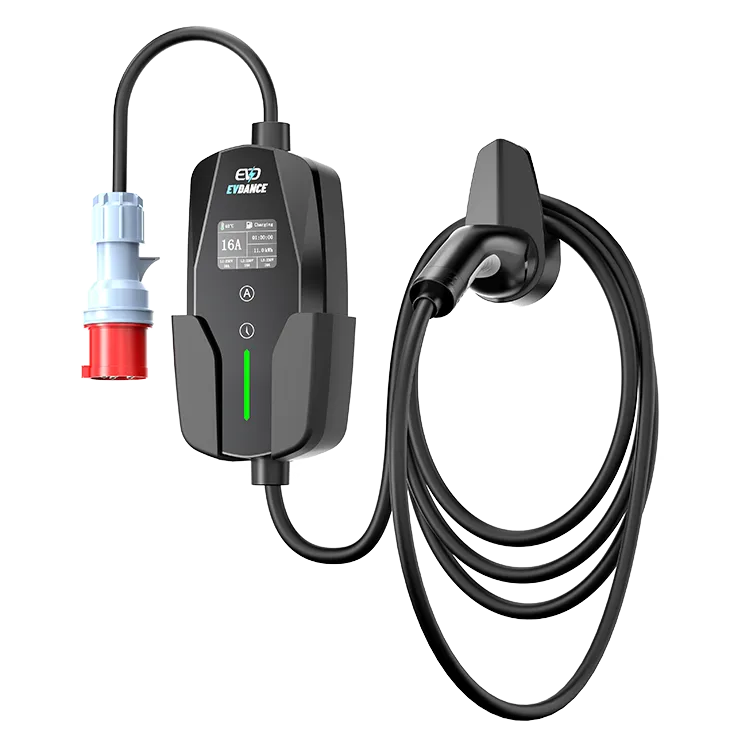
EVDANCE is a Shenzhen manufacturer founded in 2011, exporting to 30+ countries, with a 3-year standard warranty. Sort your range against the full product range, and start through the distributor program or contact us — each model’s market version is confirmed in writing first.
Frequently Asked Questions
Is there one standard Irish home charger I can stock for everyone?
No. Dwelling class decides the form — portable, wallbox or shared station — and the confirmed supply at each address decides the model. Stock the forms; confirm per address.
A customer in a terraced house parks on the street. What fits?
If the car does not park beside a confirmed supply point, a home charger may not be the right product. Do not sell cable length as the fix; an installer confirms what is permitted at that address, and workplace or shared charging may be the honest answer.
Do Irish homes have three-phase supply for a 22 kW wallbox?
Not as a market fact this page will state. The wallbox states a three-phase input, so the dwelling must confirm a three-phase supply — per address, in writing, through the installer — before that model is quoted.
Related Reading
- How Much Is the EV Charger Grant in Ireland?
- Single-Phase vs Three-Phase EV Charging: 7kW, 11kW and 22kW Explained
- CEE Plugs Explained: Choosing 16A or 32A for a Three-Phase Portable EV Charger
- Type 2 vs J1772 vs NACS: Which EV Charger Connector Does Your Market Need?

