
As of October 2026, there is no verified ranking of EV charging business opportunities, and no honest shortcut around the site work. The opportunities that hold up are specific sites — workplace car parks, hotels, fleet depots, retail hosts, corridor stops — and each can be tested before money moves: count the cars, time the dwell, confirm the electricity supply, price the installation class. An opportunity is a site that passes those tests, not a sector headline.
Key Takeaways
- An opportunity is a tested site, not a market claim: parc, dwell, supply and cost class are observable before purchase.
- The U.S. 30C credit no longer covers property placed in service after June 30, 2026 — price new projects without it.
- Each site type has one deal-breaker question; answer it before gathering anything else.
- Hardware is chosen after the test, in the class the dwell and programme rules require.

What “Opportunity” Means in October 2026
Two dated facts frame this year. First, the U.S. federal 30C credit no longer applies to charging property placed in service after June 30, 2026, so new project numbers must stand without it. Second, public programmes still set terms where they operate: U.S. NEVI corridor stations must run 24/7, take contactless payment without membership, hold average annual uptime above 97%, and provide DC ports of at least 150 kW under 23 CFR Part 680. Subsidies and programme terms change — a plan priced on last year’s terms is priced on a guess.
The Opportunity Test, by Site Type
| Site type | Demand evidence to gather | Cost anchor class | Deal-breaker question |
|---|---|---|---|
| Workplace car park | Count employee and visitor EVs over several weeks; ask tenants and staff | Public Level 2 class: DOE-cited U.S. figures of about $3,500 equipment plus $2,500 installation per connector | Does the lease allow installation, and who pays for the electricity? |
| Hotel or hospitality site | Guest EV arrivals from the property’s own booking and parking records | Level 2 class, per connector as above | Will guests pay per session, or is charging an amenity the room rate carries? |
| Retail host site | Observed shopper dwell, set against what a Level 2 session adds | Level 2 class; compact DC as its own lines | Will the host share cost — and who owns the driver relationship? |
| Fleet depot, light vehicles | Vehicles returning to base nightly; hours standing still between duties | Level 2 per connector, across the bays the pattern needs | Does the return pattern leave a long enough dwell window for AC charging? |
| Corridor or public fast site | Traffic past the site; eligibility rules of any funding programme | DC fast class: DOE-cited U.S. figures of about $38,000–$90,000 equipment plus $20,000–$60,000 installation per unit | Can the grid connection and site meet programme conditions — 24/7 opening, contactless payment, uptime? |
Evidence Before Enthusiasm
- Count the parc. Vehicles already parking at the site are the only demand observable today; the rest is projection.
- Time the dwell. Level 2 delivers roughly 10–20 miles of range per hour on U.S. DOT figures — a site works only if cars stay that long, or it genuinely needs DC.
- Get the supply answer in writing. The utility’s connection terms decide whether the cost anchor survives the site.
- Answer the deal-breaker first. If the lease, host or programme rules say no, demand evidence cannot repair it.
A site that passes is then measured, not assumed: whether a charging station business is profitable covers revenue and costs, and the investment question covers the return test.
Hardware Matched to the Test
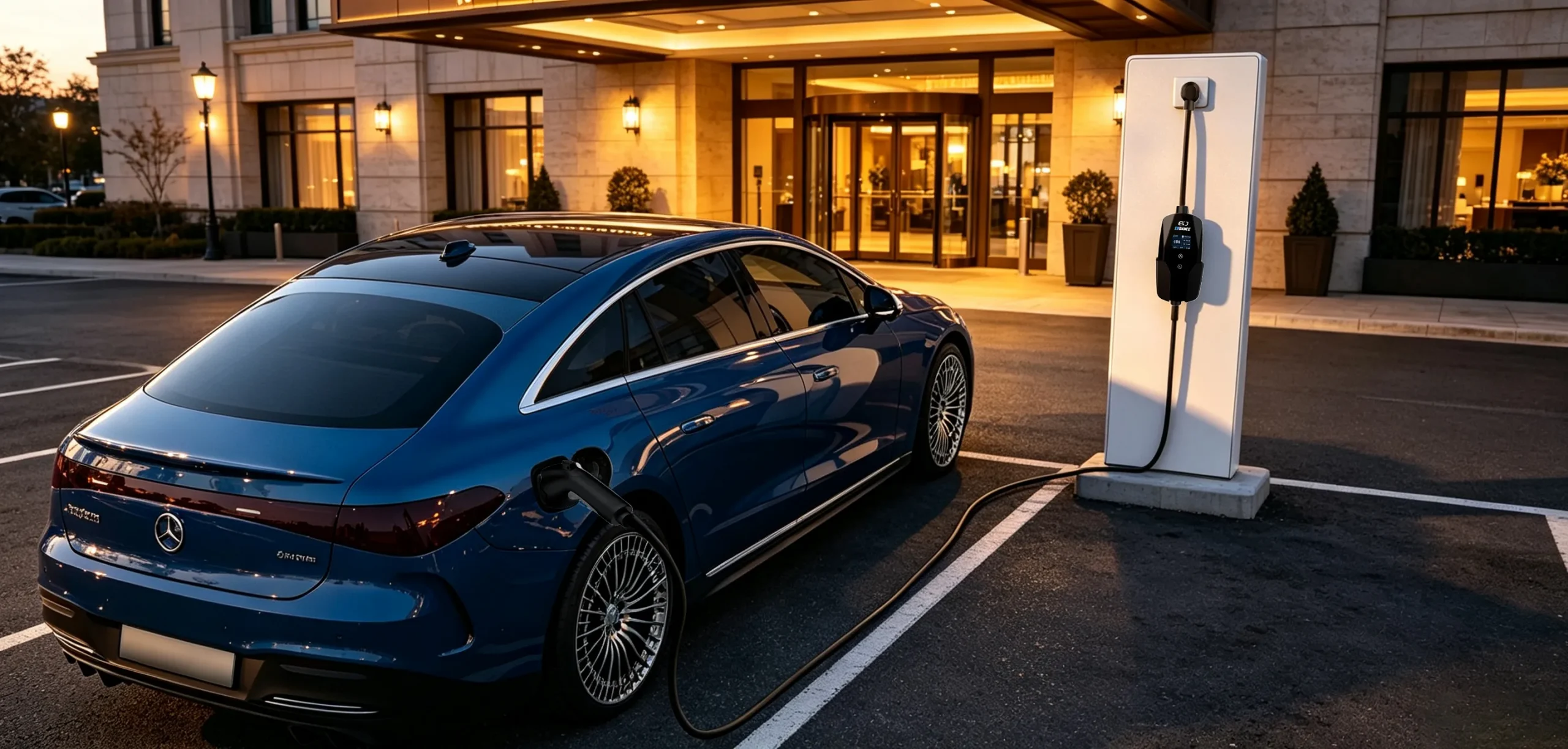
Hardware follows the site type that passed. For workplace and hotel AC charging, EVDANCE’s EV-AC03201T dual-connector AC station — two Type 2 connectors, up to 43 kW shared, OCPP 1.6J, RFID, IP54 — serves shared bays from one floor-standing unit. Where dwell is short but corridor hardware is out of scale, the EV-RHDC30K-L is a compact DC unit at 22 kW — not a substitute for the 150 kW-plus units NEVI-type programmes specify. See the wider range on our commercial charging page, or bring your site evidence to contact us.
Frequently Asked Questions
Is EV charging still a good opportunity in 2026?
At the right site, it can be; as a blanket statement about the sector, the question has no sourced answer. Run the test in the table and let the site’s evidence decide.
Which site type is the best opportunity?
No verified source ranks site types, and this article will not invent one. The strongest candidate is the type whose demand you can observe directly and whose deal-breaker already has a documented answer.
Do grants and credits change the picture?
They change the arithmetic where they apply, and they change often. The U.S. 30C credit is closed to property placed in service after June 30, 2026; other programmes have their own current terms. Confirm any incentive in the programme’s current documents — DSIRE tracks U.S. state programmes — before pricing it in.
Related Reading
- Is an EV Charging Station Business Profitable?
- Are EV Charging Stations a Good Investment?
- How to Open an EV Charging Station: Step by Step

