
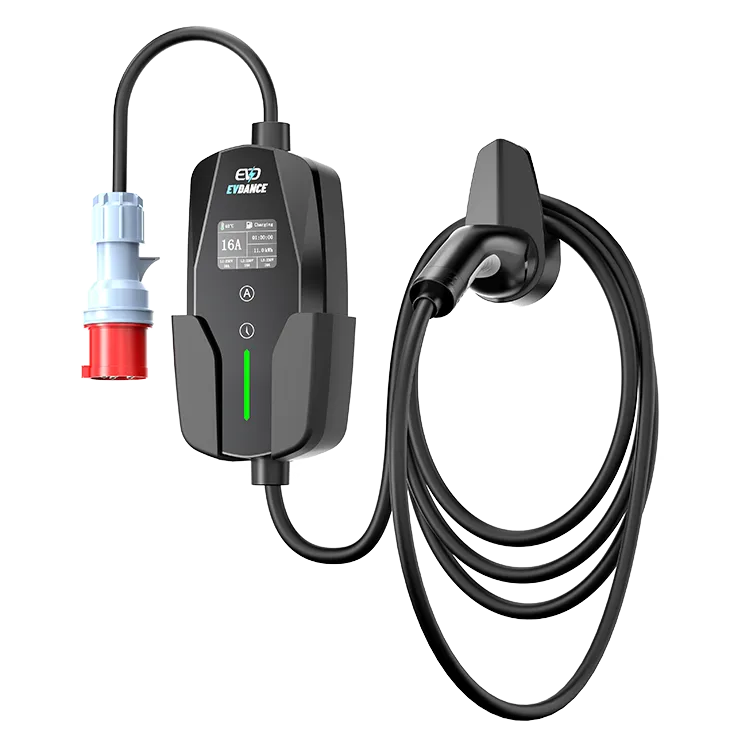
Mobile mechanics working on EVs sometimes need to add charge before a test drive or after diagnostics. An 11 kW portable charger like the ACS1605PE can do that wherever a 16 A three-phase CEE outlet is available, such as at a customer’s workshop, farm or business premises. It is not a roadside rescue tool: it needs a proper outlet, the customer’s permission, and the same safety discipline as any electrical work.
Key Takeaways
- A portable 11 kW charger needs a 16 A CEE outlet on site.
- It is for top-ups, not roadside rescue.
- Get permission and record charging on the job sheet.
- Check the charger like any other tool before use.
When a Mobile Mechanic Needs Charging
| Situation | Need | Portable charger role |
|---|---|---|
| Battery low after diagnostics or software update | Enough charge for a test drive | Top-up on customer’s CEE outlet |
| Car stored for months with a low battery | Initial charge to bring it back into use | Slow, supervised charge |
| Fleet servicing at a depot | Charge between jobs | Use depot outlets |
| Roadside breakdown with no outlet | Rescue | Not suitable; needs a dedicated mobile charging service |
What You Need on Site
- A 16 A three-phase CEE five-pin outlet in good condition, on a protected circuit.
- The customer’s permission to use their electricity, and agreement on cost if relevant.
- A safe cable route away from walkways and vehicle movements.
- A dry place for the control box, off the ground.
Never use adapters to connect to a different outlet type, and never use extension leads. If no suitable outlet exists, a single-phase charger on a suitable circuit or a trip to a public charger may be the answer. Read why extension cords are unsafe.
Professional Practice
Follow the vehicle manufacturer’s service information for high-voltage systems, and only work within your training and qualifications. Record charging done as part of the job sheet, including start and end state of charge. Check the charger and cable before each use, as you would any tool. Our guides on testing a tethered charger and portable charger safety help with routine checks.
How Much Charge in a Typical Visit
At 11 kW, an hour adds about 11 kWh, enough for 60 to 80 km in many cars. That is usually plenty for a road test. Cars with single-phase onboard chargers charge more slowly, around 3.7 kW on one 16 A phase. Our article on charging times shows more examples.
Why the ACS1605PE Suits Service Vans
It is compact, rated IP66 for dust and water, and uses a 16 A CEE plug that is common on commercial and agricultural sites across Europe. The ACS1605PE delivers up to 11 kW at 16 A, 230/400 V, with a Type 2 connector, a 1.77-inch display and a 7.6 m cable. Workshops that want fixed charging can look at EVDANCE commercial solutions.
Frequently Asked Questions
Can a mobile mechanic charge a dead EV at the roadside?
Not with a portable charger alone; it needs a suitable outlet. Roadside charging requires a dedicated mobile charging service.
How long does a test-drive top-up take?
At 11 kW, about an hour adds enough charge for a typical road test in many cars.
What outlet does the ACS1605PE need?
A 16 A three-phase CEE five-pin outlet on a properly protected circuit.
Related Reading
- Can You Use an Extension Cord With an EV Charger?
- How to Test a Tethered EV Charger
- Portable EV Charger Safety Guide 2026: NEC Rules, Extension Cords, and What to Avoid
- How Long Does It Take to Charge an EV at 7 kW, 11 kW and 22 kW?

