
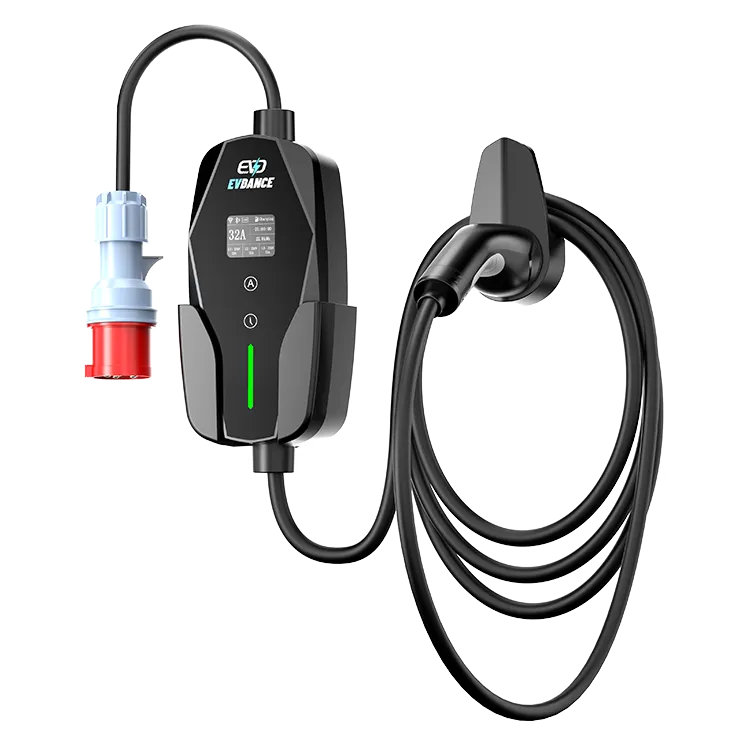
Car clubs running EVs from remote bases, such as village halls, farm yards or temporary sites, can charge with a 22 kW three-phase portable charger like the EV-ACS3205PE plugged into a 32 A CEE five-pin outlet. It avoids a fixed wallbox at each base while still charging cars that accept 22 kW quickly. The base needs a suitable three-phase outlet installed by an electrician, and the club needs a clear routine for members.
Key Takeaways
- A portable 22 kW charger can move with shared cars between bases.
- Each base needs a 32 A CEE outlet on a three-phase supply.
- Simple member routines keep cars charged.
- Store chargers locked and dry at unstaffed bases.
Why Portable Suits Remote Bases
Fixed chargers make sense where a car lives permanently. Remote or seasonal bases change: a car might be stationed at a community building for a season, then moved. A portable unit can follow the car, while each base only needs a robust industrial outlet. That keeps capital cost down and avoids leaving expensive hardware unused at quieter bases.
What Each Base Needs
| Item | Requirement | Notes |
|---|---|---|
| Supply | Three-phase, 380 to 400 V | Many rural buildings have it; check first |
| Outlet | 32 A CEE five-pin, installed by an electrician | On a dedicated circuit with correct protection |
| Location | Next to the car’s bay, protected from impact | Weatherproof outlet if outdoors |
| Storage | Lockable box or cabinet for the charger | Protects against theft and weather |
| Signage | Simple instructions for members | Include a support number |
How Fast Shared Cars Charge
At 32 A per phase, the charger can supply up to 22 kW. Cars with an 11 kW onboard charger draw around 11 kW, and single-phase-only cars draw less. Shared cars often sit for hours between bookings, so even 11 kW refills a typical booking’s energy in a few hours. Read which cars can charge at 22 kW and how fast a 22 kW charger charges.
A Member Routine That Works
- Plug in at the end of every booking, using the bay’s instructions.
- Leave the charger’s current at the default the club sets.
- Report any damage to the cable, plug or outlet through the club’s app or phone line.
- Return the charger to its storage box if the car is not charging.
Keep the routine short. If members must remember complicated steps, cars end up uncharged for the next person.
Safety Points for Clubs
Choose outlets with residual current protection suited to EV charging, check cables regularly, and never let members use adapters or extension leads. Our guides on CEE plugs for portable chargers and Mode 2 vs Mode 3 charging explain the standards.
The EV-ACS3205PE is a 22 kW three-phase portable charger at 32 A, 380 to 400 V, with a Type 2 connector, CEE five-pin plug, 1.77-inch display and IP66 protection.
Frequently Asked Questions
Can a car club use portable chargers instead of wallboxes?
Yes, at bases with a suitable three-phase CEE outlet. A portable unit can move with the car between bases.
Do all EVs charge at 22 kW on this charger?
No. The car’s onboard charger sets the maximum. Many accept 11 kW; some accept 22 kW.
How should the charger be stored at an unstaffed base?
In a lockable, weatherproof box near the bay, with the connector capped.
Related Reading
- What Cars Can Charge at 22kW?
- How Fast Does a 22 kW Charger Charge? Nameplate Speed vs Real-World Speed
- CEE Plugs Explained: Choosing 16A or 32A for a Three-Phase Portable EV Charger
- Mode 2 vs Mode 3 Charging: What IEC 61851 Means for Portable EV Chargers

