
CHAdeMO is pronounced “chah-deh-mo” — three short, even syllables, said the way it would be in Japanese. The unusual capitals are the clue to where the word comes from: the CHAdeMO Association explains the name as a blend of “CHArge” and “MOve”, which also echoes the Japanese phrase “o cha demo ikaga desuka” — “how about a cup of tea?” The idea built into the name is that the car charges in about the time a tea break takes.
Key Takeaways
- Say “chah-deh-mo” — three short, even syllables, Japanese-style vowels.
- The name blends CHArge and MOve; the capitals mark the borrowed syllables.
- It also puns on “o cha demo ikaga desuka” — “how about a cup of tea?” — a break-length charge.
- Behind the word sits a Japanese DC fast-charging standard with its own separate inlet.

Saying It, Syllable by Syllable
| Syllable | Sounds like | Note |
|---|---|---|
| CHA | “chah” | The “cha” of “o cha” — Japanese for tea |
| de | “deh” | Short and light, never “dee” |
| MO | “mo” | As in “move”, without the “ve” |
Put together with an even rhythm — chah-deh-mo — and you have it. The common misreadings come from reading it as English: “cha-DEE-mo” gives the middle syllable a vowel it does not have, and “shademo” drops a syllable. Coined in Japan, its vowels behave as in Japanese: short, clear and evenly stressed.
Where the Name Comes From
Most charging standards are named like engineering documents — initials, numbers, committee language. CHAdeMO was deliberately named like a product. Per the CHAdeMO Association’s own explanation, the word is built from two pieces of English: CHArge and MOve, joined by “de” — the name is usually expanded as “charge de move”, charging for movement. The capitalisation is not decoration: CHA and MO are capitalised in the wordmark because those are the syllables the source words contribute.
The second thread is the pun. In Japanese, “o cha” is tea, and “o cha demo ikaga desuka” is the everyday invitation “how about some tea?” Early CHAdeMO charging was pitched as a top-up that fits inside a break, so the name winks at the experience it was selling: plug in, have tea, leave charged. The U.S. DOT class figures show the scale of that promise — DC fast charging as a category runs at 50–350 kW, adding roughly 180–240 miles of range per hour — so a break-length stop genuinely moves the battery needle in a way an AC top-up never could.
The Standard Hiding Behind the Name
For anyone meeting the word at a charger: CHAdeMO is a DC fast-charging standard developed in Japan, fitted mainly to earlier Japanese EVs — the Nissan Leaf above all — through its own separate round inlet. It is DC-only, so those cars charge at home through a second, AC inlet. Sessions work like any other fast charge — park, connect, start, unplug when you have enough, as our guide to using a DC fast charger walks through. The name is now better travelled than the connector: new models elsewhere launch with CCS or NACS, while CHAdeMO cars and cables remain in daily service.
EVDANCE and CHAdeMO, Honestly
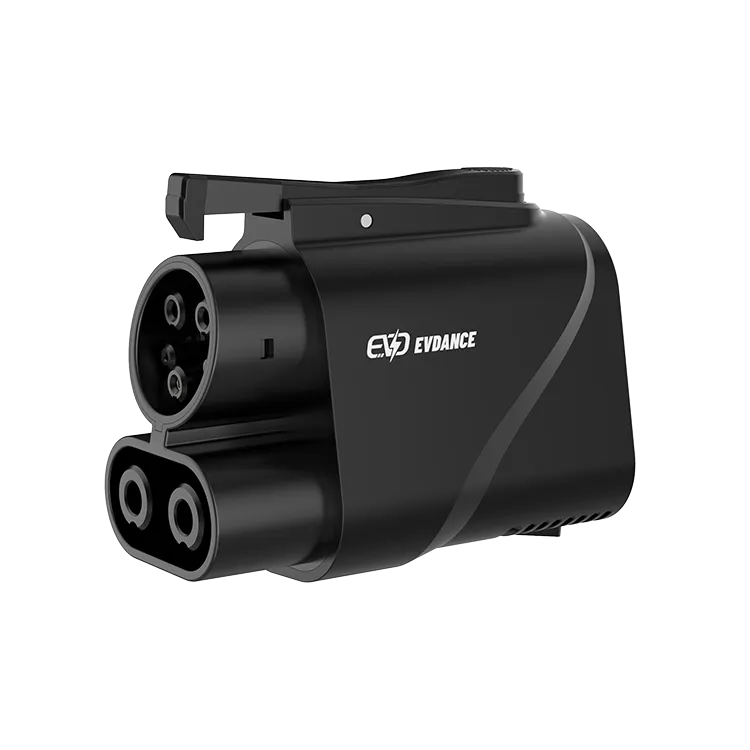
No EVDANCE product uses CHAdeMO, and no adapter converts a car to it — the DC systems do not cross over. The adapters that do exist bridge NACS and CCS1: the JT08 and JT09 let a CCS1-inlet car charge at NACS DC stations open to that car, including Superchargers open to it, only where the vehicle maker approves a third-party DC adapter for the exact car and the station is open to it. If your car has the round CHAdeMO inlet, your charging world is CHAdeMO cables plus your home AC inlet — and knowing how to say the name at least makes asking for the cable easier.
Frequently Asked Questions
Is CHAdeMO an acronym?
Not in the initials-of-an-organisation sense. It is a coined blend: CHA from “charge”, MO from “move”, per the association that owns the standard. The capitals in the middle of the word mark where the source words sit.
Why is it spelled with capitals in the middle?
Because the spelling is a map of the name. CHAdeMO is written so the two borrowed syllables stand out — CHA from charge, MO from move — a styling carried over from the wordmark into ordinary text.
Does the tea story mean a charge takes five minutes?
No — the tea break is the name’s image, not a specification. A real session’s length depends on the station’s rating and the car’s own limit, and most drivers take a partial top-up in the fast part of the session rather than a full charge.
Related Reading
- How to Use a DC Fast Charger: Step by Step
- How Fast Is a DC Fast Charger?
- Does J1772 Work With CCS? CCS Connectors Explained
- Type 2 vs J1772 vs NACS: Which EV Charger Connector Does Your Market Need?

