
There is no single number, because watts are amps multiplied by volts — the voltage decides. On the 240 V supply a North American home charger uses, 32 A × 240 V = 7,680 W, about 7.7 kW. On a 120 V supply the same 32 A would be only 3,840 W, and on a 208 V supply about 6,660 W. When a charger is sold as “32 A, 7.7 kW”, the 240 V row of that table is the one it means.
Key Takeaways
- Watts = amps × volts: 32 A has no fixed wattage until the voltage is named.
- At 240 V, 32 A = 7,680 W (about 7.7 kW) — the pairing on 32 A charger listings.
- At 120 V the same current is 3,840 W; at 208 V, about 6,656 W.
- The circuit behind a 32 A draw is a 40 A circuit under the NEC’s 125% continuous-load rule.
The Conversion, at the Voltages Charging Actually Uses
| Supply context | Voltage | 32 A × voltage (computed) | In kilowatts |
|---|---|---|---|
| Household outlet (Level 1 territory) | 120 V | 3,840 W | 3.8 kW |
| Commercial supply (one leg of a three-phase system) | 208 V | 6,656 W | about 6.7 kW |
| Home Level 2 circuit | 240 V | 7,680 W | about 7.7 kW |
Every figure in the table is the same multiplication with a different voltage in it. That is the whole method: if a listing, a quote or an electrician gives you amps, ask which voltage the figure assumes before you compare it with a kilowatt rating. An amps figure quoted without its voltage is only half a specification.
Why 32 A Chargers Are Called 7.7 kW Chargers
Charger listings pair the two numbers because buyers shop both ways: electricians think in amps and circuits, drivers think in kilowatts and charging speed. At 240 V the pair is 32 A and about 7.7 kW, which sits at the start of the U.S. DOT’s 7–19 kW Level 2 band — the home-charging class that how many amps an EV charger needs maps across charger sizes. One caution: 7.7 kW is what the charger can offer. What the car actually draws is capped by its own onboard charger, so a car with a smaller onboard unit takes less from the same 32 A supply.
The Circuit Behind the Number Is Rated Higher
Do not confuse the draw with the circuit. EV charging is a continuous load under the NEC, so the circuit is sized at 125% of the charger’s current: a charger drawing 32 A belongs on a 40 A circuit. The watts describe the power delivered to the car; the breaker describes the wiring’s safe ceiling. What size breaker an EV charger needs gives the pairing for each charger current, and your electrician confirms it against your panel and the local code.
32 A in the EVDANCE Range
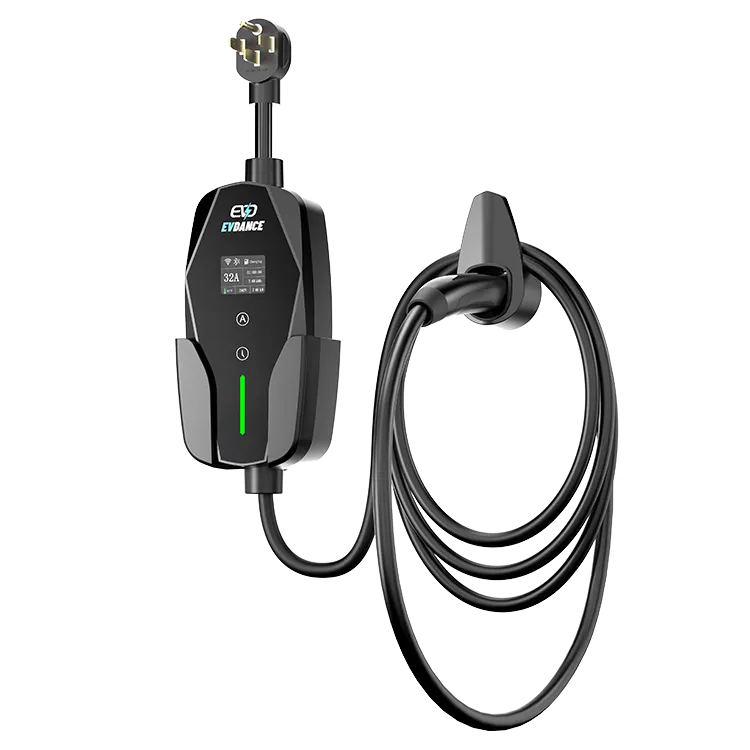
The EV-ACS3210T is built around exactly this figure: a 32 A NACS portable charger, adjustable from 10 to 32 A in six steps, rated about 7.7 kW on its NEMA 14-50P supply, IP66. Set to a lower step it draws less — the watts fall with the amps at the same 240 V. The EV-ACS4005T passes through 32 A on its way up: its 16/24/32/40 A settings top out at 40 A, which at 240 V is the 9.6 kW on its listing — the same multiplication, one step further.

Frequently Asked Questions
Is 32 amps always 7,680 watts?
Only at 240 V, single-phase. Watts follow the voltage: 32 A is 3,840 W at 120 V and about 6,656 W at 208 V. The amps alone never fix the watts — always convert with the supply voltage your installation actually has.
What is 32 amps in kilowatts on a three-phase supply?
About 22 kW, because three-phase delivers 32 A on each of three phases instead of one. That is a different equipment class from the single-phase 7.7 kW figure — the per-phase arithmetic is set out in our single-phase vs three-phase explainer, linked below.
Does a 32 A charger need a 32 A breaker?
No — a 40 A breaker. Charging is a continuous load, and the NEC sizes the circuit at 125% of the charger’s current (32 A → 40 A). The charger’s setting may be lower than the circuit allows, never higher.
Related Reading
- How Many Amps Does an EV Charger Need?
- What Size Breaker Do I Need for an EV Charger?
- Single-Phase vs Three-Phase EV Charging: 7 kW, 11 kW and 22 kW Explained

