
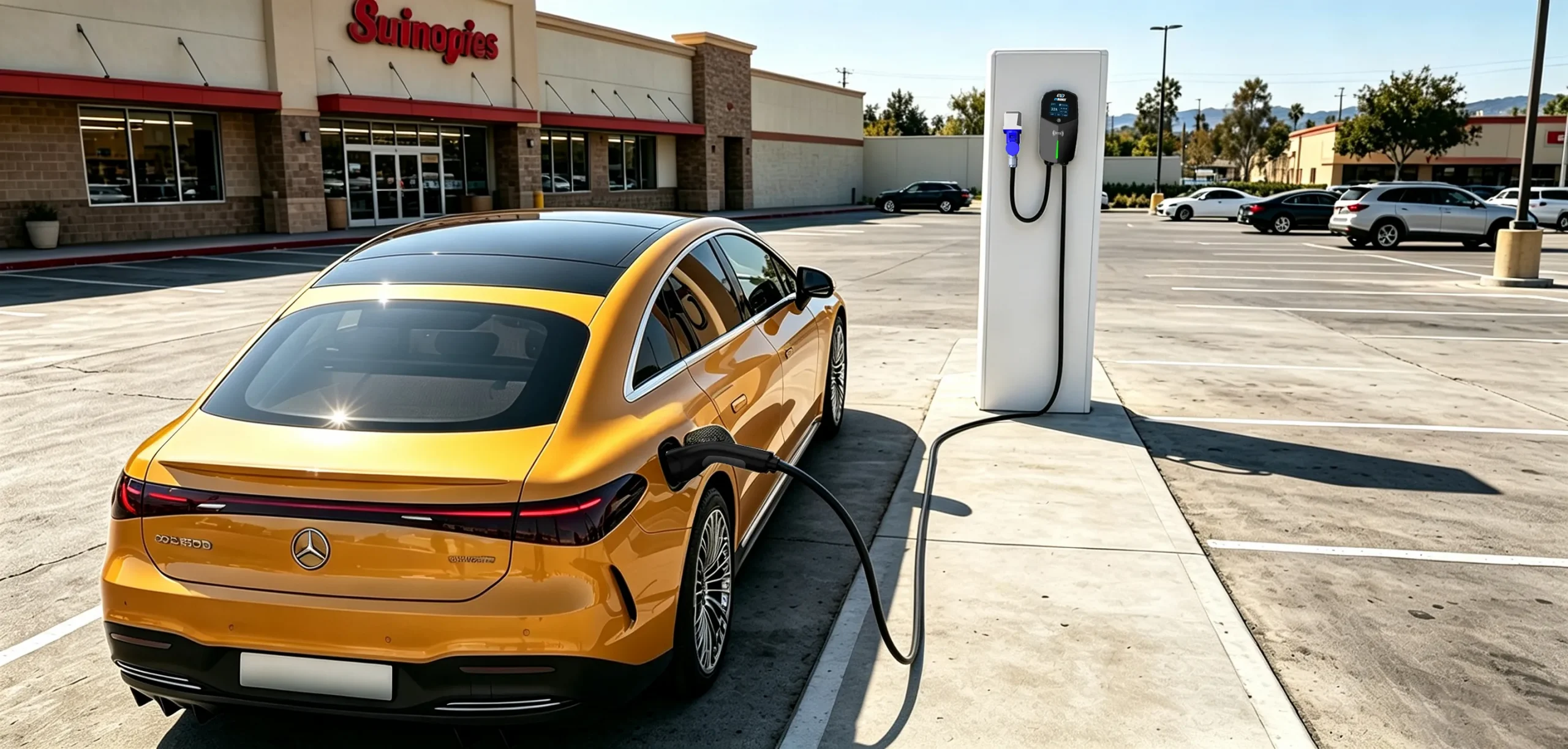
Level 3 chargers — the common name for DC fast chargers — are generally located where drivers stop briefly on longer journeys or pass through in numbers: at highway exits and travel plazas, in retail and hospitality car parks, at dedicated urban charging hubs, and at fleet depots. You will rarely find them at homes or ordinary workplaces, because their speed, cost and power supply only make sense where a short stop needs a lot of energy.
Key Takeaways
- Level 3 (DC fast) chargers sit where short stops meet strong power supplies: highway exits, retail and hospitality sites, urban hubs and depots.
- Dwell time, grid capacity and equipment cost draw the map — not driver preference alone.
- NEVI-funded corridor stations add fixed requirements: at least 150 kW, 24/7, contactless payment, CCS1 and uptime above 97%.
- Homes, offices and kerbsides are Level 2 territory because cars stay there for hours.
The Location Map
| Setting | Why chargers land there | Typical stop |
|---|---|---|
| Highway exits and travel plazas | Long-distance routes concentrate demand; exit plots are commercial land with power, lighting and facilities | A short break, roughly matched to a fast-charge session |
| Retail parks, supermarkets and restaurants | Drivers are already stopping; the host gains a visit while the car charges | Shopping or a meal while the battery fills |
| Urban charging hubs | City drivers without home charging need a fast top-up near where they live and work | A deliberate short visit, often combined with errands |
| Fleet depots and logistics sites | Operators charge their own vehicles on their own land, on their own schedule (usually private, not public) | Between shifts or overnight turnarounds |

Why the Pattern Looks Like This
Three forces draw the map. The first is dwell time: the U.S. DOT puts DC fast charging at 50–350 kW, adding roughly 180–240 miles of range per hour, so a session fits a break, a shop or a meal — not an eight-hour workday or an overnight stay, which are Level 2 territory (7–19 kW). The second is power: a fast charger needs a heavy electrical supply, so sites with commercial connections — forecourts, retail parks, depots — win over kerbsides and homes. The third is money: DOE-cited figures put DC fast equipment at about $38,000–$90,000 plus $20,000–$60,000 installation per unit, so operators place them where utilisation will be high.
Public funding reinforces the corridor pattern. Under the U.S. NEVI rules, funded highway stations must provide DC ports of at least 150 kW with a CCS1 connector, stay open 24/7, accept contactless payment with no membership, and hold average annual uptime above 97% — a service level designed for staffed commercial sites. One detail surprises many drivers: on U.S. interstates the chargers sit at exits rather than inside rest areas, because rest-area land is generally non-commercial; exit businesses are where paid charging can operate.
Where You Will Not Usually Find Them
- Homes. Houses rarely have the supply or the need; overnight Level 2 covers daily driving at a fraction of the equipment cost.
- Ordinary office car parks. Cars sit there for hours, so cheaper Level 2 posts match the stay better — see Level 1 vs Level 2 vs DC fast charging for the comparison.
- On-street residential kerbs. Kerbside posts are almost always AC; the supply and the parking pattern do not suit fast charging.
Hardware Matched to the Stop
Site hosts mix hardware to the dwell time. A compact DC unit such as the EVDANCE EV-RHDC30K-L (22 kW DC, OCPP 1.6J, IP54) serves shorter-stop sites below the big corridor class, while AC posts such as the EV-AC03201T dual-connector AC station (two Type 2 connectors, up to 43 kW shared, RFID) cover the cars that stay for hours at the same location. The full range for mixed sites is on our commercial charging page.
Frequently Asked Questions
Is “Level 3” the official name?
It is the popular name. Officially, U.S. sources call this DC fast charging, and our explainer on whether DC fast charging is Level 3 covers the naming. In practice, “Level 3” on a map or app means a DC fast charger.
How do I find one on a route?
Use a charging app or the DOE’s station locator and filter for DC fast charging; our walkthrough of how to use a DC fast charger covers the session itself once you arrive.
Why is there no fast charger in my neighbourhood?
Usually utilisation and supply: operators build first where traffic, stops and grid capacity meet. Residential areas are normally served by home and destination Level 2 charging instead, and coverage follows demand from there.
Related Reading
- How Fast Is a DC Fast Charger?
- Is DC Fast Charging Level 3?
- How to Use a DC Fast Charger: Step by Step
- Level 1 vs Level 2 vs DC Fast Charging: A Practical Comparison

