
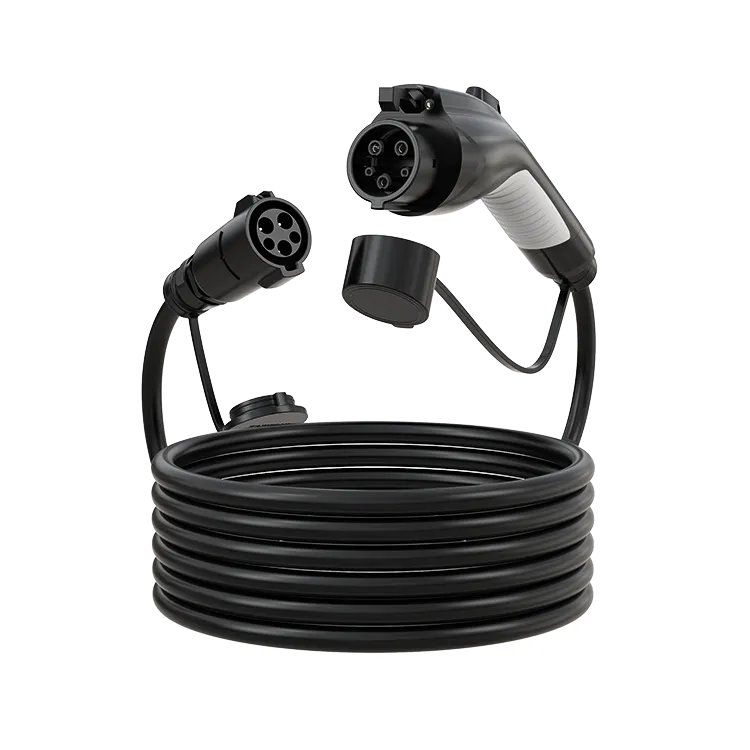
A “Type 1 charger” is a charger fitted with a Type 1 connector — the IEC name for the connector defined by SAE J1772, the single-phase AC plug used across North America and Japan. The label names the connector, not the machine behind it: it tells you which cars the charger plugs into, that the power is AC, and nothing yet about speed. The plug hardware itself is covered in our J1772 explainer; this article is about the name.
Key Takeaways
- “Type 1” is the IEC name for the SAE J1772 connector; a Type 1 charger is classified by its plug.
- The label commits you to single-phase AC at Level 1 or Level 2, for cars with a matching inlet.
- Speed, cable length, wall connection and features are separate stated figures — the connector name promises none of them.
Two Names for One Connector
The same connector answers to two names because two standards families describe it. SAE, the North American body, calls it J1772. The IEC naming system — used in international catalogues, spec sheets and import listings — sorts AC connectors into numbered types, and J1772 is its Type 1. A listing written for the world market says “Type 1”; one written for North America says “J1772”. Same round, five-pin, single-phase connector.
| IEC name | Also called | What it is | Main market |
|---|---|---|---|
| Type 1 | SAE J1772 | Single-phase AC connector | North America, Japan |
| Type 2 | Mennekes | Single- and three-phase AC connector | Europe and Type 2 markets |
| CCS1 (Combo 1) | — | Type 1 with two DC pins added below | North America |
| CCS2 (Combo 2) | — | Type 2 with two DC pins added below | Europe and Type 2 markets |
The comparison across the AC families is set out in our guide to Type 2 vs J1772 vs NACS connectors. The point here is narrower: a listing that says “Type 1 charger” is classifying the charger by its connector, in IEC language.
What the Label Commits You To
- AC charging only. A Type 1 connector carries alternating current. DC fast charging needs the CCS1 plug, which adds two DC pins — a different, larger connector, as our piece on how J1772 works with CCS explains.
- Single-phase power. Type 1 is a single-phase interface, so a Type 1 charger works within the U.S. DOT’s Level 1 and Level 2 bands — about 1 kW at Level 1, and 7–19 kW at Level 2.
- A matching inlet. The charger serves cars with a Type 1 (J1772) inlet, or the J1772 upper section of a CCS1 inlet, for AC charging. A car with a different inlet connects only through an adapter, and only for AC.
- A market. Type 1 equipment is built for North American and Japanese practice.
What the Label Does Not Tell You
“Type 1” settles the plug and the kind of power. It settles nothing else — the figures that decide a purchase sit elsewhere in the listing:
| Question | Where the answer lives |
|---|---|
| How fast will it charge? | The charger’s stated current and kilowatts, capped by the car’s onboard charger |
| How long is the cable? | The maker’s stated cable length for that model |
| Wall side: plug-in or hardwired? | The stated wall connection (for example a NEMA 14-50P plug) in the specification |
| Smart features, apps, access control? | The maker’s feature list — the connector name promises none of them |
A Type 1 Charger in the EVDANCE Range
The EV-AC04001U is the stated Type 1 product in the range: a 40 A J1772 portable charger, 9.6 kW, NEMA 14-50P on the wall side, SAE J1772 at the car, IP66, 25 ft cable as stated. In its listing, “J1772” fixes the cars it serves; “9.6 kW” and “25 ft” are separate stated figures that do the buying work. Adapter direction matters too — the JT02 (AC, up to 80 A, IP65) reshapes a NACS charger’s plug into J1772 form, so a Type 1 car can use NACS AC chargers; it does not turn a Type 1 charger into a NACS one.

Frequently Asked Questions
Is a Type 1 charger the same as a J1772 charger?
Yes — the IEC name and the SAE name for the same connector. A charger described either way carries the same plug and serves the same cars.
Can a Type 1 charger fast-charge?
No. It delivers AC at Level 1 or Level 2 rates. DC fast charging on this connector family uses CCS1, which adds two DC pins below the Type 1 section and needs a CCS1 inlet on the car.
My car has a NACS port. Can I use a Type 1 charger?
Only through an adapter made for that direction — J1772 charger to NACS car — and for AC charging. Check the adapter’s stated rating and the car maker’s position on adapters first; the connector names alone do not make the pairing.
Related Reading
- What Is J1772? The North American EV Plug Explained
- Does J1772 Work With CCS? CCS Connectors Explained
- Type 2 vs J1772 vs NACS: Which EV Charger Connector Does Your Market Need?
- Can a Tesla Use J1772 Chargers?

