
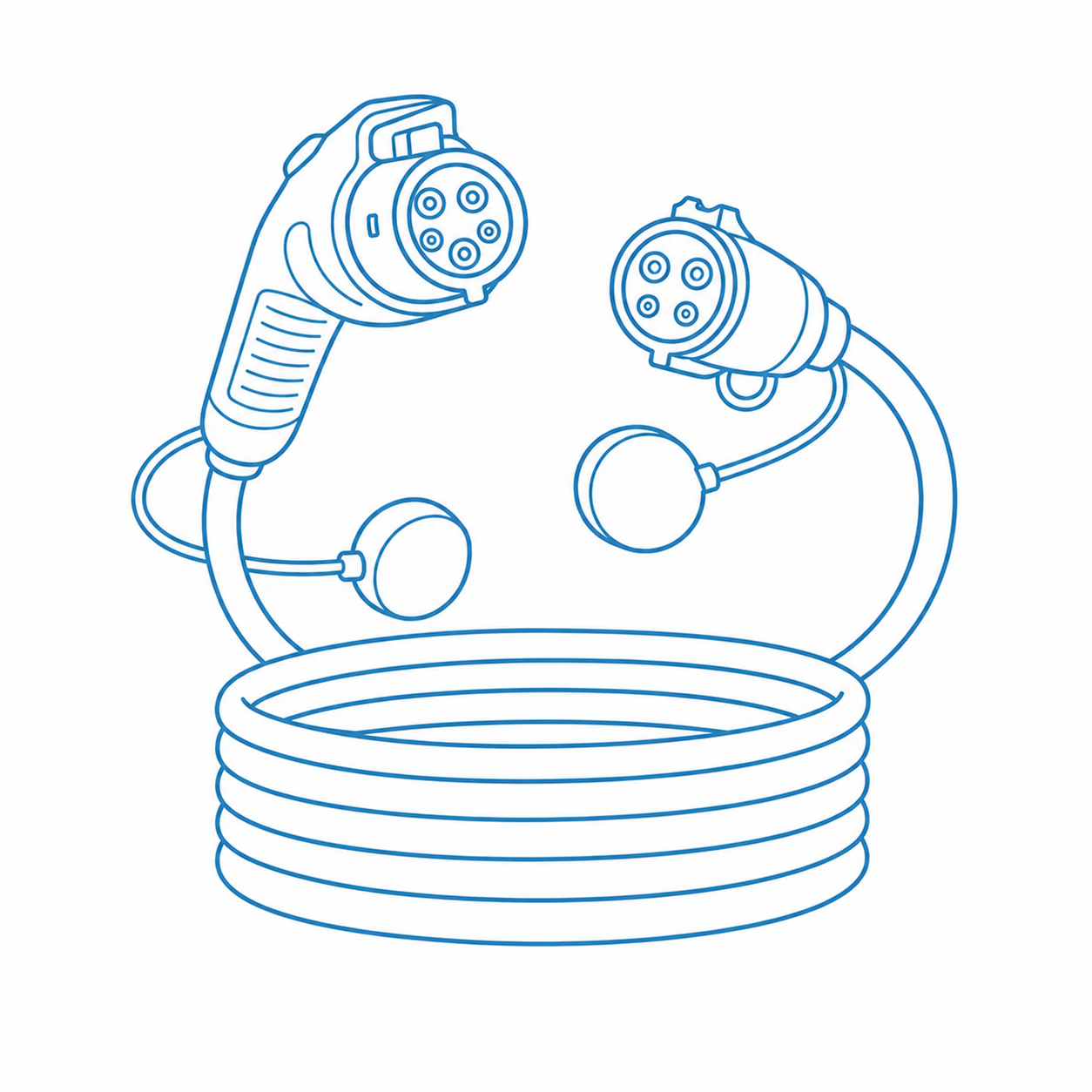
A charging plug — the connector you push into the car — that is hot to the touch is a stop-and-inspect sign. The heat is made inside the joint, where the plug’s faces meet the car’s inlet: resistance turns part of the current into heat, and wear, dirt or a loosening fit raise it. Warmth spread along the cable is a different, usually milder story (our guide to whether EV charging cables get hot); heat concentrated at the plug is the finding to act on.
Key Takeaways
- A hot plug means resistance at the contact faces — wear, dirt or a loosening fit. It is a stop-and-inspect sign, not a quirk.
- Judge each joint separately: the hot end assigns the call — charger maker for the plug, dealer for the inlet.
- Never re-test a heat-marked connector, turn the current down to live with it, or clean and file the faces yourself.
- On portables, the connector is a daily wear item; the visual check is part of ownership.
Why the Heat Concentrates at the Plug
Every amp crosses the connection through the small area where the contact faces touch — a fraction of the pin surface. On a sound joint that area is generous, and the plug runs close to the cable’s warmth. Anything that shrinks it — worn faces, grit carried into the inlet, a loosening fit — crowds the same current through less metal, and the crowded point heats.
Read the Plug: Which End Is Hot Assigns the Call
| What you find | What it points to | Whose call it is |
|---|---|---|
| The plug body is hot; the cable and the car’s inlet are comfortable | The joint inside the charger’s connector | The charger manufacturer |
| Heat is centred in the car’s inlet; the plug less so | The inlet side of the joint | The car’s dealer or manufacturer |
| One contact face looks discoloured or pitted against the others | That contact is the failing one | Stop. Photograph it and report it — charger maker for the plug, dealer for the inlet |
| The connector has become stiff, or loose, to insert | The fit has changed — the wear class | Inspection before further sessions, on the side that changed |
Visual checks only, made after the session ends and the connector cools. Look — never probe the contacts, and never plug a suspect connector back in “to test it”.
The Moment a Plug Feels Hot
- End the session from the car or charger controls, then unplug and let everything cool before handling it.
- Look, and note. Discolouration, a hot-plastic smell, a changed fit — findings for the report, none of them a user repair.
- Do not plug back in to see whether it happens again. A damaged contact does not heal between sessions.
- Do not turn the current down and carry on with that connector. A lower setting reduces stress; it does not repair the joint.
- Never spray or clean the contact faces as a do-it-yourself fix, and never file, bend or spread pins. Contact faces are precision surfaces; the same boundary runs through our guide to whether EV charging adapters are safe — once heat has marked a joint, inspection is a professional’s job.
The Connector Is a Wear Item on EVDANCE Portables
Portables are plugged and unplugged daily, so their connectors live the hardest life in the range. The EV-ACS4005T 40A NACS portable charger (9.6 kW, 16/24/32/40 A adjustable, IP66) and the EV-AC04001U 40A J1772 portable charger (9.6 kW, NEMA 14-50P, 25 ft, IP66) both put their connector faces in the owner’s hands at every session — the visual check above is part of normal ownership, and the highest settings are the hardest hours those faces work. EVDANCE publishes no temperature figure for a connector, and we will not invent one: judge by the table’s signs. EVDANCE chargers carry a 3-year standard warranty; report a heat-marked connector through the contact page.
Frequently Asked Questions
The plug feels warm, but not hot, after a long session. Is that fine?
Even, mild warmth matching the cable after hours at a high setting can be ordinary. The stop signs: heat you cannot hold comfortably, heat in one spot or at one end, discolouration, a hot-plastic smell, a changed fit. Any one ends the “fine” reading.
Can I clean the pins to fix it?
Not as a repair. Dirt on the faces is a finding; cleaning cannot restore a worn or pitted joint and can hide the evidence while it keeps failing. Report what you see and let the maker or dealer inspect.
It gets hot at home but not at public chargers. What does that tell me?
The joint that changed is the one at fault. Public sessions put a different connector into the same inlet; home sessions use yours every time — a home-only pattern points at your plug, and heat everywhere would point at the inlet.
Related Reading
- Do EV Charging Cables Get Hot?
- Are EV Charging Adapters Safe?
- How Long Do EV Charging Cables Last, and Can They Be Repaired?

