
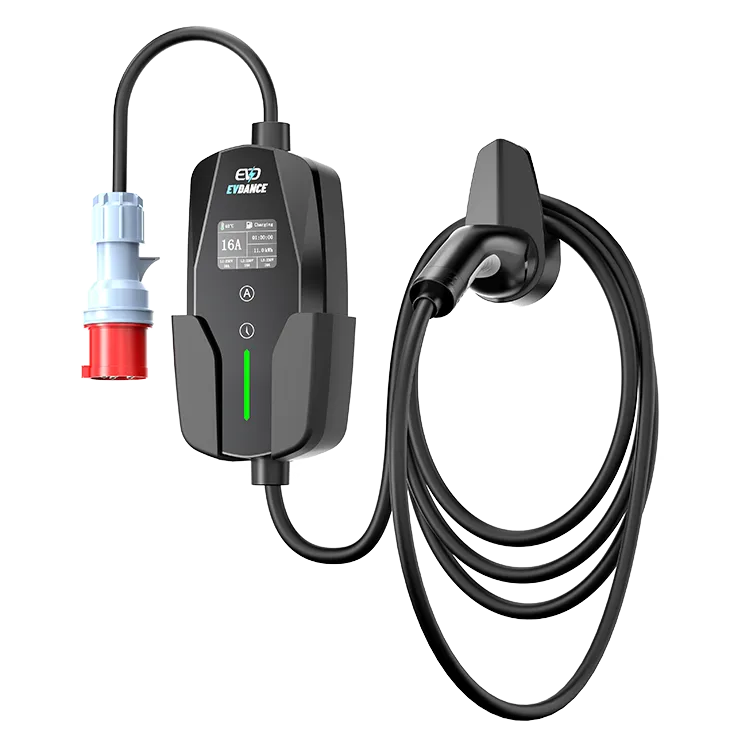
A 22 kW portable charger has two plugs, and they do different jobs. At the wall it uses the region’s three-phase industrial plug — in Europe, a red 32 A, 5-pin CEE (commando) plug. At the car it uses a Type 2 connector. Neither end can be a domestic plug: 22 kW is three-phase power, and a household socket is a single-phase device.
Key Takeaways
- A 22 kW portable uses a 32 A three-phase industrial plug at the wall — the red 5-pin CEE in Europe — and the market’s car connector at the vehicle.
- No domestic plug can carry the class: it is single-phase and built for lighter duty.
- The real gate is the supply: 22 kW exists only where three phases reach the building.
- A single-phase car on a 22 kW portable charges at roughly a third of the headline rate — the car, not the plug, is the ceiling.
The Two Ends at a Glance
| End | Plug | What decides it |
|---|---|---|
| Wall end (supply side) | 32 A, 5-pin CEE commando plug in Europe; each region’s own three-phase industrial pattern elsewhere | The building’s three-phase supply and its industrial socket standard |
| Car end (vehicle side) | Type 2 connector on European-market units | The inlet fitted to the cars in that market |
| Either end | Never a domestic plug | A household socket is single-phase and not built for this class of continuous load |
The Wall End: Why It Has to Be a 32 A Industrial Plug
22 kW is what three phases deliver at 32 A per phase. That fixes the wall plug: it must carry three phases at 32 A, continuously, for a whole charging session. In Europe that is the red 32 A CEE plug, the industrial pattern of workshops, depots and farms. Other regions use their own three-phase industrial patterns; the logic is the same.
A domestic plug cannot stand in for it, for two separate reasons. It offers only one phase, so the supply the charger is built around is not there; and a household socket is a light-duty device, not built for a load that holds its full rating for hours. Our explainer on single-phase vs three-phase charging sets out how the 7, 11 and 22 kW classes follow from the supply.
The Car End: Type 2, and a Different Family Entirely
The car-end connector belongs to a different plug family from the wall plug. On European-market 22 kW portables it is Type 2 — the standard AC inlet on European cars. The two ends are not interchangeable terms: CEE describes the supply side, Type 2 the vehicle side, and a charger in this class has one of each. Our comparison of Type 2, J1772 and NACS maps the car side by market; our CEE plug guide covers the wall side.
The Plug Question Is Really a Supply Question
A 22 kW portable is only a 22 kW charger where a three-phase supply exists. Two common disappointments trace back to that:
- The building has no three-phase supply. Then no socket can feed it, whatever plug it carries — a licensed electrician confirms whether three phases reach the building and a matching socket can be fitted.
- The car takes only one phase. A car with a single-phase onboard charger draws on one phase of the three, so the session runs at roughly a third of the unit’s headline rate — about 7 kW. The plugs are all correct; the car is the ceiling — the session runs at the lowest link in the chain.
The EVDANCE Example: EV-ACS3205PE
The EV-ACS3205PE states both ends plainly: a 32 A CEE 5-pin plug on the supply side, a Type 2 connector on the car side, 22 kW three-phase output, an IP66 rating and a 1.77-inch display. Its smaller sibling, the ACS1605PE, keeps the same arrangement at the 11 kW class. Read any 22 kW portable the same way: wall plug, car connector, then the supply behind your socket.

Frequently Asked Questions
Can a 22 kW portable charger plug into a normal socket with the right lead?
No. A normal socket is single-phase, so the supply the charger is built for is absent — and no lead or adapter creates the missing phases.
Does the car end ever differ between 22 kW portables?
The car end follows the market the unit is built for — Type 2 on European units. The split never changes: industrial plug at the wall, car connector at the vehicle.
My car charges at about 7 kW on a 22 kW portable. Is something wrong with the plugs?
Probably nothing: a car that accepts only single-phase AC draws on one of the three phases, landing near 7 kW. The limit is the car’s onboard charger rating, not the plug.
Related Reading
- CEE Plugs Explained: Choosing 16A or 32A for a Three-Phase Portable EV Charger
- Single-Phase vs Three-Phase EV Charging: 7kW, 11kW and 22kW Explained
- Portable EV Charger Types Explained: 10A, 16A, 32A and Three-Phase Models

