
A three-phase portable EV charger is a charger that draws on all three phases of an industrial supply — 11 kW or 22 kW — yet is never installed. It plugs into an existing three-phase socket, charges, and packs away again. Its defining trait is that the socket is its installation: where a suitable socket exists, it delivers wallbox-class charging; where none exists, the charger has nothing to work with.
Key Takeaways
- A three-phase portable delivers wallbox-class power (11 or 22 kW) with no installation — the existing industrial socket is its installation.
- The recognition test is physical: find a red 5-pin CEE socket, or ask an electrician whether three phases reach the building.
- The full rate needs supply, socket and car to agree; a single-phase car takes roughly a third.
- It suits sites that already have machinery power — workshops, farms, depots — and work that moves between them.
How It Differs From Its Neighbours
| Class | How it connects | Power class | What stays behind |
|---|---|---|---|
| Wallbox | Hardwired by an installer | Up to 11 or 22 kW three-phase models | The charger — permanently |
| Three-phase portable | Plugs into an existing industrial (CEE) socket | 11 kW or 22 kW | Only the socket — the charger travels |
| Single-phase portable | Household or dedicated single-phase outlet | About 7 kW ceiling on one phase | Nothing — the charger travels |
The three-phase portable borrows the wallbox’s power class and the portable’s freedom. What it gives up is independence: a wallbox gets its own circuit, designed for it, while the portable can only use a socket somebody else’s building already provides. Our guide to portable charger types maps the family; the single-phase vs three-phase explainer covers the supply side.
The Recognition Test: Do You Have the Socket?
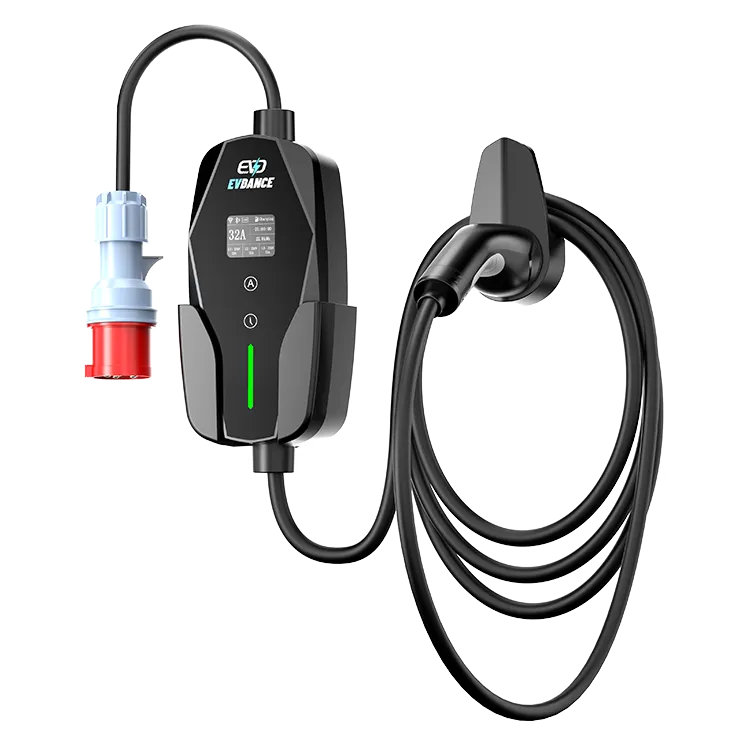
Everything about this category turns on one question you can answer by walking around your site. Three-phase portables plug into red, 5-pin CEE sockets — the industrial outlets fitted for machinery in workshops, barns, depots, farms and some commercial garages, marked 16 A or 32 A. If you can find one, you are most of the way there: confirm its condition and that its circuit is sound (an electrician’s check on older wiring), and a matching portable plugs in.
If you cannot find one, the honest position is that the charger is not yet usable at your site. A licensed electrician can tell you whether three phases reach the building. Fitting a socket is fixed electrical work, done once — any matching portable can use it afterwards; the charger itself never becomes an installation.
When the Full Rate Actually Happens
The headline rate needs three agreements at once: a three-phase supply, a socket rated for the charger’s draw, and a car whose onboard charger accepts three-phase power. The session runs at the lowest of the three. A car that accepts only single-phase power draws on one phase — roughly 3.7 kW from the 16 A class, roughly 7 kW from the 32 A class — and the rate tapers as the battery fills, as with any AC charging. This is why the category rewards a site-and-car check before purchase more than any feature list.
Who Uses Them
The pattern fits sites that already run machinery: a workshop charging its own van between jobs, a farm with three-phase power in the barn, a small depot whose vehicles park beside industrial sockets, a tradesperson working across sites. In every case the value is that it moves — next socket, next building, next job — at a power class a household-socket portable cannot reach.
Two EVDANCE Examples
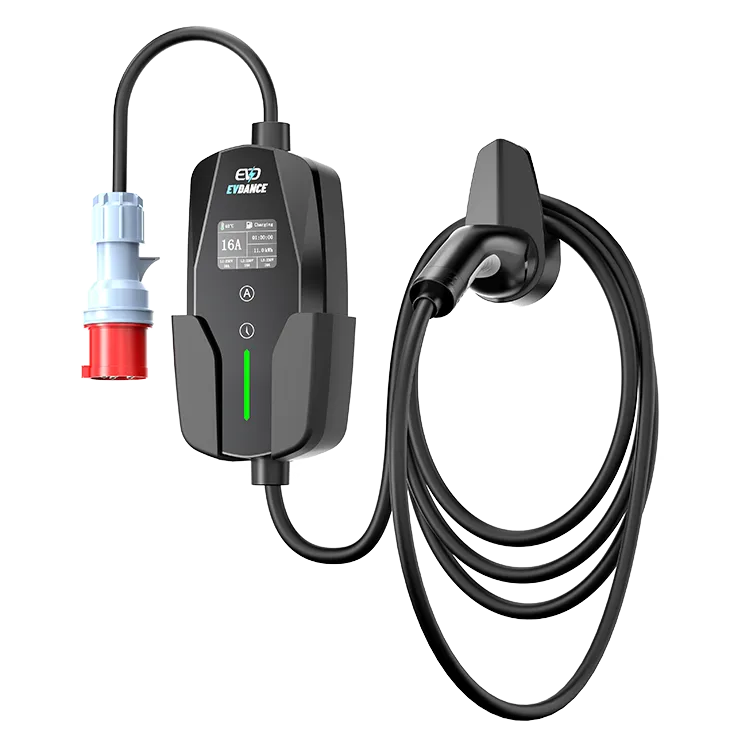
The ACS1605PE is the 11 kW member of the class: a 16 A CEE 5-pin plug, a Type 2 connector, a 7.6 m cable, an IP66 rating and a 1.77-inch display. The EV-ACS3205PE is the 22 kW member, built on a 32 A CEE plug with the same Type 2 car end and IP66 rating. Neither listing claims an app, RFID or a network platform — what they state is the unit itself, which is the point of the category.
Frequently Asked Questions
Is a three-phase portable faster than a wallbox?
It is the same power class — 11 kW and 22 kW exist in both. The difference is not speed but installation: the wallbox is wired in permanently, the portable depends on a socket that already exists.
Can I use a three-phase portable at home?
Yes, if your home has a matching three-phase socket, or an electrician fits one where the supply allows. Many homes have no three-phase supply at all, which settles the question before the charger is chosen.
Does a three-phase portable work on a single-phase supply?
No. Three phases are the category’s defining requirement. On a single-phase supply you need the single-phase portable class instead, at its lower power ceiling.
Related Reading
- Portable EV Charger Types Explained: 10A, 16A, 32A and Three-Phase Models
- CEE Plugs Explained: Choosing 16A or 32A for a Three-Phase Portable EV Charger
- Single-Phase vs Three-Phase EV Charging: 7kW, 11kW and 22kW Explained

