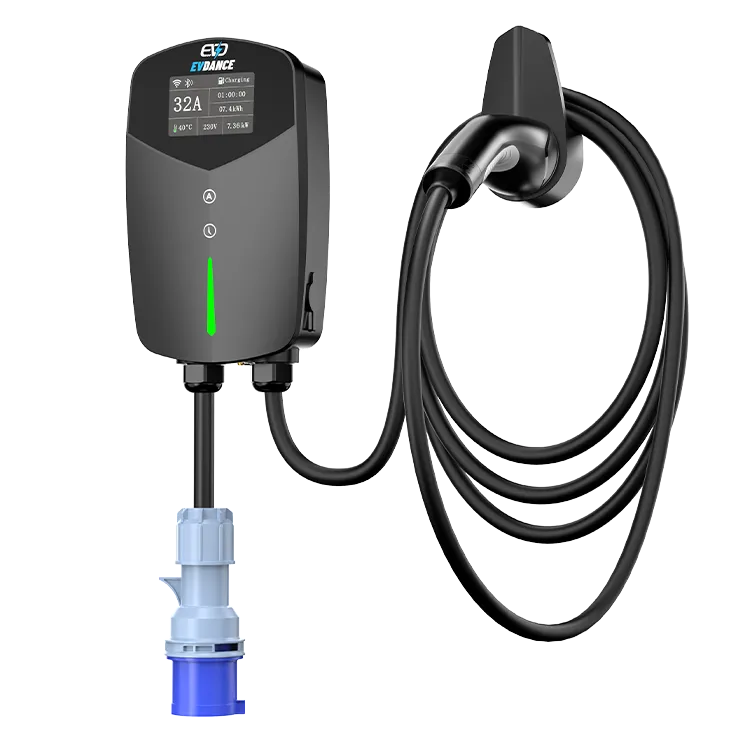
Residual current devices (RCDs) protect people from electric shock by disconnecting the supply when current leaks to earth. EV charging adds a complication: the car’s onboard charger can produce smooth DC fault currents, which can stop a standard RCD from working correctly. That is why installation rules for EV charging in IEC markets require protection against DC fault currents as well.
RCD Types in Brief
| Type | Detects | Typical use |
|---|---|---|
| Type AC | Sinusoidal AC residual current only | General circuits; not suitable for EV charging |
| Type A | AC and pulsating DC residual current | General circuits; EV charging only with additional DC detection |
| Type F | As Type A plus mixed frequencies | Circuits with variable-speed appliances |
| Type B | AC, pulsating DC and smooth DC residual current | EV charging and equipment that can produce smooth DC faults |
Why Smooth DC Is a Problem
A smooth DC fault current can magnetically saturate the core of a Type A or Type AC RCD, so the RCD may fail to trip even when a dangerous AC fault occurs at the same time. For EV charging circuits, the installation must therefore either use a Type B RCD, or combine a Type A RCD with a device that detects smooth DC residual current of 6 mA or more and disconnects the supply.

6 mA DC Detection (RDC-DD)
The 6 mA DC detection function is defined in IEC 62955 as an RDC-DD, a residual direct current detecting device. Many wallboxes and portable chargers build this function into the charger itself. When the charger includes an RDC-DD, the installer can typically use a Type A RCD upstream instead of a more expensive Type B device, subject to local wiring rules such as IEC 60364-7-722 or BS 7671 Section 722.
What Buyers Should Check
- Does the charger include 6 mA DC fault detection, and to which standard?
- Which upstream RCD type does the manufacturer’s installation manual require?
- For portable chargers, does the in-cable control and protection device meet IEC 62752?
- Does the charger perform a self-test of its protection at start-up?
Our portable EV charger safety guide covers the installation side of charging safety in more detail.
Related Reading
- IP Ratings for EV Chargers: IP54, IP65 and IP66 Compared
- Mode 2 vs Mode 3 Charging: What IEC 61851 Means for Portable EV Chargers
- EV Charging News: Walmart Reaches 109 Fast-Charging Sites, With CCS1 and NACS on Every Charger
Key Takeaways
- EV charging can produce smooth DC fault currents that impair standard RCDs.
- EV circuits need a Type B RCD, or a Type A RCD plus 6 mA DC detection.
- 6 mA DC detection is defined in IEC 62955 and is often built into the charger.
- Always follow the charger manual and local wiring rules for the required upstream protection.
Sources & Standards
- IEC 62955 — Residual direct current detecting device (RDC-DD) for Mode 3 charging
- IEC 60364-7-722 — Low-voltage installations: supplies for electric vehicles
- IEC 62752 — In-cable control and protection device for Mode 2 charging
- BS 7671 Section 722 — Electric vehicle charging installations (UK)