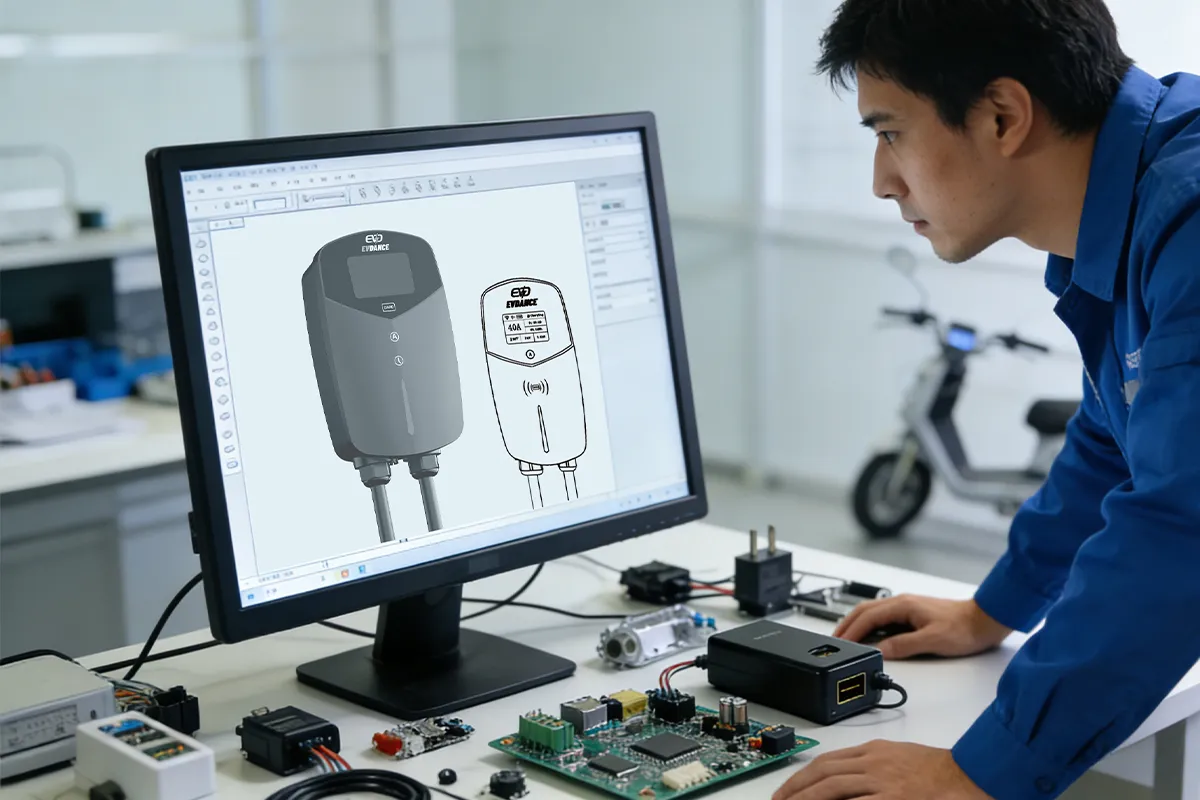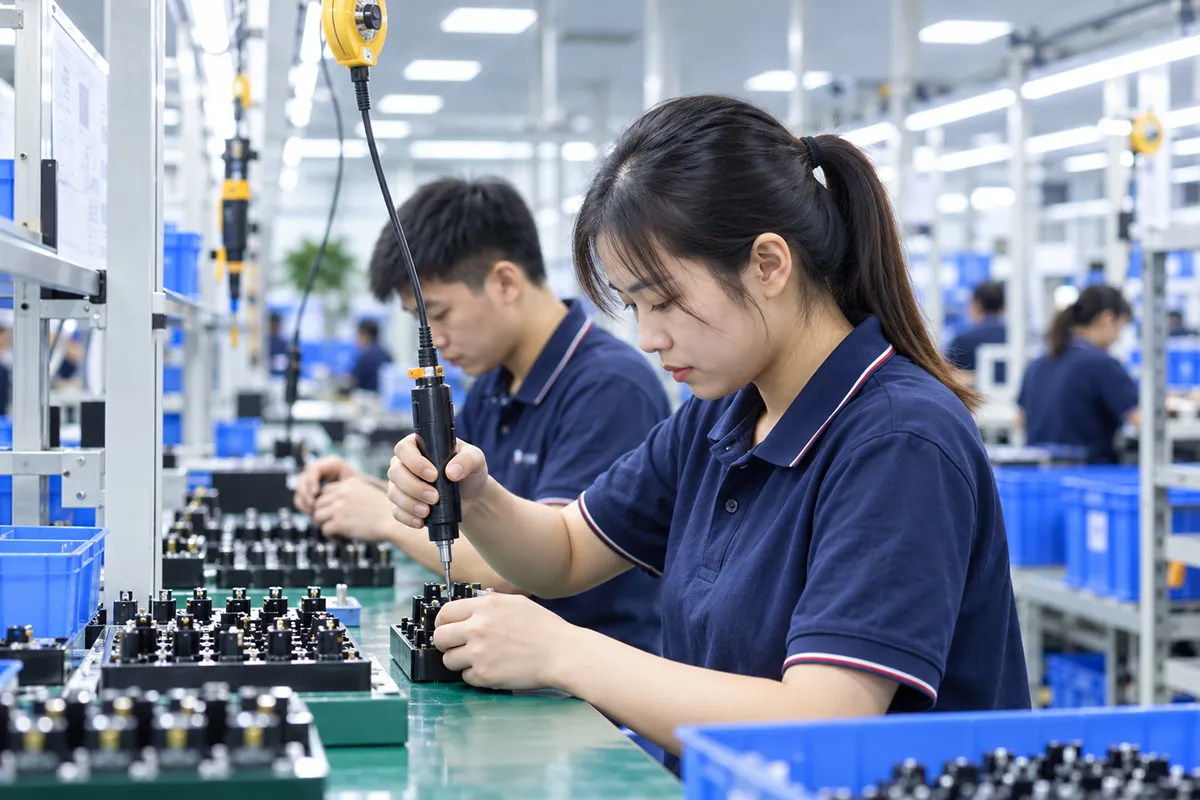
A factory audit tells you whether a supplier can make the same charger correctly every time, not just once for a sample. For private-label EV chargers, where your brand carries the responsibility, that consistency is the whole point. This checklist covers what to look at in an EV charger factory, from management system certificates to the test bench at the end of the line. It is part of our guide to OEM and private-label EV chargers.
You can run the audit yourself, send a third-party auditor, or combine both: a desk review of documents first, then a site visit to see whether practice matches paper.
Before the visit: a desk review
Ask for documents in advance so the site visit can focus on checking them against reality rather than collecting paper.
- Business licence, with the registered scope and address.
- ISO certificates and a summary of the most recent certification audit.
- Product certificates and test reports for the models you plan to buy.
- An organisation chart showing the engineering, quality and production leads.
- A list of key component suppliers for cable, relays and PCBs.
- Incoming inspection and production test records from a recent order.
Management system certificates and the 2026 editions
Most buyers start with ISO 9001 for quality management and ISO 14001 for environmental management. Both were revised this year. ISO 9001:2026 was published on 16 September 2026 and replaces ISO 9001:2015, and ISO 14001:2026 was published in April 2026, superseding the 2015 edition. ISO 14001 is the only standard in the ISO 14000 family that an organisation can be certified to.
Because the new editions are so recent, most factories will still hold certificates issued against the 2015 versions. That is normal while certification bodies move clients across. What matters is that the certificate is current, issued by an accredited certification body, and covers the right scope and address.
- Check that the company name and address match the business licence and the site you are visiting.
- Check that the scope covers design or manufacture of EV charging equipment or electrical products, not only trading.
- Check the expiry date and verify the certificate with the issuing certification body.
- Ask how and when the factory plans to move to the 2026 editions.
Product certification files
Management certificates say nothing about whether a specific charger is safe. For that you need product certificates and test reports for the exact model and configuration you will buy. Check the factory name and address on those documents as well. Some certification bodies must be told before production moves; UL, for example, must be informed before manufacturing locations change. Our explainer on EV charger certifications covers which marks apply in each market, and it is worth settling early who owns the certificate in a private-label deal.
Production and testing: the on-site checklist
Walk the process in the order the product is made, and ask to see records at each step rather than only the equipment.
| Area | What to look for | Red flags |
|---|---|---|
| Incoming inspection | Checks on cable, conductor size, relays, PCBs and plastics against approved specs, with records | No records, or approved parts swapped without notice |
| Injection molding | In-house presses or a named subcontractor, mold storage and maintenance logs | Housings bought from whoever is cheapest that month |
| Assembly | Work instructions at each station, ESD protection, torque control on terminals | Instructions missing or a different revision from the sample |
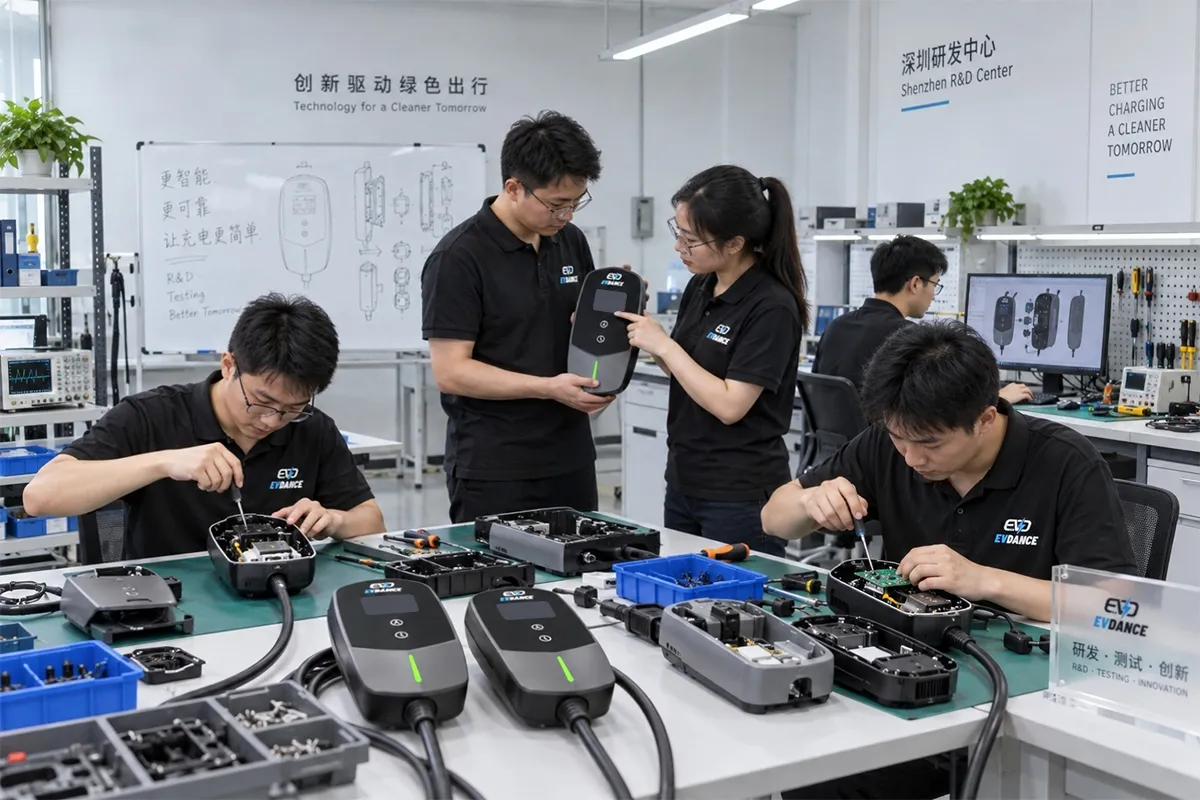
| In-line and final testing | Function, hi-pot and earth continuity tests on every unit, aging where specified, results saved | Testing on a sample basis only, or results not recorded |
| Calibration | Calibration labels and certificates for test equipment | Expired calibration or no instrument list |
| Nonconformance | Quarantine area, defect log, corrective action records | Failed units reworked with no record |
Traceability
If a fault appears in the field, you need to know which units are affected. Good traceability links each serial number to a production date, the batch of key components such as relays and cable, and its final test result. Ask the auditor to pick a random finished unit and trace it back. A factory that can do this quickly can also support a targeted recall or warranty claim instead of a blanket one, which protects both your customers and your margins. Check, too, that records are kept for a defined period, at least as long as your warranty.
Capability, people and environment
- Engineering: can the team change firmware, artwork or cable specifications in-house, or does every change go to an outside design house?
- Capacity: the number and condition of production lines and equipment compared with your forecast.
- Environment: waste handling, chemical storage, and how the ISO 14001 system works in practice on the floor.
- Working conditions: fire exits, protective equipment and working hours; many retailers require a separate social compliance audit.
- Communication: a named contact who understands both the engineering and your market.
An audit is a snapshot. Follow it with a pre-shipment inspection on the first order; our guide to pre-shipment inspection and AQL sampling explains how to set one up.
Auditing EVDANCE
EVDANCE was founded in Shenzhen in 2011 and runs engineering, injection molding, assembly and testing in-house, with more than 200 manufacturing equipment units. Each OEM customer has a dedicated account engineer from sampling to mass production. Certification marks vary by model, so request the certificate and test report for the exact model and configuration you plan to order. Start with our factory tour, or contact us to plan a visit.
Key Takeaways
- ISO 9001:2026 and ISO 14001:2026 are new, so many factories will still hold valid 2015-edition certificates.
- Management certificates do not prove product safety; check product certificates and test reports for the exact model and factory address.
- On site, focus on incoming inspection, molding, assembly, final testing on every unit and calibration records.
- Test traceability by tracing one random finished unit back to its components and test results.
Sources & Standards
- International Organization for Standardization (ISO) — ISO 9001:2026 Quality management systems: Requirements
- International Organization for Standardization (ISO) — ISO 9001:2015 Quality management systems: Requirements
- International Organization for Standardization (ISO) — ISO 14001:2026 Environmental management systems
- International Organization for Standardization (ISO) — ISO 14000 family: Environmental management
- UL Solutions — Submitting Products FAQ