
No. An EV charging cable is not universal. It works only when three things match: the connector that plugs into the car, the connector or socket at the charger, and the cable’s ratings for current and phases. A cable bought for a Type 2 car in Europe will not plug into a J1772 car in North America, and a cable with the right plug can still be the wrong rating.
Key Takeaways
- Charging cables are standardised by region and connector, not universal worldwide.
- Current and phase ratings limit the session to the weakest part of the chain.
- Tethered chargers fix the cable choice; socketed chargers make it yours.
- Adapters can bridge some AC connectors, but never AC to DC.
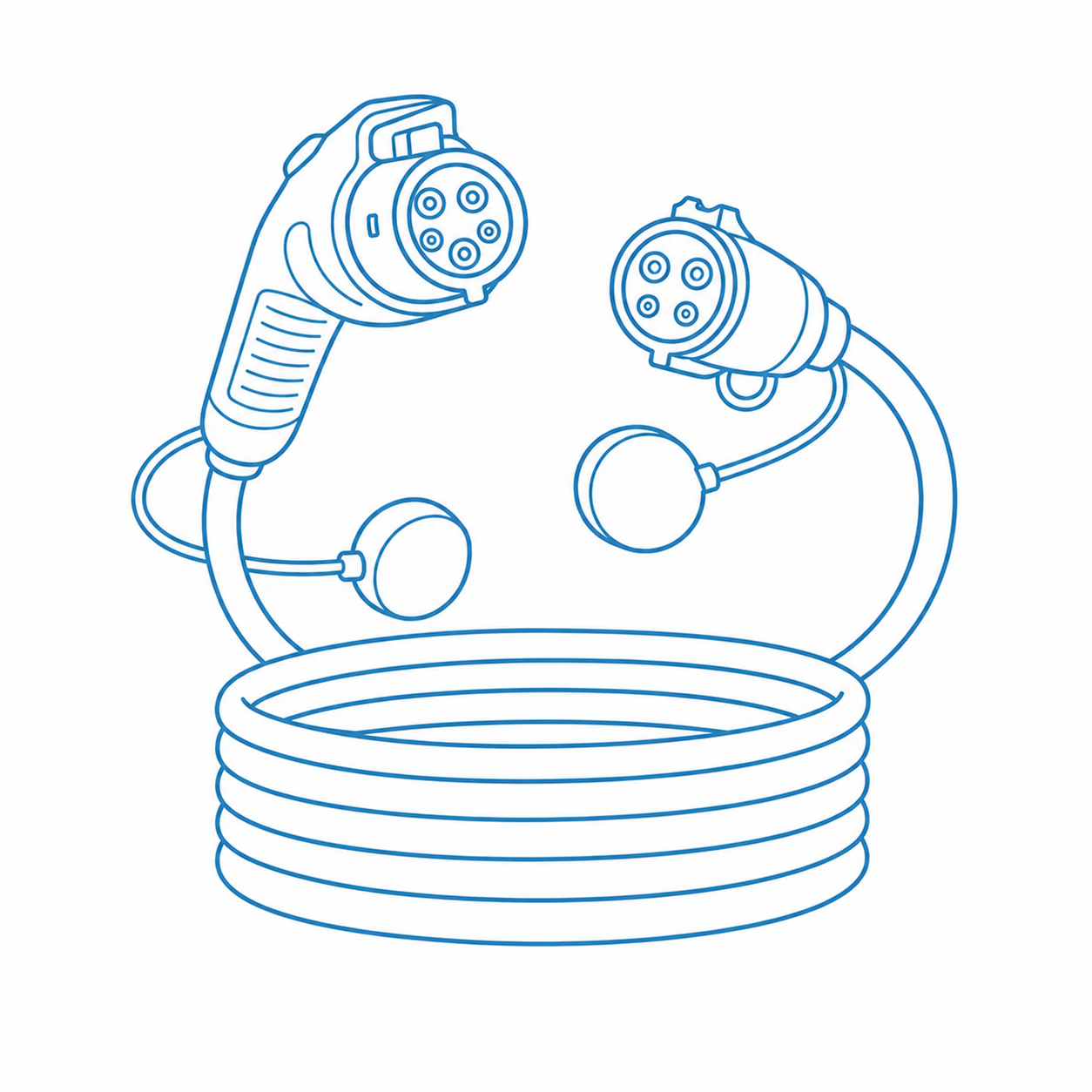
The connector decides first
AC charging uses different connectors in different regions, and DC fast charging uses different connectors again. The plug shape is standardised per market, not worldwide. Our guide to Type 2, J1772 and NACS connectors explains how the main AC standards differ and where each one is used.
| Connector | Main region | Used for |
|---|---|---|
| J1772 (Type 1) | North America | AC Level 1 and Level 2 charging |
| Type 2 | Europe and many other markets | AC charging, single-phase and three-phase |
| NACS | North America | AC and DC charging on one connector |
| CCS1 / CCS2 | North America / Europe | DC fast charging; the cable is fixed to the station |
This is why there is no single cable in the boot that covers every car. A driver who changes cars, or moves between regions, often needs a different cable even though the charger on the wall stays the same.
The ratings decide second
Even when the plug fits, the cable has to be rated for the job. A charging cable signals its maximum current to the charger, and the session runs at the lowest rating in the chain: car, charger or cable. A 16 A cable used with a 32 A wallbox limits charging to 16 A.

Phases matter in the same way. A single-phase Type 2 cable plugged into a three-phase wallbox charges on one phase only, at about 7 kW instead of 11 or 22 kW. This is why choosing the right charging cable starts with your car’s onboard charger and your supply, not with the cable itself.
Tethered chargers remove the question
If your wallbox is tethered, the cable is part of the charger and always matches it; only the car end has to fit your vehicle. With a socketed charger, the loose cable is yours to choose and carry. A household with two different cars may keep one cable per car, and drivers who use public AC posts in Europe carry a Type 2 cable in the trunk because those posts are usually socketed.
Cables and adapters from EVDANCE
EVDANCE portable chargers are supplied with the connector matched to their market. The EV-ACS3210E is a 32 A Type 2 portable charger for single-phase charging at about 7 kW, rated IP66. Where two AC standards meet, an adapter can help: the JT02 adapter lets a J1772 car charge from a NACS AC charger at up to 80 A. Adapters bridge AC connectors only; they cannot turn an AC cable into a DC fast-charging cable.
Frequently Asked Questions
Can I use a European Type 2 cable in North America?
Not directly. The car inlet has a different shape, J1772 or NACS, so the cable will not connect. Use a cable with the connector your car was built with.
Will any Type 2 cable give me 22 kW?
No. The cable must be a three-phase cable rated at 32 A, and the charger and the car’s onboard charger must also support 22 kW three-phase charging.
Are charging cables interchangeable between brands?
Yes, within the same standard. A Type 2 cable from any maker works with any Type 2 car and charger, as long as its current and phase ratings are high enough for the session.
Related Reading
- Which EV Charging Cable Do I Need?
- Type 2 vs J1772 vs NACS: Which EV Charger Connector Does Your Market Need?
- What Is J1772? The North American EV Plug Explained
- Are EV Chargers Universal?

