
You can usually tell from your switchboard: a three-phase home has a wider, three-pole main switch and often a meter marked for three-phase supply, while a single-phase home has a single-pole main switch. The distinction matters because it decides your charging ceiling — about 7 kW on single-phase, or 11–22 kW with a three-phase charger. Treat the switchboard signs as clues only; a licensed electrician confirms the supply before you buy anything.
Key Takeaways
- A three-pole main switch and a three-phase meter label are the quick switchboard clues.
- Single-phase homes charge at up to about 7 kW; three-phase homes can reach 11–22 kW.
- The car’s onboard charger can cap you below what the supply offers — check the manual.
- An electrician confirms the supply and installs any fixed charger or three-phase socket.
How to Check What Your Home Has
Most Australian and New Zealand homes are single-phase. Three-phase supply turns up in larger and newer homes, homes with big ducted air conditioning or pool equipment, properties with workshops, and some rural supplies. You do not need to open anything to get a first indication:
- Main switch width. On the switchboard, a single-phase main switch is usually one pole wide. A three-phase main switch is three linked poles, clearly wider.
- Meter markings. Electricity meters are often labelled single-phase or three-phase; a three-phase meter may also show three sets of readings.
- Service fuses. The supply side of the board may show one service fuse or three. These are the distributor’s equipment — look, do not touch.
- Paperwork. Building plans, a previous electrician’s invoice, or your distributor’s records sometimes state the supply type.
Our single-phase vs three-phase explainer covers how the two supplies differ in general. What it cannot tell you is which one your house has — that is a switchboard question, and your electrician will confirm it as part of any charger quote.

What Three-Phase Changes About Charger Choice
| Your supply | Sensible charger choices | Charging power |
|---|---|---|
| Single-phase | Single-phase wallbox or a portable unit on a suitable socket | Up to about 7 kW (32 A) |
| Three-phase | Single-phase wallbox (runs on one phase) or a three-phase wallbox | About 7 kW, or 11 kW / 22 kW with a three-phase unit |
| Three-phase, car accepts only single-phase AC | Single-phase wallbox; a three-phase charger adds nothing for this car | About 7 kW maximum |
Two limits apply at once: the supply and the car. Many EVs cap AC charging at 11 kW even on three-phase, and some accept single-phase only, so check the onboard charger rating in your car’s manual before paying for 22 kW hardware. Session lengths at each power level are compared in our 7 kW, 11 kW and 22 kW charging-time guide. A three-phase charger also cannot be run from a single-phase supply — if the board check says single-phase, the 7 kW path is your ceiling unless the distributor upgrades the supply, which is a separate, bigger job.
Equipment That Fits Each Case
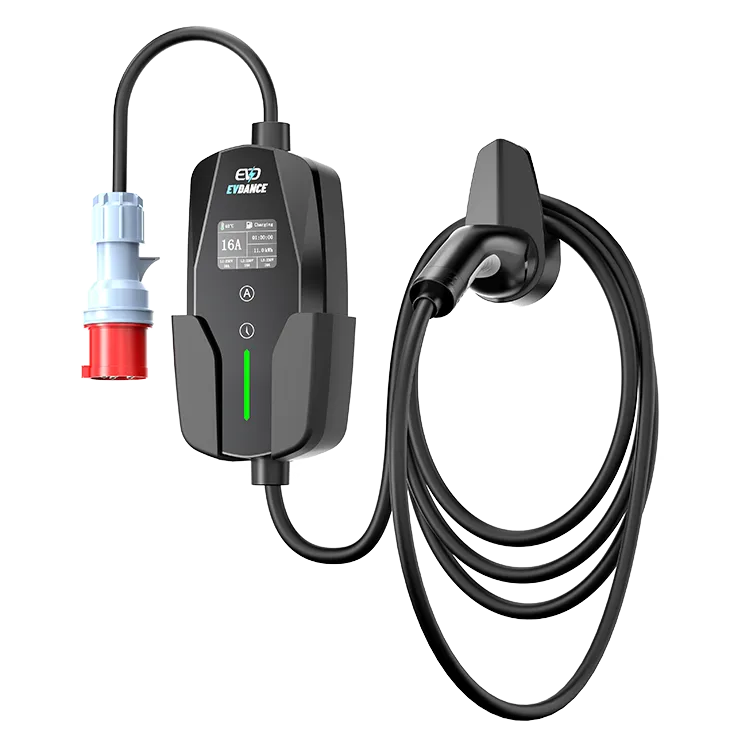
For a confirmed three-phase home, the EV-ACT3204PE is a 22 kW three-phase Type 2 wallbox with RFID and app control, rated IP66. If you want three-phase charging without a fixed installation, the ACS1605PE is an 11 kW three-phase portable charger (16 A, CEE 5-pin, Type 2, IP66), and the EV-ACS3205PE is the 22 kW portable version (32 A, CEE 32 A plug, IP66). Portable three-phase units need a matching three-phase socket, which is itself licensed electrical work. Whatever you buy for the Australian or New Zealand market should carry the local approvals described in our Australia certification guide.
Frequently Asked Questions
Can I get three-phase power connected just for EV charging?
Usually it is not worth it for charging alone. Upgrading a supply involves your distributor as well as an electrician, and a 7 kW single-phase wallbox already refills most cars overnight. Ask for a quote only if you have other large loads planned.
Will a three-phase charger damage a car that only takes single-phase?
No. The car draws only what its onboard charger accepts. A three-phase wallbox connected to a single-phase car simply delivers on one phase at the car’s lower limit.
Does three-phase charging cost more to run?
The energy used is the same; you pay for kilowatt-hours, not for phases. What changes is time — a bigger battery finishes sooner, which can help you stay inside an off-peak or solar window.
Related Reading
- Single-Phase vs Three-Phase EV Charging: 7kW, 11kW and 22kW Explained
- How Long Does It Take to Charge an EV at 7 kW, 11 kW and 22 kW?
- Portable EV Charger Types Explained: 10A, 16A, 32A and Three-Phase Models
- EV Charger Certification for Australia: SAA, RCM and EESS Explained

