
It changes it a lot. The energy is the same either way, but home electricity at the US average residential price of 18.31 cents per kWh costs a fraction of DC fast charging. In the worked examples below, a 12,000-mile year costs about $660 charged entirely at home and about $1,140 on a half-home, half-fast-charging mix. Your mix is the biggest single lever on what EV driving costs you.
Key Takeaways
- The home/public mix is the biggest lever on a year of charging cost.
- At average prices, a mostly-home year costs hundreds less than a fast-charging-heavy one.
- Only the middle of a road trip is usually bought at fast-charging prices.
- Re-run the table with your own mileage, efficiency and local fast-charging price.

The Two Prices You Are Mixing
Every kilowatt-hour you use comes from one of two very different price worlds. At home you pay your residential rate, 18.31 cents per kWh on the EIA average. Public DC fast charging is priced by the network and varies widely by state and site; the U.S. DOE guide to public charging simply advises checking the price before you start. To make the maths concrete, the examples use 45 cents per kWh as a labelled example price for fast charging. Replace it with the price your network actually charges.
The examples also assume 12,000 miles a year and a car that uses 0.30 kWh per mile measured at the wall, the same example efficiency used in our comparison of charging versus gasoline. That is 3,600 kWh a year. Substitute your own mileage and efficiency the same way.
Four Mixes, One Year of Driving
| Home / DC fast mix | Home energy cost | Fast-charging cost (example 45¢/kWh) | Total for the year |
|---|---|---|---|
| 100% home | 3,600 kWh × 18.31¢ = $659 | $0 | about $659 |
| 90% home / 10% fast | 3,240 kWh = $593 | 360 kWh = $162 | about $755 |
| 70% home / 30% fast | 2,520 kWh = $461 | 1,080 kWh = $486 | about $947 |
| 50% home / 50% fast | 1,800 kWh = $330 | 1,800 kWh = $810 | about $1,140 |
Two things stand out. First, even a road-trip-heavy year stays far below what the same miles would cost in gasoline at recent prices. Second, moving from 90% home to 50% home adds roughly $385 a year in this example: frequent fast charging, not the car, is what narrows the EV cost advantage.
Where Trip Energy Actually Comes From
A road trip is not one price. The first charge of the day usually leaves your garage, bought at home rates. En-route stops are DC fast charging at network prices. Overnight stops may be Level 2 charging at a hotel or destination, priced anywhere from free to a per-kWh or session fee, as the guide to public charging prices explains. In practice only the middle of the trip is bought at that rate.
- Price the departure charge and the return home at your home rate.
- Price only the en-route stops at the DC rate you actually pay.
- Treat destination Level 2 as its posted price, which is often lower, or free.
How to Shift Your Own Mix
You cannot remove fast charging from a long trip, but you can shrink its share. Leave home full instead of “topping up on the way out”. Plan to arrive home low rather than buying expensive energy at the last stop for miles you will drive locally. And where a destination has only a standard outlet, a portable charger you control can turn an overnight stay into home-style charging.
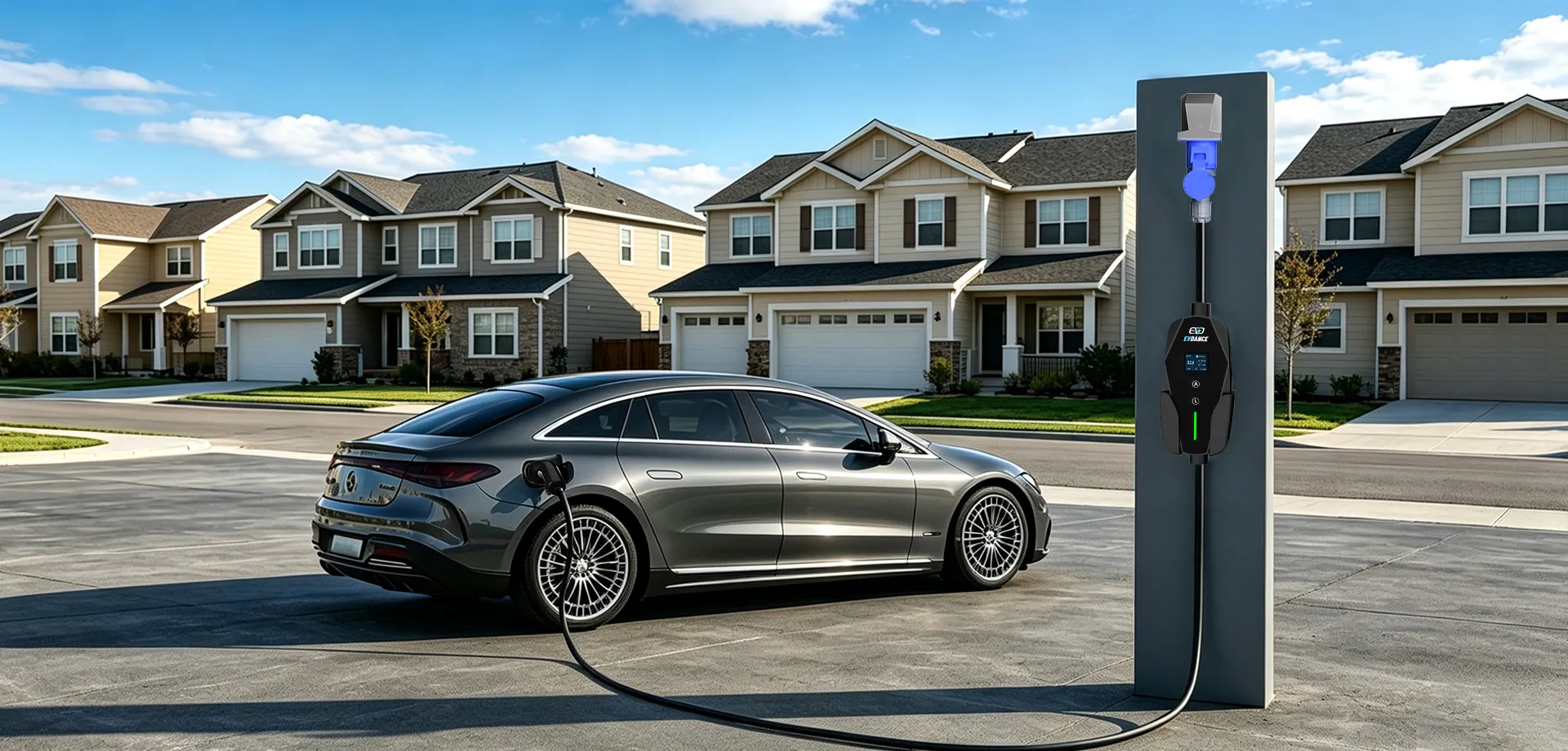
A home base that refills the car fully every night does most of the work. The EVDANCE EV-ACT5006T 48A Level 2 wall charger delivers up to 48 A hard-wired, and the EVDANCE EV-ACS3210T 32A NACS portable charger (about 7.7 kW, NEMA 14-50P, adjustable 10-32 A) covers trips from a 240 V outlet. Our guide to what home charging costs works through the home side in more detail.
Frequently Asked Questions
Does public Level 2 charging change the picture much?
It sits between the two prices. Price it at its posted rate in the same table; a few hundred kilowatt-hours a year at Level 2 prices moves the total far less than the same energy on DC fast chargers.
Will one long road trip ruin my yearly average?
No. A 2,000-mile trip uses about 600 kWh at the example efficiency. Even if all of it were fast charging at 45 cents, that is about $270, versus about $110 for the same energy at home. Noticeable, but one trip does not undo a year of home charging.
Is it worth driving out of my way for cheaper fast charging?
Rarely. The saving is the price difference times the energy bought. On a 40 kWh stop, a 10-cent difference is $4, which a long detour in time and extra miles can easily erase.
Related Reading
- How Much Does It Cost to Charge an Electric Car at Home?
- Is Charging an Electric Car Cheaper Than Gas?
- How Much Do EV Charging Stations Charge? Pricing Models Explained
- How to Use a Public EV Charger (and How to Stop It)

