
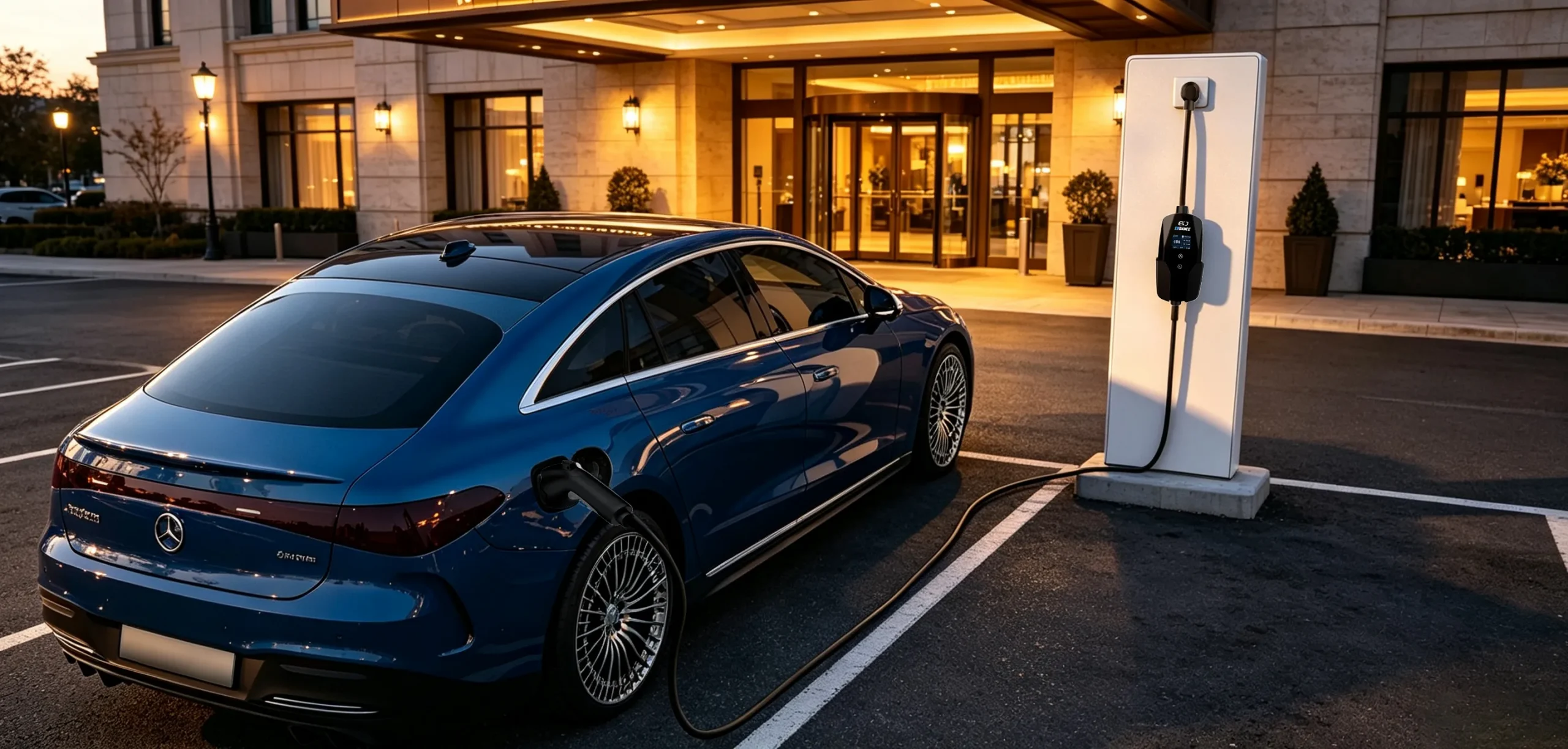
Destination charging is AC Level 2 charging at a place where your car is parked anyway — a hotel, workplace, car park, gym or attraction. You plug in on arrival, do what you came to do, and unplug when you leave. Nobody waits for it: the parked time is the charging time.
Key Takeaways
- Destination charging is AC Level 2 charging where the car is parked for hours anyway.
- Its value is fit, not speed: a long stay turns a modest post into a useful refill.
- Hotels, workplaces and car parks are the typical hosts; price and access rules are theirs.
- Sites choose AC because several Level 2 posts cost far less than one DC fast charger.
The Idea: Charge Where the Car Already Sits
Most charging debates are about speed, but destination charging is about fit. A car parked for three hours does not need a fast charger; it needs a modest, steady one. That is why destination posts are almost always AC: Level 2 delivers 7–19 kW on the U.S. DOT’s scale, adding roughly 10–20 miles of range per hour — plenty across a workday, a film or an overnight stay. Whether a given charger supplies AC or DC, and why, is set out in Are EV Chargers AC or DC?
| Stop type | Typical parked time | Charging that fits |
|---|---|---|
| Highway corridor stop | Minutes — the stop exists to charge | DC fast charging |
| Hotel, workplace, leisure visit | Several hours | Destination charging (AC Level 2) |
| Home overnight | All night | Home AC charging |
Where You Will Find It
- Hotels and holiday rentals. Overnight dwell time makes even a modest post useful — you leave with most of a charge without planning a stop.
- Workplaces. Cars sit for a full working day, so employers can offer charging without fast-charging hardware.
- Retail, leisure and public car parks. A two-hour visit at Level 2 quietly replaces the miles you drove to get there.
- Visitor attractions and venues. Anywhere the visit itself takes hours, the charging rides along for free in time terms.
Whether the charging itself costs money depends on the host. Some include it as an amenity; others bill through an app or a per-kWh price. Our guide to whether hotel EV charging is free works through the most common case.
What a Destination Session Looks Like
There is no queue-and-wait ritual. You park in the marked bay, connect, and start the session the way that post requires — a tap card, an app, or simply plugging in where the host leaves it open. Then you walk away. The courtesy rules are simple: plug in only if you actually need the charge, and move the car when you leave or once you have enough, so the next driver can use the post. Because the session is long and unattended, a post that reports its status to an app is worth preferring where you have a choice.

Why Sites Choose AC for Destination Charging
The economics explain the pattern. DOE-cited figures put public Level 2 at about $3,500 of equipment plus $2,500 of installation per connector, while DC fast charging runs about $38,000–$90,000 of equipment plus $20,000–$60,000 of installation. A hotel or office that needs to serve many cars for hours each is better served by several AC posts than one fast charger. The EVDANCE EV-AC03201T dual-connector AC station is built for exactly this job — two Type 2 connectors sharing up to 43 kW, with OCPP 1.6J and RFID for managed access — and our commercial charging solutions cover site planning.
Frequently Asked Questions
Is destination charging the same as home charging?
The technology is the same — AC power converted inside the car — but the setting differs. Home charging is private and scheduled around your night; destination charging is shared, public or semi-public, and scheduled around your visit.
How much range does a destination charge add?
At the DOT’s Level 2 rate of roughly 10–20 miles of range per hour, a three-hour stay adds about 30–60 miles — usually enough to cover the trip there and back. It is a top-up pattern, not an empty-to-full one.
Do I need an account to use destination chargers?
It varies by host and network. Some posts are open, others need an app, an RFID card or reception’s permission. Check the listing before you rely on one for a trip.
Related Reading
- Are EV Chargers AC or DC?
- Is Hotel EV Charging Free?
- Where to Find EV Charging Stations: Maps, Apps and Tips
- How Do Home EV Chargers Work?

