
Plan on 15 to 30 minutes per charging stop on a road trip — several short stops, not one long one. DC fast chargers add roughly 180 to 240 miles of range per hour, according to the U.S. DOT’s charger speed guide, so stop length converts directly into miles. Charging in the fast part of the battery, roughly 10% to 80%, keeps stops in that range.
Key Takeaways
- Budget 15–30 minutes per fast-charging stop: at the DOT’s typical 180–240 miles per hour, 30 minutes buys 90–120 miles.
- Run the trip in the 10–80% window: two stops to 80% beat one stop to 100%.
- A 600-mile example day needs about 50 minutes of road charging, with first and last charges overnight.
- Cold batteries and dead-end chargers stretch stops — both are plannable.

Minutes Into Miles: The Only Conversion You Need
The DOT’s typical DC fast-charging band — 50–350 kW, about 180–240 miles of range per hour — is a session average, not a promise for your car. As planning arithmetic:
| Stop length | Miles added at 180 miles/hour | Miles added at 240 miles/hour |
|---|---|---|
| 10 minutes | About 30 miles | About 40 miles |
| 20 minutes | About 60 miles | About 80 miles |
| 30 minutes | About 90 miles | About 120 miles |
| 45 minutes | About 135 miles | About 180 miles |
One caution: your car’s own maximum rate decides where you sit in that band, however strong the charger is. A car that accepts less power gets the left-hand column, not the right.
Why Trips Are Built From Short Stops, Not Full Charges
The last part of the battery fills much more slowly than the middle. That is why charging slows after 80%: past that point you pay full stop time for a trickle of miles. On a trip, two stops ending near 80% almost always beat one stop ending at 100%. The working pattern:
- Leave with a full battery — the trip’s one 100% charge happens overnight.
- Drive each leg down to roughly 10–20% before stopping.
- Charge back to about 80%, unplug, and drive the next leg.
A Worked Example: A 600-Mile Day
An example plan — your car, weather and chargers will move the numbers — for a 600-mile day with roughly 200-mile legs:
| Stage | What happens | Charging time |
|---|---|---|
| Depart | Leave at 100% (overnight charge) | None on the road |
| Stop 1, after roughly 200 miles | Fast-charge from low back to about 80% | About 25 minutes |
| Stop 2, after roughly 200 more miles | Same again — also the meal stop | About 25 minutes |
| Arrive | Charge overnight at the destination | None counted |
Total road charging: about 50 minutes. Charging to 100% at both stops would add substantially more — the slow top slice, twice — for miles the plan did not need.
What Stretches a Stop
- A cold battery. A pack that has sat in cold weather charges slowly until it warms; battery preconditioning en route is the fix most cars offer.
- A slow or shared unit. Not every post delivers its badge rate; if the first minutes run far below what your car accepts, moving to another unit can beat waiting.
- No plan B. A broken or queued charger adds a detour; knowing the alternative stop on each leg is part of the budget — see where to find charging stations.
Cut the Last Stop With Destination Charging
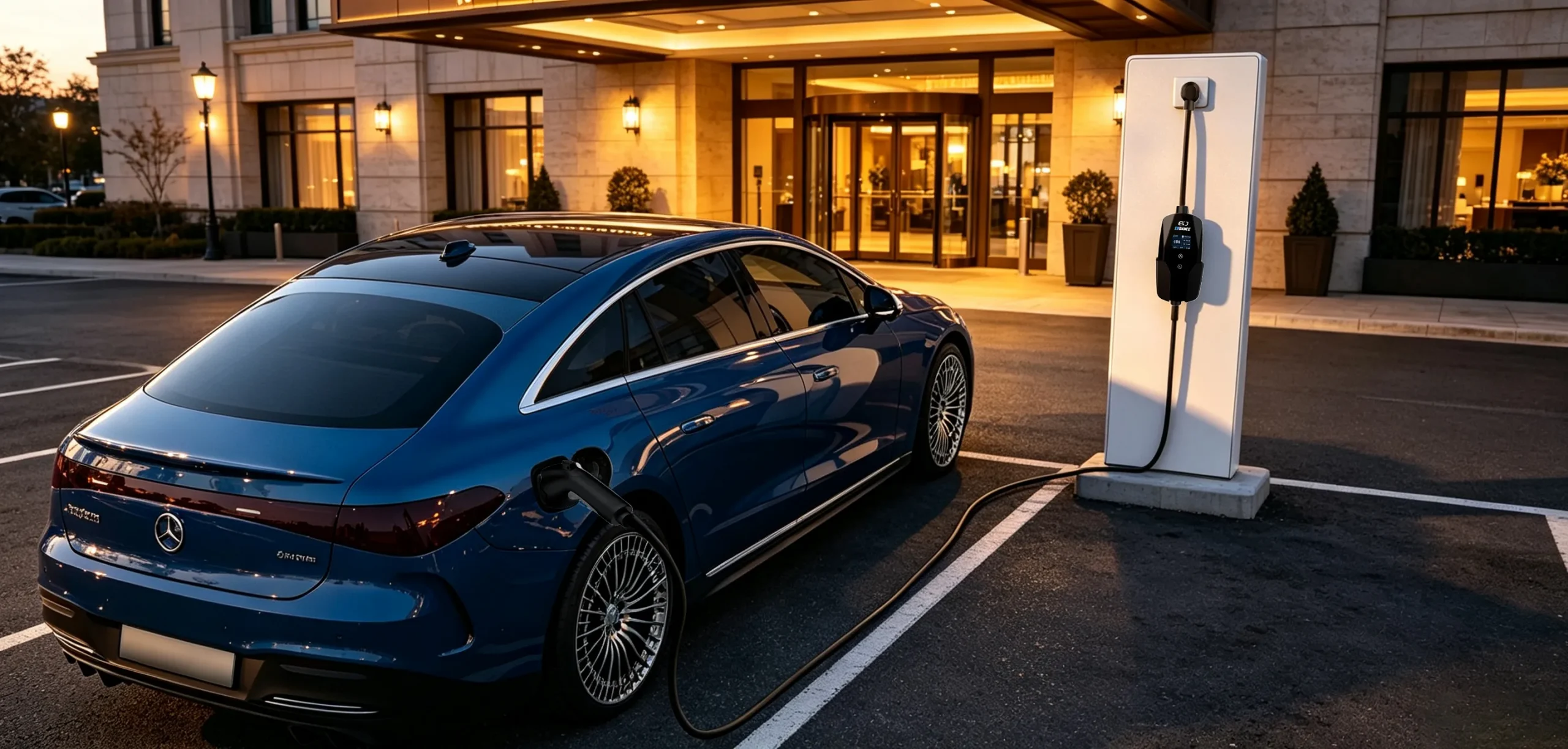
The cheapest stop, in time, is the one that happens while you sleep. Hotels with charging cover some trips; a portable charger in the trunk covers the rest, turning any suitable 240 V outlet into the overnight charge. The EVDANCE EV-ACS3210T 32A portable charger delivers about 7.7 kW from a NEMA 14-50 outlet, adjustable 10–32 A for weaker circuits; J1772 cars take the EV-AC04001U 40A portable charger at 9.6 kW with a 25 ft cable. Either gives you a full battery by morning — the next day starts with the long leg, not a charger.
Frequently Asked Questions
Should I charge to 100% at every stop to be safe?
Almost never on a planned route. The miles above 80% arrive at the session’s slowest rate, so they cost the most time. A buffer is wise where chargers are sparse — but buy it by stopping earlier on the next leg, not by filling to 100%.
Is it faster overall to stop more often for less time?
Usually about the same, often quicker, because every stop stays inside the fast part of the curve. The trade-off is each stop’s fixed cost — parking, plugging in, paying — so very short hops waste their own overhead.
How long does the first charge of the day take?
It should not happen on the road at all. Start at or near 100% from an overnight charge, and the first leg is the longest free one of the day. Our step-by-step on how to use a DC fast charger covers the stop itself.
Related Reading
- How to Use a DC Fast Charger: Step by Step
- Where to Find EV Charging Stations: Maps, Apps and Tips
- Why Does EV Charging Slow Down After 80%?
- Do Hotels Have Charging Stations for Electric Cars?

