
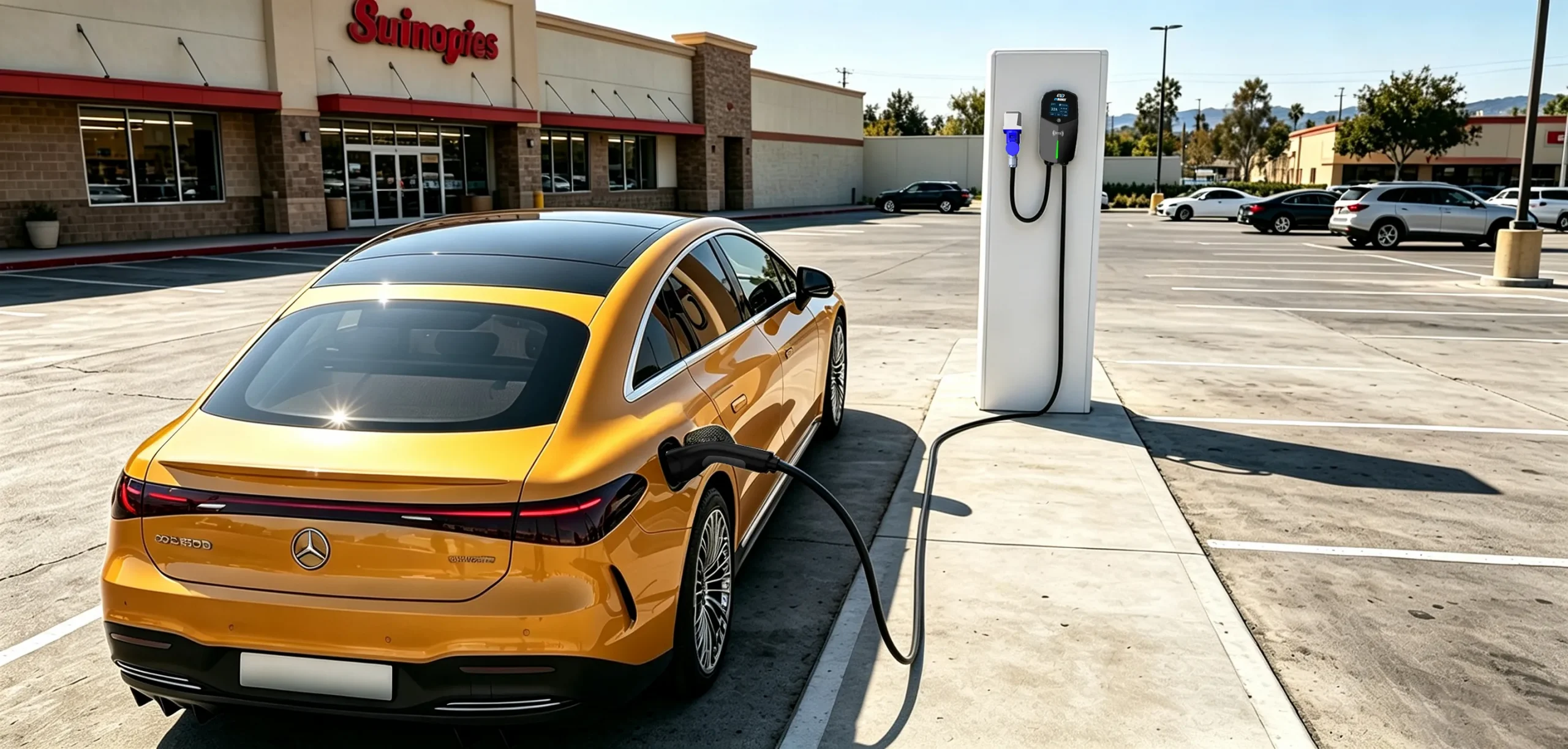
A charge point operator (CPO) is the company that owns or runs a network of public chargers. It sets the price you pay, keeps the chargers working and answers the support line. The confusing part is that three parties meet at one charger: the site host who owns the land, the operator who runs the charger, and the app or card provider you pay through — and all three names can be different.
Key Takeaways
- A charge point operator owns or runs public chargers: prices, maintenance and support are its job.
- Host, operator and payment provider are separate roles, so three different names at one charger is normal.
- Roaming and white-labelling explain most brand mismatches between the charger and your app.
- For faults, contact the operator named on the unit, not the site host.

Three Roles at One Charger
Most public charging sites split the work three ways. Knowing which role does what explains almost every confusing name and price a driver meets.
| Role | What they do | Where you see their name |
|---|---|---|
| Site host | Owns or leases the land and parking bays; agrees to host the chargers | The shop, hotel or car park brand on the building |
| Charge point operator | Owns or operates the chargers, sets prices, maintains them and runs support | On the charger itself and its help line |
| Service provider (eMSP) | Holds your account, app or RFID card and bills you for sessions | In the app you start the session with |
One company can hold two or three of these roles, which is why the simple cases feel simple. At many sites, though, a retailer hosts chargers it does not run, an operator runs them under the retailer’s branding, and your own provider bills you for the session.
Why the Names Never Match
Three common arrangements produce the mismatched names. First, white-labelling: an operator runs chargers painted in the site host’s or a partner’s brand, so the logo on the post is not the company behind it. Second, roaming: your provider’s app or card can start a session on another operator’s charger, and the two companies settle the bill between themselves — so the name in your app is your provider, not the operator. Third, networks change hands: a site can be sold or rebranded while the hardware stays in the ground. The layer underneath all of this is the software link between charger and operator platform, covered in our explainer on what OCPP means for charge point operators.
Who Sets the Price, Who Fixes the Charger
The operator sets the price at its own chargers and holds the maintenance duty: monitoring, repairs and the support number printed on the unit. If a charger is broken, the operator named on the unit is who to contact, as our walkthrough of how to use a public EV charger notes. Funded corridor sites carry extra duties: under the U.S. NEVI rules in 23 CFR Part 680, stations must stay open 24/7, accept contactless card payment with no membership, and average above 97% uptime. When you pay through a roaming provider, the provider’s price applies instead — which is why the price in your app can differ from the price on the charger’s screen.
Running Chargers as an Operator
Operators choose hardware that reports to a management platform and authorises drivers flexibly. The EVDANCE EV-AC03201T dual-connector AC station delivers up to 43 kW shared across two Type 2 connectors with OCPP 1.6J and RFID, and the EVDANCE EV-RHDC30K-L compact DC fast charger adds DC charging at 22 kW, also on OCPP 1.6J. Both can be connected to standard operator platforms and roaming services; see our commercial charging solutions for the site side.
Frequently Asked Questions
Is a charge point operator the same as an electricity company?
No. The operator runs chargers and buys electricity like any large customer; it is not your utility. Your home electricity supplier, the site’s operator and your app provider can be three unrelated companies.
Why does the charger show one brand and my app another?
Usually white-labelling or roaming. The charger may carry the site host’s brand while the operator runs it, and your app shows your own provider, which billed the session. The operator’s name is normally on the unit’s label and help line.
Who do I contact when a public charger is broken?
The operator named on the charger. Use the support number or app shown on the unit itself rather than the shop or car park staff — the host usually cannot reset or repair the equipment.
Related Reading
- How to Use a Public EV Charger (and How to Stop It)
- How Much Do EV Charging Stations Charge? Pricing Models Explained
- Can You Use Any EV Charging Station?
- OCPP Explained: What Charge Point Operators Need From EV Charger Hardware

