
Yes. If you own or lease a site with parking — a shop, hotel, workplace or car park — you can buy EV chargers and run them as your own small charging station. Owning is not the only route: many sites instead host chargers that an operator owns and runs. The model you choose decides who pays for the hardware, who sets the price drivers pay, and who keeps the chargers working.
Key Takeaways
- Yes, you can own a charging station: buy the chargers and run them on your own business, car park or land.
- The alternative is hosting, where an operator owns and runs the chargers on your site.
- Owning means you control pricing and keep the revenue — and you carry the hardware cost and the maintenance duty.
- Permits, electricity-resale rules and any funding conditions apply either way; check them before buying.

Three Ways Chargers End Up on Your Site
Own and run. You buy the chargers, hold the network account, set the prices and arrange maintenance. The station is your asset and your responsibility, whether it serves the public, your customers or your own staff.
Host. An operator installs its own chargers on your land. You provide the parking bays and enough electrical capacity; the operator owns the equipment, bills the drivers and handles repairs. Your site gains charging without you buying hardware.
Franchise or brand licence. You own the business but operate under a network’s brand, software and rules. What to check before signing up is covered in our guide to getting an EV charging station franchise.
What Changes Between Owning and Hosting
| Question | You own and run | An operator hosts on your site |
|---|---|---|
| Who pays for hardware and installation? | You do | The operator does |
| Who sets the price drivers pay? | You | The operator |
| Who maintains and repairs the chargers? | You, or your service contractor | The operator |
| Who keeps the charging revenue? | You, minus electricity and network costs | The operator; your return is whatever the hosting agreement gives you |
| Your day-to-day work | Monitoring, driver support, keeping bays usable | Little beyond keeping the bays clear |
What Owning One Commits You To
The hardware is the smaller half of the commitment. U.S. DOE figures put public Level 2 at about $3,500 equipment plus $2,500 installation per connector, and DC fast charging at about $38,000–$90,000 equipment plus $20,000–$60,000 installation. On top of the purchase come permits and the local rules on selling charging to the public, which vary by state and country — our guide to charging station licences and permits lists what to check.
Funding can add duties. Stations built under the U.S. NEVI corridor programme must stay open 24/7, accept contactless card payment with no membership, average above 97% uptime and provide DC ports of at least 150 kW. The full process, from site choice to pricing, is in our step-by-step guide to opening an EV charging station. Whether the numbers work for your site is a separate question, covered in our look at whether charging stations are a good investment.
Hardware Built for Owners
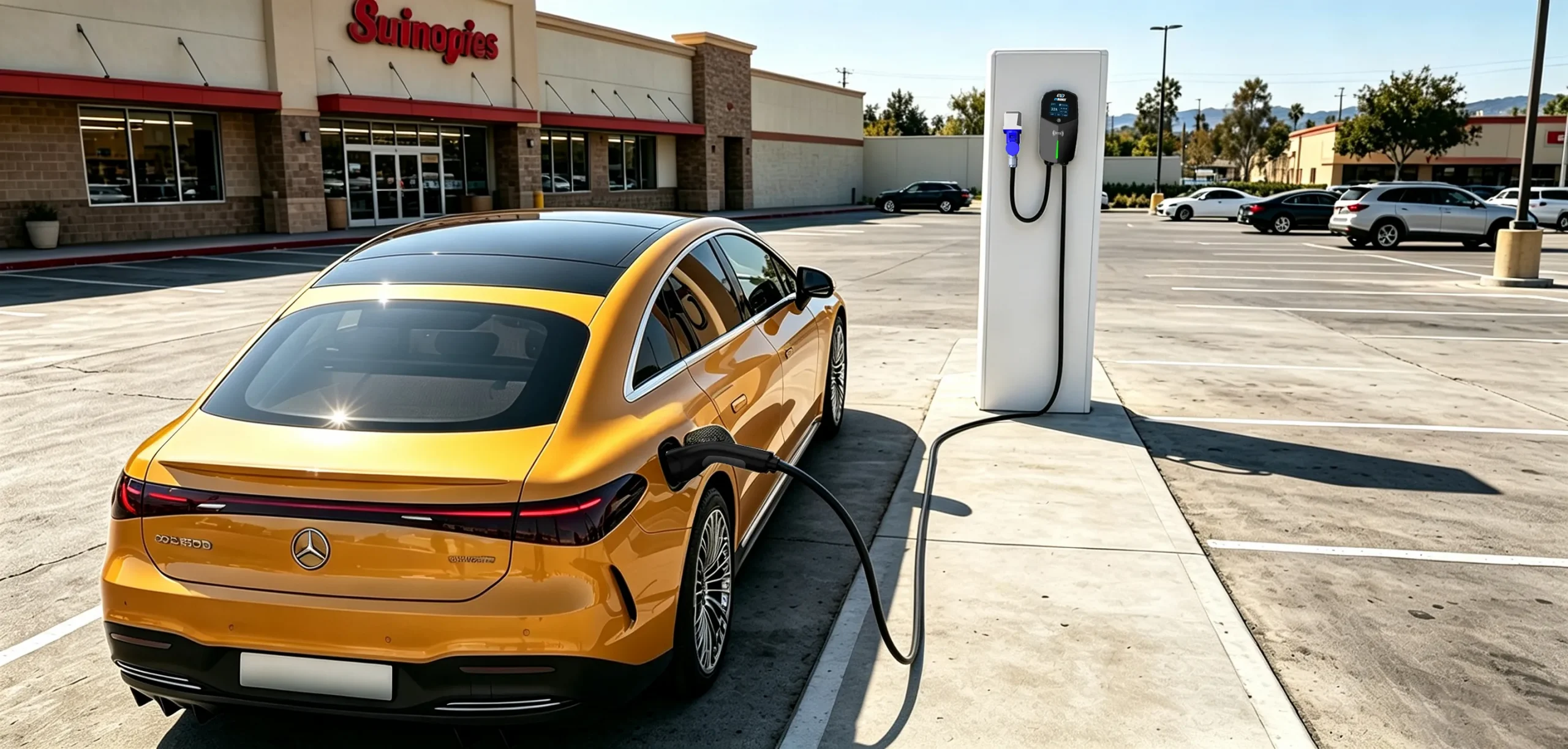
Owners who run their own sites usually choose networked chargers that report to a management platform. The EVDANCE EV-AC03201T dual-connector AC station delivers up to 43 kW shared across two Type 2 connectors (22 kW per connector) with OCPP 1.6J and RFID, suiting sites where cars stay an hour or more. For shorter stops, the EVDANCE EV-RHDC30K-L compact DC fast charger adds DC charging at 22 kW, also on OCPP 1.6J. See our commercial charging solutions for the full site range.
Frequently Asked Questions
Do I need a licence to own a charging station?
Permits for the electrical work are standard, and some places also regulate reselling electricity or charging by the kilowatt-hour. Rules vary by state and country, so check the local position before you buy hardware — a licensed electrician and your local authority can confirm what applies.
Can I start with just one charger?
Yes. Many owners begin with one or two ports, prove the demand, and lay conduit during the first installation so adding ports later stays cheap.
If an operator hosts chargers on my site, who fixes a broken one?
The operator. Under a hosting arrangement the equipment, its monitoring and its repairs belong to them. Your part is keeping access open and the bays usable.
Related Reading
- Are EV Charging Stations a Good Investment?
- Is an EV Charging Station Business Profitable?
- Where to Install an EV Charging Station: Site Selection Guide
- What Is the Best EV Charger for a Small Business?

