
Almost every electric car on sale uses a lithium-ion battery — the same family as a phone or laptop battery, built far bigger. Carmakers settled on it because it stores more energy for its weight than any other rechargeable chemistry manufactured for cars, and it can be charged and discharged for years of daily use.
Key Takeaways
- Nearly every EV’s main battery is lithium-ion — the same family as phone and laptop batteries, at car scale.
- It won on energy per kilogram: lead-acid is too heavy to drive a car far, and nickel-metal hydride suits small hybrid packs.
- Variants within the family (LFP, NMC and others) differ in cost, lifespan and charging guidance — follow your own car’s manual.
- Chargers do not care about chemistry; the car sets the limits and the charger supplies the power.

What the Name Means
A lithium-ion cell stores energy by moving lithium ions between two electrodes — out of one and into the other as it discharges, back again as it charges. Lithium suits the job because it is the lightest metal: a cell built around it carries much energy for little weight. The word “family” matters: lithium-ion is an umbrella, and its variants — named for their electrode materials, such as LFP and NMC — trade range, cost and lifespan in ways that matter when you charge.
The Other Batteries You May Meet
| Battery type | Where you will find it | Why it is (or is not) in the main pack |
|---|---|---|
| Lithium-ion | The traction pack of almost every EV and plug-in hybrid | Most energy per kilogram among rechargeable chemistries built at car scale |
| Lead-acid (12-volt) | The small auxiliary battery nearly every EV also carries — lights, locks, computers | Cheap and proven for small loads — far too heavy for its energy to drive a car any distance |
| Nickel-metal hydride | The traction battery in many conventional hybrids | Durable, but stores less energy per kilogram — suits a small hybrid pack, not a long-range EV |
| Sodium-ion and solid-state | In development and early use by some makers | Promising, but not yet what you will find in a showroom EV |
Why the Older Chemistries Lost
A car battery has one brutal constraint: it must carry the car. Every kilogram in the pack is hauled on every trip, so energy stored per kilogram decides how much range fits under the floor. A lead-acid pack holding a useful amount of energy would weigh far more than a car could sensibly carry — why lead-acid stayed in its small accessories role for a century without powering mainstream cars. Nickel-metal hydride improved on it and still works in hybrids, whose packs are small because an engine does most of the work. Lithium-ion was the first chemistry to make a practical long-range EV possible, and manufacturing scale has only widened its lead.
What the Choice Means for Charging
For a driver, the chemistry mostly disappears. Every variant charges from the same chargers and connectors; the car, not the chemistry, sets the limits. Two things do reach the driver:
- Charge-limit advice differs by variant. Some packs are happiest charged fully and often; others age more slowly on a lower daily limit — hence the different guidance for different versions of similar cars. See our guide to whether to charge to 80% every night.
- The lifespan is long. FuelEconomy.gov estimates EV batteries may last 12–15 years in moderate climates and 8–12 years in severe ones. How ageing shows up in range is in our explainer on whether an EV battery degrades over time.
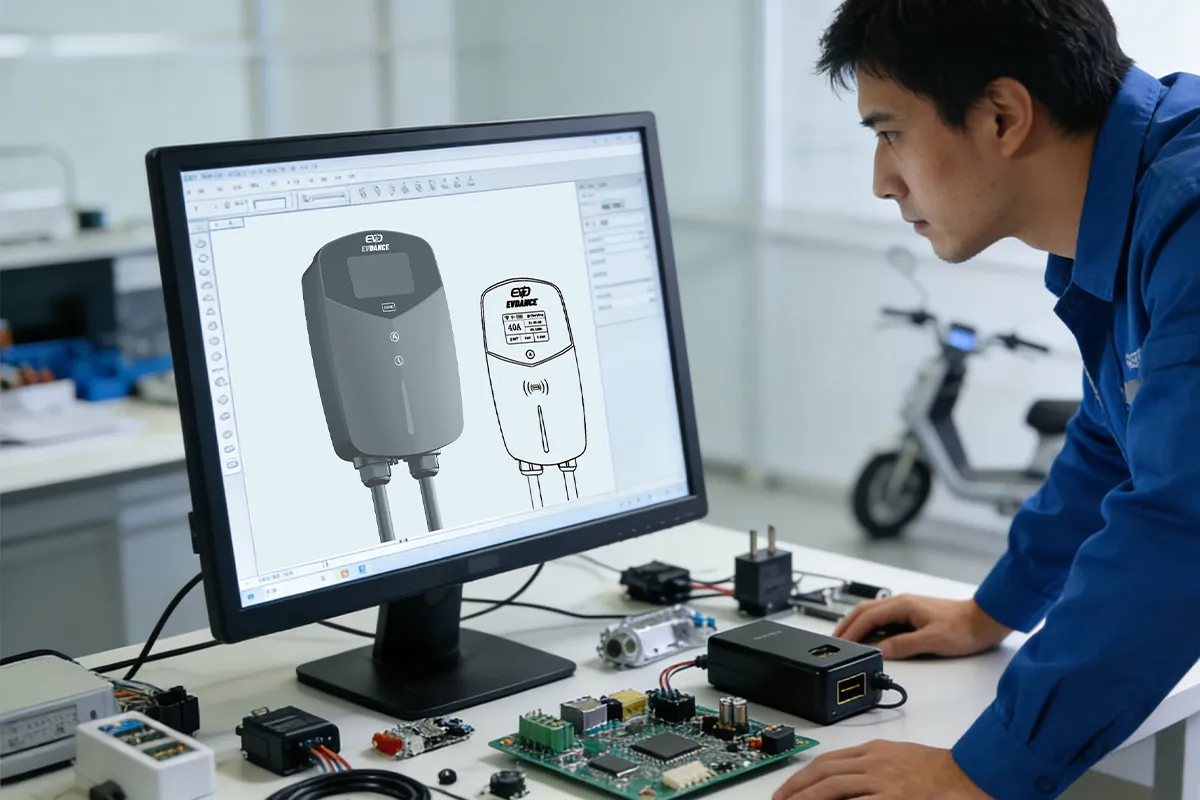
Because the limits live in the car, charger choice does not depend on chemistry. An adjustable portable — the EVDANCE EV-ACS4005T 40A NACS portable charger (9.6 kW, current adjustable at 16/24/32/40 A) — serves any lithium-ion car, as does the EVDANCE EV-AC04001U 40A J1772 portable charger for J1772 cars. Set the limit in the car; the charger supplies the power.
Frequently Asked Questions
Is an EV battery just a giant phone battery?
Same family, different engineering. A phone uses one or a few cells with minimal protection. A car pack combines many cells in a sealed, cooled, crash-protected structure, watched by a management system that controls charging, temperature and faults. The chemistry is shared; the scale and management are not.
Do all EVs use exactly the same battery?
No. Almost all use lithium-ion, but the variant differs — LFP, NMC and relatives trade energy density against cost and lifespan — and pack sizes differ by model. The difference a driver sees is the maker’s charging guidance for that car.
Will EVs always use lithium-ion?
Not necessarily. Sodium-ion and solid-state are in development, and either could take part of the market if it proves cheaper or better in use. No timeline is certain, and nothing on sale today depends on them: today’s lithium-ion pack is a known quantity with a long record.
Related Reading
- Should I Charge My EV to 80% Every Night?
- Does an EV Battery Degrade Over Time?
- Can an EV Battery Be Replaced or Repaired?

