
“Charging connector” is the manufacturer’s term for the assembly in your hand at the end of a tethered cable: the grip, the latch and the connector face that plugs into the car, all built as one unit. Station specifications count them — a “dual-connector” station has two — while drivers usually call the same part the handle or the plug.
Key Takeaways
- “Charging connector” is the trade name for the handle-and-connector assembly on a tethered cable.
- It combines the connector face, latch and release button, grip housing and cable strain relief.
- Single-connector and dual-connector describe how many assemblies a station carries; socket stations have none.
- The connector is not live in your hand — power flows only once it is latched in and confirmed.
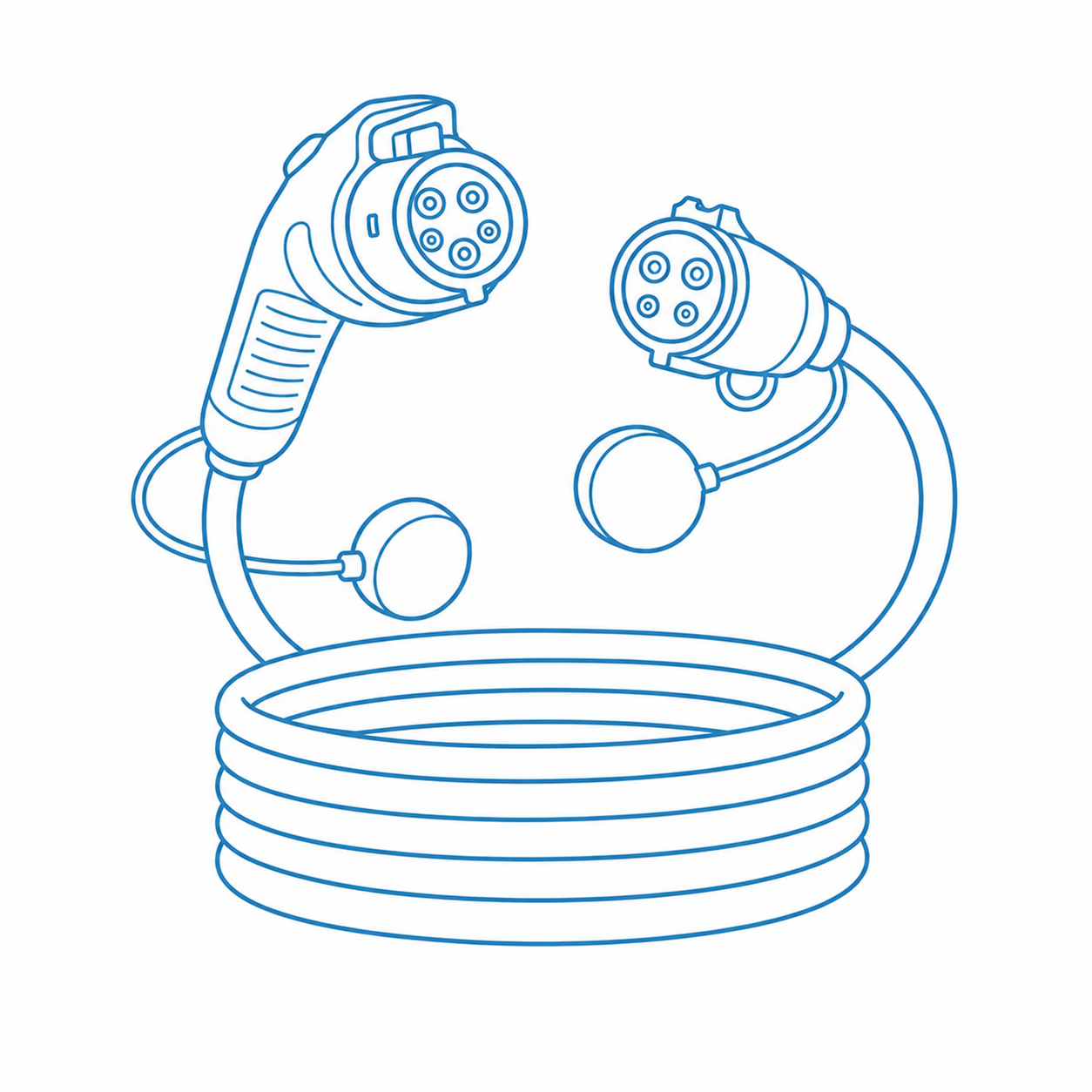
What the Assembly Includes
| Part of the connector | Its job |
|---|---|
| Connector face | The shaped end that mates with the car’s inlet — J1772, Type 2, NACS or a DC format, depending on the connector |
| Power and signal contacts | Carry the charging current and the low-voltage signals that confirm the connection before power flows |
| Latch and release button | Locks the connector into the car during the session; its button requests a clean stop before removal |
| Grip housing | The insulated body you hold, sealed against weather (portable EVDANCE connectors are IP66) |
| Cable entry and strain relief | Where the cable meets the handle; bends here are supported so the conductors inside are not stressed |
One point worth keeping straight: the connector is built to be safe in the hand. The power contacts sit recessed inside the connector face, and no charging power flows until the connector is latched into the car and the connection is confirmed — which is why a connector can hang in its holster on a live charger without being a hazard.
Connector, Plug, Connector, Inlet: Four Words, Two Ends
Half the confusion is that the same hardware collects names from different trades. Manufacturers and datasheets say “connector”; spec sheets also say “connector” or “plug”. The matching socket on the car is the inlet (or charge port): connector at the cable end, inlet at the car end. The comparison of Type 2 vs J1772 vs NACS connectors maps the shapes you will meet, and how CCS builds on the J1772 inlet shows why a DC connector looks different — it carries an extra pair of large contacts for fast charging.
Single-connector, Dual-connector — and Stations With No Connector at All
A single-connector station serves one car at a time. A dual-connector station carries two assemblies and serves two cars, usually sharing one power supply: the EVDANCE EV-AC03201T dual-connector AC station, for example, delivers up to 43 kW shared, at up to 22 kW per connector. And some stations — common in Europe — have no connector at all: they end in a socket, and the driver brings the cable. Neither design is better in itself; tethered connectors are quicker to use, sockets keep the cable with the car. The guide to choosing plug, cable and connector by market explains why regions settled differently.

Looking After the Connector
- Holster it. Between sessions the connector belongs in its holster or dock, contacts shielded from rain and dirt.
- Do not drop it. The connector face is a precision fit; a cracked housing or bent contact is a stop-and-inspect fault.
- Keep the contacts clean. Dirt on the face is the common, fixable cause of a poor connection — see how to clean an EV charger connector.
- Never force it. A connector that will not seat or release is telling you something; forcing it damages the car end too.
On a portable charger, the connector is the far end of the unit you carry: the EVDANCE EV-ACS4005T 40A NACS portable charger pairs its connector with a 25 or 28 ft cable and an IP66 rating. The same word covers a fast charger’s much larger connector: DC connectors are built bigger because they carry far higher currents, in the 50–350 kW range the U.S. DOT cites for fast charging.
Frequently Asked Questions
Is the charging connector live when it is hanging in its holster?
No. The contacts are not energised with charging power until the connector is plugged into a car and the connection is confirmed. Treat a damaged connector as out of service all the same.
Can you replace just the connector if it is damaged?
On most chargers the connector and cable are one assembly, replaced by the manufacturer or a service partner, not repaired at home. Opening the housing yourself ends any warranty argument.
Why do some charging cables have no connector?
Those are cables for socket-style stations. The connector shape — a gripped handle with a latch — is standard on tethered home and public chargers.
Related Reading
- Type 2 vs J1772 vs NACS: Which EV Charger Connector Does Your Market Need?
- Does J1772 Work With CCS? CCS Connectors Explained
- How to Clean an EV Charger Connector
- Choosing Plug, Cable and Connector for an OEM Charger by Market

