
Two of the best-known EV brands on the road have quietly stopped putting a portable EV charger in the box. Rivian confirmed it is dropping the bundled unit from every 2026 R1T and R1S — including the high-end Quad-Motor trims — and now sells it as a $400 accessory. Tesla made the same call back in 2022 and never looked back. Neither company has framed this as bad news, but the practical effect is the same either way: more EV owners than ever now have to go out and buy a portable charger themselves, at the same moment regulators are tightening the rules around how those chargers get wired in. Here’s what actually changed, with links back to the primary sources, and what it means if you’re the one shopping for a portable EV charger right now.
Two of the Biggest EV Makers Have Stopped Including a Portable Charger
Rivian’s change applies to the entire 2026 R1T and R1S lineup. According to reporting from RivianTrackr, the portable charger — previously standard equipment capable of charging from either a 120V household outlet or a 240V NEMA 14-50 outlet — is now a separate $400 purchase, offered in both NACS and J1772 versions. The article notes the change applies “even on the high-end Quad-Motor trims,” despite those trims still including a long list of other bundled extras.
Tesla set the precedent years earlier. Buyers who ordered a Tesla after April 17, 2022 stopped receiving the Gen 2 Mobile Connector automatically; it became a standalone accessory priced at $275 and later dropped to $200 after customer pushback. Elon Musk’s stated reason at the time was simple: “usage statistics were super low, so seemed wasteful.”
| Automaker | What changed | Effective | Now costs |
|---|---|---|---|
| Tesla | Gen 2 Mobile Connector no longer standard | Orders after Apr 17, 2022 | $200 accessory |
| Rivian | Portable charger dropped from all trims, incl. Quad-Motor | 2026 model year (announced Jul 2025) | $400 accessory (NACS or J1772) |
The Mobile and Portable Charging Market Is Growing Fast — Just Read the Segment Carefully
The broader mobile/portable charging equipment category is expanding quickly, though it’s worth being precise about which slice of it is growing where. Market research covering portable DC fast chargers — the higher-power, often trailer- or cart-mounted units used by fleets, event organizers, and roadside-assistance providers, not the small AC unit you’d keep in a trunk — puts that segment at $0.94 billion in 2025, rising to $1.19 billion in 2026 at a 26.9% compound annual growth rate, and projects it reaching $3.05 billion by 2030, according to a market report distributed via GlobeNewswire. Asia-Pacific is named as both the largest region in 2025 and the fastest-growing through the forecast period. The report attributes the growth to range-anxiety mitigation, demand for emergency and roadside charging, flexibility at temporary sites like construction projects and events, fleet electrification in last-mile delivery, and the rise of mobile-charging-as-a-service business models.
The everyday AC portable EV charger — the kind that plugs into a NEMA outlet in a garage — is a different, smaller-ticket product, but it rides the same underlying wave: EV ownership growing faster than fixed home and workplace charging infrastructure can keep up, and buyers filling the gap with a charger they can plug in themselves, take with them, or keep as a backup.
What Regulators Are Watching: GFCI Rules for Plug-In Chargers
If you charge a portable EV charger from a NEMA 14-50 outlet, there’s a code detail worth knowing about. The National Electrical Code requires ground-fault protection on that circuit twice over — once under NEC 210.8(A) for any 125–250V garage receptacle, and again under NEC 625.54, which independently requires GFCI protection on any receptacle installed specifically for EV charging. According to an explainer from Qmerit, the practical problem is that most portable Level 2 chargers already include their own built-in ground-fault protection — so when an external GFCI breaker is added on top, the two systems can both react to the same minor electrical fluctuation, tripping the circuit and interrupting a charge for no real safety reason. Qmerit notes that “NEMA plugs are also subject to wear and tear with the continual plugging and unplugging of the units,” which compounds the reliability question over time. Electricians’ most common fix is to hardwire a charger instead, since a hardwired unit isn’t subject to the 625.54 receptacle requirement at all — one more reason the portable-vs-hardwired decision is worth thinking through rather than defaulting to whichever one the car happened to ship with.
The code itself keeps moving too. The 2026 edition of the NEC lowers the GFCI trip threshold for EV charging circuits from the older 20mA standard to a stricter 5mA (Class A) threshold and tightens certification requirements for load-management systems, according to ChargeRight’s summary of the changes. Adoption is still uneven — Massachusetts adopted the 2026 NEC effective April 24, 2026, while most U.S. jurisdictions are still working from earlier editions — so what applies to a given driveway depends heavily on where that driveway is.
What This Means If You’re Buying a Portable Charger Right Now
With fewer new EVs arriving with one in the box, and code requirements getting more specific rather than less, a few things are worth checking before buying a portable EV charger on the aftermarket:
- Match the plug to your actual outlet. NEMA 14-50, 6-20, and 5-15 draw very different amperage — buying the wrong plug type means buying an adapter or a second unit.
- Look for adjustable output. A charger with selectable amperage (for example 10A–32A) can be dialed down for an older circuit and dialed up later without replacing the hardware.
- Confirm independent safety certification. UL, ETL, or an equivalent listing on the charger itself is separate from — and doesn’t replace — the GFCI protection required on the circuit it plugs into.
- Ask about IP rating if it’ll live outdoors. A portable charger stored in a garage has different weatherproofing needs than one left on an exterior wall hook.
Where EVDANCE Fits In
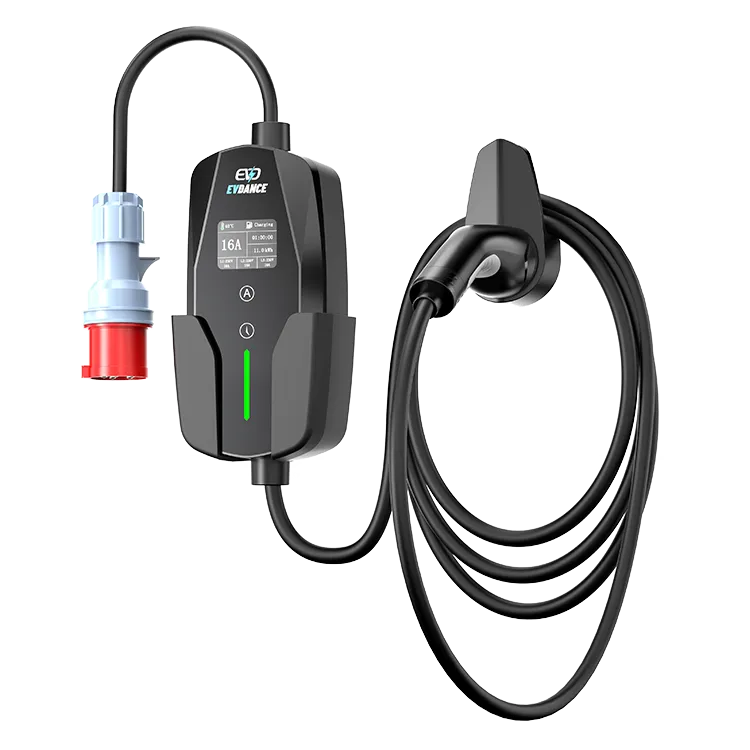
EVDANCE builds its portable AC chargers — the ACS1605PE, ACS3210E, ACS3210T, and ACS4005T — around exactly this shift: adjustable output, NEMA and industrial plug options, and independent safety certification, aimed at the buyer who now has to source a portable charger separately rather than assume one comes with the car.
Key Takeaways
- Rivian dropped the bundled portable charger from all 2026 R1T/R1S trims; it’s now a $400 accessory. Tesla made the same move in 2022.
- The high-power portable/mobile DC fast charging market is growing at roughly 27% a year, though that figure covers fleet- and event-scale hardware, not small home AC units.
- NEC 625.54 requires GFCI protection on EV charging receptacles like NEMA 14-50, which can cause nuisance tripping with chargers that already have built-in ground-fault protection.
- The 2026 NEC further tightens GFCI thresholds to 5mA, though state-by-state adoption is still in progress.
- Buyers shopping for a portable charger should check plug type, adjustable amperage, independent certification, and outdoor rating before buying.
Sources & Standards
- RivianTrackr — Rivian No Longer Includes Portable Charger With 2026 R1T and R1S (Jul 8, 2025)
- Not a Tesla App — Tesla is no longer including the mobile charging connector with new vehicles
- GlobeNewswire — Global Portable DC Fast Chargers Market report (Jul 8, 2026)
- Qmerit — NEMA 14-50 vs. Hardwired EV Chargers: GFCI Code Requirements & Nuisance Tripping
- ChargeRight — NEC 2026 EV Charger Rules: What Changed