
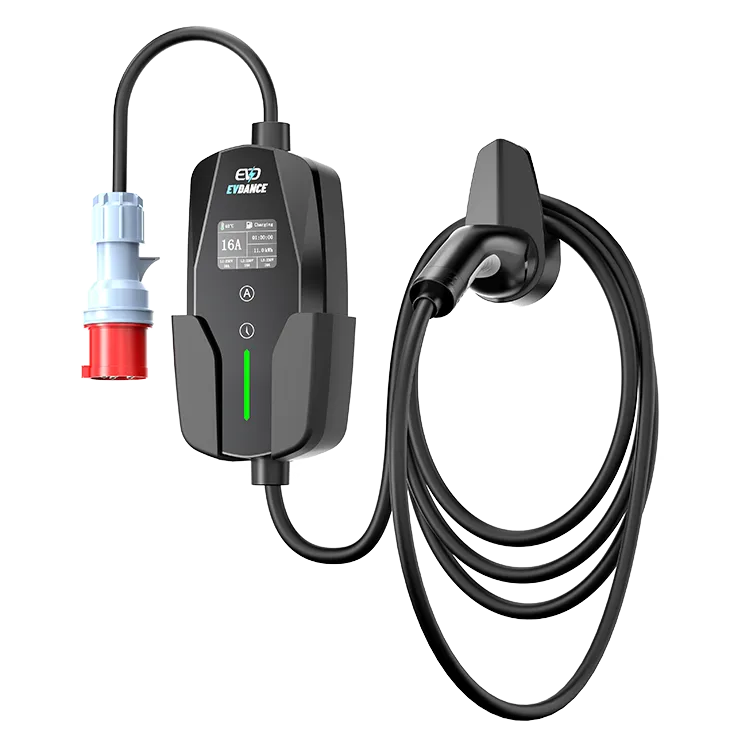
Where a barn, outbuilding or allotment building already has a 16 A three-phase CEE socket, a portable charger needs no installation at all. The ACS1605PE’s five-pin plug is made for that socket, and its cable is 7.6 m — the distance you have to work with. Three checks decide whether the place works: the socket’s rating and condition, the reach to parking, and whose electricity a shared supply would give you.
Key Takeaways
- With a sound 16 A CEE socket already fitted, the portable charger is the whole installation.
- The marked rating is the ceiling; a different socket class is a different fitting, not an adapter job.
- Measure the real route: socket to charge port must fit inside 7.6 m, with slack.
- On shared supplies, permission and payment are the site’s questions — settle them before the first session.
The Socket Is the Ceiling
The rating marked on the socket is the ceiling, and this unit asks a continuous 16 A per phase. Its fitting is the 16 A five-pin three-phase CEE — our CEE plugs explainer shows how to tell the classes apart. A 32 A or single-phase socket is a different fitting: the plug does not mate, and adapter leads are no answer for a load that runs for hours. That mismatch is a question for an electrician or for EVDANCE before you buy.
Condition counts as much as class: legible markings, a firm fit, no heat damage or scorch marks. A socket failing that glance is fixed wiring — an electrician replaces it; it is not worked around. Many outbuilding feeds were sized for lights and tools, so an electrician’s check that the feed is content with a continuous load comes before regular use.
| Check | What you are looking for |
|---|---|
| Socket | 16 A five-pin three-phase CEE, markings legible, no heat damage or looseness |
| Reach | Tape-measured route from socket to charge port inside 7.6 m, with slack |
| Supply | A feed an electrician is content to run at a continuous 16 A per phase |
Reach: The Outbuilding Problem
In a house the socket is near the car; in a barn it sits deep inside, fitted for machinery, while the car stands outside. The 7.6 m cable must cover the whole route: socket, doorway, across to the car, up to the charge port, with slack at both ends. Measure it with a tape; a route reading close to 7.6 m is too long, because the cable curves and does not stretch.
If the tape says no, park within reach or have a socket fitted where the car stands. An extension lead is not an answer: a session is a continuous load for hours. The unit itself is sealed to IP66 — our IP ratings guide explains the scale.
Shared Supplies: The Allotment Questions
A shared barn or allotment building often runs on a communal supply, and a charger is not a kettle: it draws full power for hours. Four questions belong to the site association or owner before the first session:
- Whose supply and meter would the session draw from, and is such a load allowed on it?
- Who gives permission, and should it be in writing?
- How would your energy be measured or paid for? This model lists no metering or accounts, so the arrangement is the site’s — a meter reading, a flat contribution, whatever is agreed.
- Are there site hours or uses — machinery, pumps, events — your sessions must fit around?
The portable’s advantage in shared places: nothing is installed. If permission ends or you give up the plot, the charger leaves with you.
The ACS1605PE in a Working Building
The ACS1605PE is an 11 kW three-phase portable: 16 A, 230/400 V, Type 2, CEE five-pin plug, a 1.77-inch display, 7.6 m cable, sealed to IP66, with the connector stored off the floor and covered between sessions. EVDANCE is a Shenzhen manufacturer founded in 2011; the unit carries its 3-year standard warranty. For a building that already has the socket, it is the whole installation: plug in, charge, take it away.
Frequently Asked Questions
My allotment has a shared supply. Can I just plug in?
Ask first: permission, metering and payment are the association’s or owner’s decisions, and a charger draws for hours. Get the arrangement agreed, ideally in writing, first.
The socket is 12 m from where I park. Can I use an extension lead?
No — not for a continuous charging load. Park within the cable’s 7.6 m reach, or have an electrician fit a suitable socket where the car stands.
The barn socket is old and the markings are worn. Can I use it at full rate?
Not on trust. If the rating cannot be read, or the socket shows heat damage or looseness, it is out of service until an electrician identifies it and replaces it if needed. The plug is only half the joint.
Related Reading
- CEE Plugs Explained: Choosing 16A or 32A for a Three-Phase Portable EV Charger
- IP Ratings for EV Chargers: IP54, IP65 and IP66 Compared
- Are Portable EV Chargers Waterproof? IP Ratings Explained for Drivers

