
A main fuse that trips during charging is usually arithmetic, not a fault. The ACS1605PE draws a steady 16 A on each of its three phases, so the load is spread evenly and no single phase carries the whole session the way it does with a single-phase charger. What decides the trip is the per-phase sum at the busy hour — the charger’s 16 A plus whatever single-phase loads stack onto the same phase.
Key Takeaways
- Trips during charging are usually a per-phase sum, not a fault.
- This charger draws an even 16 A on each phase; single-phase loads decide which phase is busiest.
- This model lists no adjustable current: stagger loads, use the car’s limit, or move the session.
- The main fuse is sealed network equipment — repeated trips are an electrician’s conversation.
Spread Across Three Phases — Capped on Each One
Each phase of a three-phase supply has its own ceiling, set by your main fuse and contract — your installer or network operator can tell you the figure. A balanced charger asks the same of every phase; most other big loads ask everything of one. So the busiest phase, not the total, is the number to watch. An invented example makes the shape clear — a home with an example 32 A per phase available:
| Example evening load | How it draws | On the busiest phase |
|---|---|---|
| The ACS1605PE charging | 16 A on each of three phases | 16 A |
| An oven cooking dinner | Single-phase, about 11 A on one phase | +11 A |
| A washing machine heating water | Single-phase, about 9 A on one phase | +9 A |
| Total on the busiest phase | — | About 36 A — over the example 32 A |
The other two phases sit at 16 A, comfortably inside — one phase was simply asked for more than its share. Our guide to adding chargers to a building works the same sum for fixed installations.
The Levers That Remain
Plan on the full draw: the listing for this model states no adjustable current setting, so every session asks the full 16 A per phase. The levers that remain are real ones:
- Stagger the single-phase loads. Run the washer and dryer outside charging hours, or charge outside the cooking hour — moving one load off the busiest phase often settles it.
- Use the car’s own limit, where the car offers one. Many EVs can cap AC current in their settings; the session slows, but each phase is asked for less.
- Move the session. Overnight, the charger is usually the only large load in the house, and 16 A per phase fits easily.
- Ask an electrician to assess the supply. Spare capacity per phase is a measurement, not a guess. If the home has too little, the conversation becomes a supply upgrade or a load-management wallbox — our dynamic load balancing explainer covers those.
The main fuse is sealed network-operator equipment: never open or replace it yourself. If it operates, restore power via your operator’s route; repeated operation is an installer’s conversation.
When It Is Not the Budget
Budget trips follow the busy-hour pattern. Trips on an idle home, trips the instant a session starts, and any heat, buzzing or discolouration at the socket, plug or consumer unit are a different message: stop and have the circuit checked by a qualified electrician. No timetable fixes a fault. Our guide to a charger that keeps tripping the breaker separates the causes.

The ACS1605PE, Planned at Full Draw
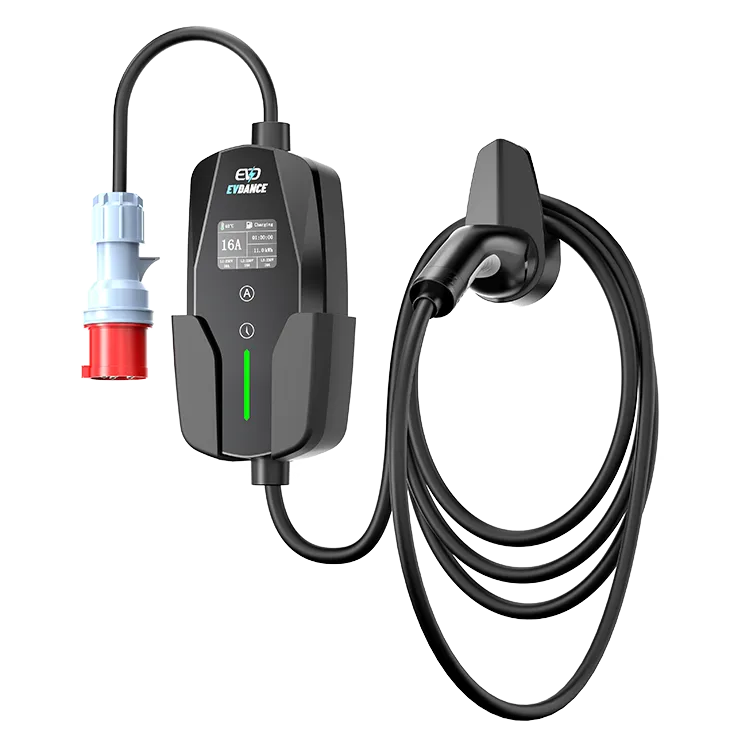
The ACS1605PE is an 11 kW three-phase portable charger — 16 A, 230/400 V, Type 2, CEE five-pin plug, 1.77-inch display, IP66, 7.6 m cable — from EVDANCE, a Shenzhen manufacturer founded in 2011, with its 3-year standard warranty. Its even draw is gentle on a supply compared with a large single-phase load. Treat it as constant: 16 A on every phase, every session, until the car is done.
Frequently Asked Questions
Why does the fuse go in the evening but never overnight?
Because the limit applies per phase, to everything running at once. Evenings stack the charger’s 16 A onto a phase with cooking and laundry; overnight it is usually the only large load, so the same draw fits.
Can I turn the ACS1605PE down to a lower current?
The model’s listing states no adjustable current setting, so plan at the full 16 A per phase. If a session must ask for less, the reduction has to come from the car’s own charge limit where offered, or from timing and staggering.
Does three-phase charging mean the main fuse cannot trip?
No. Each phase still has its ceiling. A balanced charger uses the three evenly, but single-phase loads stack onto one phase — and the trip follows the busiest phase, not the average.
Related Reading
- Why Does My EV Charger Keep Tripping the Breaker?
- Adding EV Chargers to a Building: Load Calculation Basics
- What Is Dynamic Load Balancing, and Why Does Your Wallbox Home Charger Need It?
- Can I Charge an Electric Car From a Normal Socket?

