
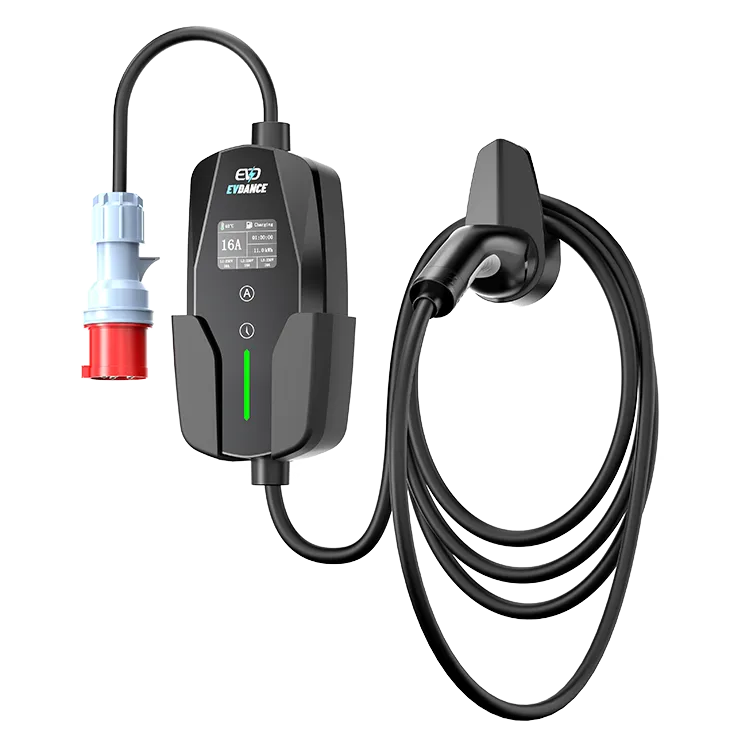
Yes — on the right pitch. The ACS1605PE needs one specific fitting: a 16 A five-pin CEE socket fed by a three-phase supply. Pitch hook-ups exist to serve the caravan itself, and that socket class is the exception among them, not the standard offer — sites differ, and no charger listing can speak for the pitch you are booking. Plan the stay around it: two questions to the site before you book decide whether it travels as a charger or as luggage.
Key Takeaways
- The ACS1605PE charges on tour only where a pitch offers a 16 A five-pin CEE socket on a three-phase supply — the exception among pitch hook-ups, so ask before you book.
- Two questions decide it: which socket, and which rating on how many phases. An unknown answer counts as no.
- Never bridge socket classes with an adapter for a continuous load; the classes differ by design.
- Where the match exists, about 11 kW returns a day’s touring in a few hours.
Two Questions to Ask Before You Book
- Which socket? You need the five-pin CEE — the industrial round-pin family. Neither the blue single-phase hook-up nor a domestic socket feeds it; both are different fittings. Our guide to CEE plugs for three-phase portable chargers shows the classes.
- Which rating, and how many phases? The socket must be the 16 A class, on a three-phase supply. A socket’s face does not prove what feeds it — that confirmation belongs to the site and its electrician.
If either answer is no, or nobody can tell you, plan the trip as if the pitch offers no charging — a plan better made at home than at the pitch.
| What the site offers | This charger? | Your plan |
|---|---|---|
| 16 A five-pin CEE socket, three-phase confirmed | Yes — up to 11 kW, car permitting | Book it; charge on your own pitch while you are parked |
| Five-pin CEE, but the 32 A class | No — a different class of fitting | That class belongs to the 22 kW EV-ACS3205PE; do not try to bridge the classes |
| Single-phase hook-up, blue CEE or domestic | No | A single-phase portable fits that post — or charge on the road |
| “Just plug in when you get here” | Treat as no | Charge before the last leg; keep the stay for the caravan |
Why an Adapter Is Not the Answer
It is tempting to bridge a near-miss with an adapter lead; resist it for this job. Charging is a continuous load — the car draws its current for hours, not in a kettle’s short bursts — and every extra joint is a contact that must stay tight and cool for hours. The classes exist so a charger only connects to a supply built for it: the 16 A plug does not fit the 32 A socket, by design. If the pitch does not match, the options are a charger built for its supply, or charging elsewhere.
On a Matching Pitch: The Session Itself
Where the match exists: three phases at 400 V and 16 A work out at about 11 kW, so a few hours returns a day’s touring. Worked example: a car using 18 kWh per 100 km, charged for three hours at 11 kW, takes on roughly 33 kWh at the wall — about 180 km of driving, before losses and the car’s own limits. The car decides how much it accepts: many take less than 11 kW of AC, and the session runs at the car’s rate. The pitch supply is also shared with the caravan’s own loads, under the site’s rules.
Between stays it lives with the hook-up kit: the ACS1605PE is EVDANCE’s 11 kW three-phase portable, with a 1.77-inch display and an IP66 housing — a rating that suits outdoor storage and use. EVDANCE is a Shenzhen manufacturer founded in 2011, and the model carries its 3-year standard warranty.
Frequently Asked Questions
Can I plug into the normal blue pitch hook-up?
No. The blue hook-up is a single-phase fitting of a different class. This charger needs a five-pin CEE socket on a three-phase supply; where the pitch offers the blue hook-up alone, a single-phase portable matches it.
The site offers a 32 A five-pin socket. Close enough?
No. The 32 A socket is a different class of the same family, and the 16 A plug does not belong in it. Never bridge socket classes with an adapter for a continuous charging load — use the charger built for that class, or charge elsewhere.
How long will a charge take on a matching pitch?
At most 11 kW, and only if the car accepts 11 kW of three-phase AC; many cars accept less and set the pace themselves. As the worked example shows, a few hours at that rate covers a day’s touring — overnight is rarely necessary.
Related Reading
- CEE Plugs Explained: Choosing 16A or 32A for a Three-Phase Portable EV Charger
- Portable EV Charger Types Explained: 10A, 16A, 32A and Three-Phase Models
- Single-Phase vs Three-Phase EV Charging: 7kW, 11kW and 22kW Explained

