
IP66 on the ACS1605PE means its housing is dust-tight and sealed against powerful water jets. A portable that lives outdoors at home — charging on the drive in the rain, on a hook between sessions — works inside that rating. It is not a licence to leave the unit in standing water, and it says nothing about knocks or temperature: on a home portable, storage between sessions decides how long the seal’s promise holds.
Key Takeaways
- IP66 on the ACS1605PE means dust-tight and sealed against powerful water jets — driveway rain and splash are covered.
- Immersion, impacts and temperature sit outside the code.
- A portable keeps its rating through handling: raised dry storage, a capped connector, and a stop on housing or jacket damage.
- The rating covers the charger, not the wall socket.
The Two Digits, Briefly
An IP code grades two tests: the first digit covers solids — 6 is dust-tight — and the second covers water — 6 means the housing passed against powerful water jets, a stronger test than level 5. The full scale sits in our comparison of IP ratings for EV chargers, and EVDANCE lists this model at IP66. What follows is that grade, applied to a home portable’s life.
What a Home Portable Actually Meets
A fixed wallbox meets weather in one place; a home portable meets it in several — out on the drive, then handled wet and coiled. Read each exposure against what the code grades:
| Exposure at home | Inside IP66? | What decides it |
|---|---|---|
| Rain during an overnight session | Yes | The jets test is stronger than rainfall |
| Wind-driven rain on the hanging wall | Yes | Driven rain hits at less force than the test jets |
| Driveway and garage dust, grit | Yes | The housing is dust-tight |
| Splash from a garden hose | Yes, as splash and jets | A pressure lance concentrates water beyond the test — keep it off the unit |
| The unit left lying in a puddle after a session | No | Immersion is a separate, higher grade — pick it up and store it raised |
| Drops onto concrete, a knock off the hook | Not an IP property | No impact rating is stated for this model; placement and handling decide |
| Heat and cold extremes | Not an IP property | The code grades dust and water only; the manual is the source for temperature limits |
Between Sessions: The Hook, the Coil and the Wet Unit
The rating is earned on a test bench. At home it survives on habits:
- Store it raised and capped. On its hook or a shelf, connector capped, off the ground — not in the garage’s low corner where water pools.
- Put it away dry on the outside. After a wet session, unplug, cap the connector, and wipe off the standing water before it goes into a box or the car. That keeps storage dry; it is not servicing.
- Look before the next session. Cable jacket, plug pins and housing, by eye: a cut jacket or cracked housing is where water stops being a surface question.
- Stop on damage. A damaged housing no longer carries its factory rating: stop, and contact EVDANCE.

The rating covers the charger, not the socket on the house wall. That CEE outlet is your installation: its cover and condition are the electrician’s side of the line; a worn socket is an electrician’s job, not a cleaning task.
The Charger Behind the Rating
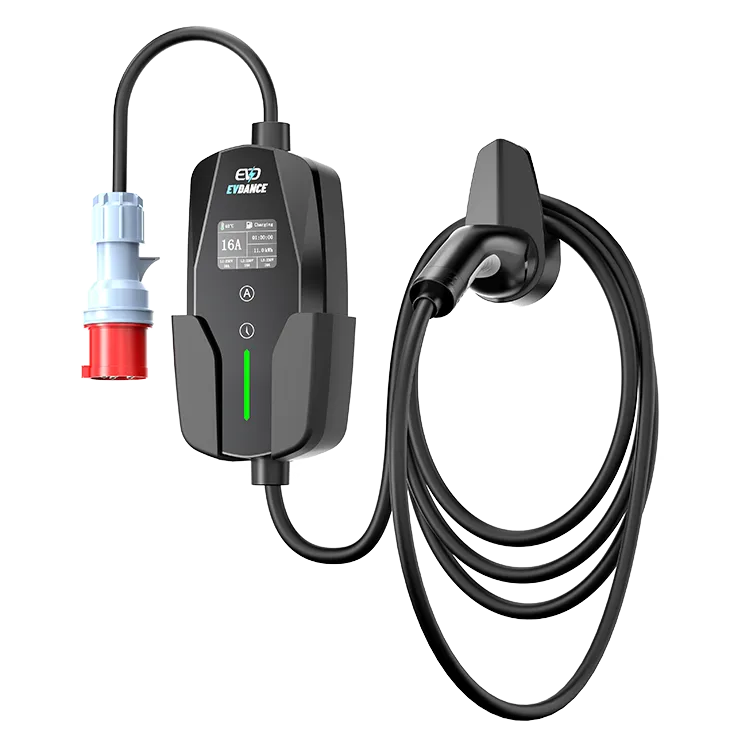
The ACS1605PE is an 11 kW three-phase portable charger: 16 A at 230/400 V through a CEE five-pin plug, a Type 2 connector, a 7.6 m cable and a 1.77-inch display. It suits a home that has — or has an electrician fit — the matching three-phase CEE outlet; our guide to CEE plugs for three-phase portable chargers covers the socket classes. Where the home’s class is the 32 A one, the sibling EV-ACS3205PE is the 22 kW version. EVDANCE, a Shenzhen manufacturer founded in 2011, gives the model its 3-year standard warranty.
Frequently Asked Questions
Can the ACS1605PE stay outside on its hook all year?
Yes — the housing is rated for the weather. Year-round life is a handling pattern: stored raised, connector capped, jacket and housing checked regularly. Damage, not rain, is what ends the rating.
Can I charge in heavy rain?
Yes — rain is inside the rating, and seated in the car the connection is made for wet use. The other half of the connection is the wall socket: if it is worn or its cover is broken, that is an electrician’s job before the next session.
Does IP66 mean the charger is waterproof if the drive floods?
No. IP66 grades jets of water, not immersion; sitting in floodwater is a different, higher grade of sealing. Keep it raised and out of standing water; if it has been submerged, treat it as damaged — do not use it, and ask EVDANCE.
Related Reading
- IP Ratings for EV Chargers: IP54, IP65 and IP66 Compared
- Are Portable EV Chargers Waterproof? IP Ratings Explained for Drivers
- CEE Plugs Explained: Choosing 16A or 32A for a Three-Phase Portable EV Charger

