
In a German or Dutch home that already has a red 16A CEE socket — in the garage, a utility room or a workshop corner — the ACS1605PE is the charger that fits it natively: 11 kW three-phase, 16 A per phase, Type 2 to the car, no wallbox to mount and no fixed wiring to book. The checks that matter: the socket’s condition, the circuit behind it, and the questions only a local installer can answer.
Key Takeaways
- A red 16A CEE socket in a German or Dutch home is this charger’s native ground — plug in, no installation.
- The plug must match the socket class natively; blue single-phase sockets belong to a different charger.
- Socket condition and circuit fitness for hours of continuous load are a local electrician’s check.
- Any notification or registration question is local — ask a local installer; this article states no country’s rules.
Where a Socket Like This Comes From
This article starts from a socket that already exists. In homes across Germany and the Netherlands, a red five-pin CEE socket is often a leftover of an earlier job: fitted for workshop machinery, a saw or a compressor, or wired in during a renovation. If your home has one near where the car parks, you already own the expensive half of an 11 kW setup. If it does not, the socket and its circuit are fixed electrical work for a local electrician — this charger needs nothing else once the socket is there.
The Fit, Exactly
| Point | What matches what |
|---|---|
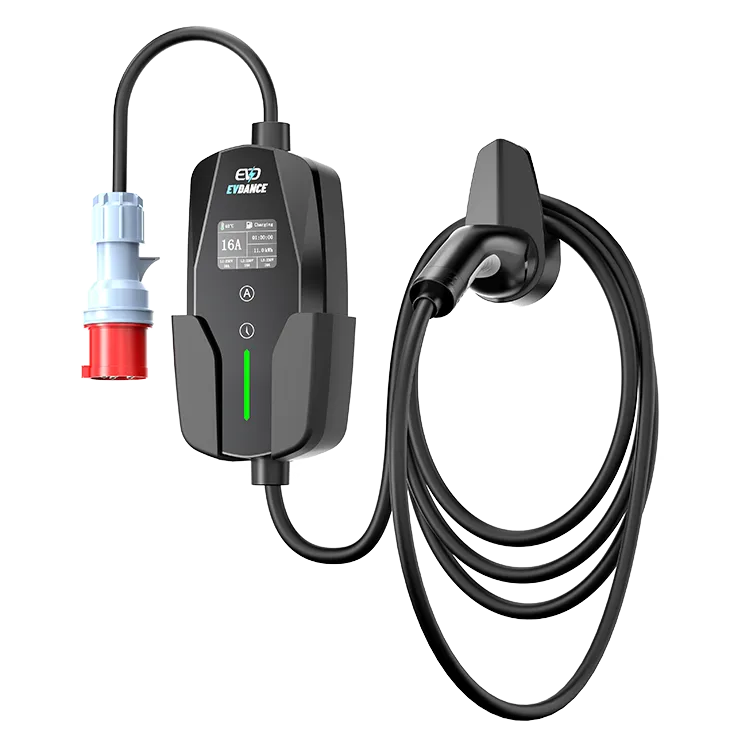
| Plug and socket | The unit’s CEE five-pin plug is the 16A class; the wall socket must be the same class — it fits its own class natively, and adapters are no route around that |
| Supply | Three-phase 230/400 V per the listing; 16 A per phase gives 11 kW |
| To the car | Type 2 connector |
| Cable | 7.6 m — the car must park within that reach of the socket |
| Sealing | IP66, for garages and outbuildings that are not fully dry |
Our CEE plug guide works through identifying the classes by sight; our single-phase vs three-phase explainer covers where 11 kW comes from.
Before the First Session
- Read the socket, not just the room. Confirm the marked rating is 16A and the plug seats fully and firmly. A loose or heat-marked socket is a stop sign.
- Respect the duty difference. A socket that ran a machine in bursts is now asked to carry 16 A per phase for hours. Whether socket and circuit are fit for continuous charging is a local electrician’s judgement — ask for it explicitly.
- Ask the local questions locally. Whether using the socket this way needs notifying or registering where you live is not stated here: rules are local — a local installer answers them.
- Check the car’s side too. The full 11 kW arrives only in a car with an 11 kW three-phase onboard charger; other cars take less.

The Same Socket, Beyond Your Own Garage
Because the charger is portable, the home socket is only its first address. The same 16A five-pin class appears in workshops, farm buildings and some campsites in the region, and the unit works at any of them — a different proposition from a wallbox serving one wall. For the wider family, see the range of portable EV charger types. At home: plug in, charge overnight — roughly 40 kWh in four hours after losses (labelled arithmetic) — and coil the cable when the car leaves.
The ACS1605PE in Short
The ACS1605PE is an 11 kW three-phase portable charger: 16 A per phase at 230/400 V, CEE five-pin plug, Type 2 to the car, a 1.77-inch display, IP66 sealing and a 7.6 m cable. The listing names no app and no access control for this model — at home the session is started and stopped at the car. EVDANCE sells it with the 3-year standard warranty.
Frequently Asked Questions
My socket is blue, not red. Is that a problem?
Yes — colours mark different classes. A blue CEE socket is single-phase class; this unit needs the red five-pin three-phase socket. For a blue socket, the match is the EV-ACS3210E.
Do I need permission or registration to charge from an existing socket?
That is a local question, and this article deliberately does not answer it: duties differ by place, and a local installer confirms the position for your home. Ask before the first session.
The socket is in a shed, not the garage. Can I run the cable out?
Only within the 7.6 m cable’s reach, with the car parked beside the building. Do not extend the run with adapter chains or extension leads — a second socket nearer the car is an electrician’s job.
Related Reading
- CEE Plugs Explained: Choosing 16A or 32A for a Three-Phase Portable EV Charger
- Single-Phase vs Three-Phase EV Charging: 7 kW, 11 kW and 22 kW Explained
- Portable EV Charger Types Explained: 10 A, 16 A, 32 A and Three-Phase Models
- Should an EV Charger Be Inside or Outside the Garage?

