
At a sustained 11 kW with about 10% allowed for charging losses, roughly 10 kWh reaches the battery per hour — and that single figure sizes every common battery. A 40 kWh-class battery refills from near empty in about four hours; a 60 kWh-class battery in about six; even an 80 kWh-class battery fits inside an eight-hour overnight window. That is the shape of 11 kW charging with a portable like the ACS1605PE: not a daytime sprint, but a rate at which the car is simply full by morning.
Key Takeaways
- At 11 kW with losses counted, about 10 kWh reaches the battery per hour.
- That refills a 40 kWh-class battery in about 4 hours, a 60 kWh class in about 6, and an 80 kWh class in about 8 — an overnight window.
- Every figure assumes the car accepts 11 kW; a 7.4 kW car stretches times by about half.
- Times near a full battery are approximate: charging tapers at the top of the pack.
The Figures, by Battery Size
The table uses battery-size classes rather than named cars, because pack size is what the arithmetic needs. Times assume the car accepts the full 11 kW and start from a low charge; the 20–80% column is the window most drivers actually use, and the full-refill column includes the slower final stretch near full, so treat it as approximate.
| Battery size class | 20% to 80% | Near empty to full |
|---|---|---|
| About 40 kWh | About 2.5 hours (24 kWh) | About 4 hours |
| About 60 kWh | About 3.5–4 hours (36 kWh) | About 6 hours |
| About 80 kWh | About 5 hours (48 kWh) | About 8 hours |
Our comparison of charging time at 7 kW, 11 kW and 22 kW works the same arithmetic for a single-phase session and for the 22 kW rate. The 11 kW column is the one that belongs to this charger — and to any car whose onboard charger is rated 11 kW, which is a large share of the cars on the road.
Why the Overnight Frame Decides It
A parked overnight window is usually eight hours or more. Read against the table, that window covers the largest battery class from near empty, the middle class with hours to spare, and a typical day’s driving — a fraction of most packs — in one to two hours. This is why 11 kW is the natural overnight rate: the question stops being “is it fast enough?” and becomes “is there a three-phase socket where the car sleeps?” Where the answer is a 16 A CEE socket, a portable covers the whole table with nothing fixed to the wall. Where the dwell is short — an hour between jobs, a depot turnaround — the same table shows the limit, and that is the case the 22 kW class exists for.
The Two Conditions Behind Every Figure
- The car must accept 11 kW. A car capped at 7.4 kW stores roughly 6–7 kWh per hour after losses, so stretch every time in the table by about half. A single-phase-only car draws on one phase at roughly 3.7 kW from a 16 A supply, and times stretch again — check your car’s AC rating first.
- The ends of the battery are slower. Charging tapers as the pack approaches full, which is why the full-refill column says “about”. Sessions inside 20–80% behave closest to the arithmetic.
The Charger in This Frame
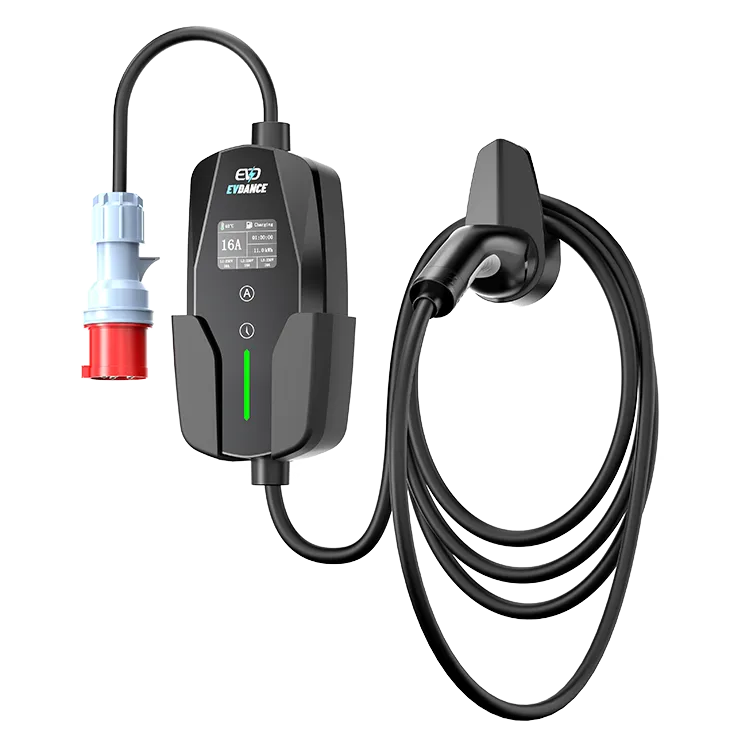
The ACS1605PE is EVDANCE’s 11 kW three-phase portable: 16 A per phase through a CEE five-pin plug, Type 2 to the car, a 7.6 m cable, a 1.77-inch display and an IP66 rating. Its times are the table above wherever a 16 A CEE socket exists — and because nothing is installed, the same unit covers a different socket next week. The single-phase vs three-phase explainer shows where the 11 kW rate comes from.

Frequently Asked Questions
My car only accepts 7.4 kW. What are my times?
Stretch the table by about half: roughly 6–7 kWh reaches the battery per hour, so a 60 kWh-class battery needs around nine hours from near empty, or about five and a half hours for 20–80%. Overnight still works; the charger is simply waiting on the car.
Is 11 kW fast enough for a large battery?
Overnight, yes — an 80 kWh-class battery refills in about eight hours. For short daytime windows it is the wrong tool: an hour adds about 10 kWh, and a car that accepts 22 kW on a 32 A supply doubles that.
Why does the last part of the battery take longer?
Every car reduces the rate it accepts as the battery nears full, to protect the pack. The effect is small inside 20–80% and largest in the final stretch, which is why full-refill times are estimates, not promises.
Related Reading
- How Long Does It Take to Charge an EV at 7 kW, 11 kW and 22 kW?
- Single-Phase vs Three-Phase EV Charging: 7kW, 11kW and 22kW Explained
- Portable EV Charger Types Explained: 10A, 16A, 32A and Three-Phase Models

