
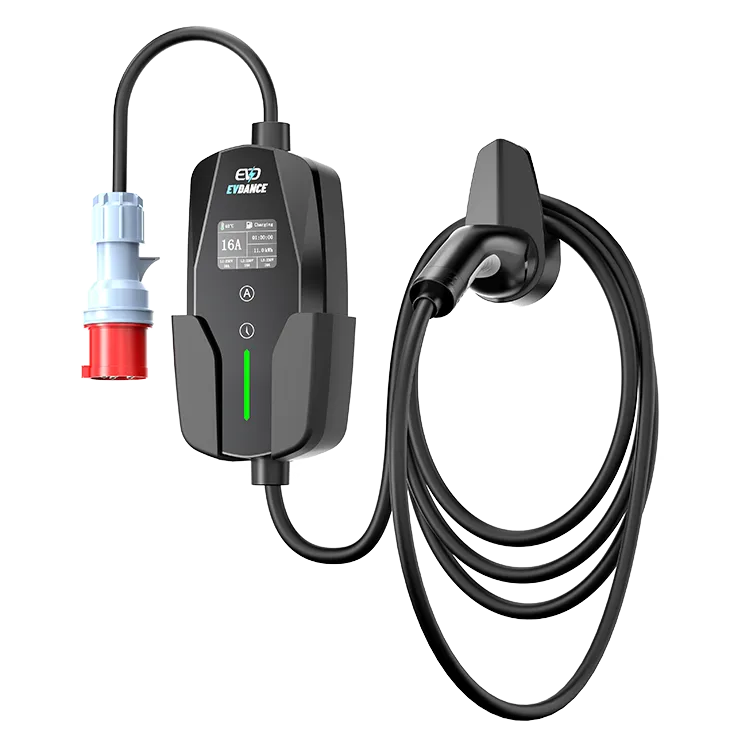
If your garage already has a three-phase supply with a red 16A CEE socket, the ACS1605PE plugs straight into it and charges at up to 11 kW — no wallbox to mount, no fixed installation to book. It is an 11 kW three-phase portable charger, drawing 16 A per phase with a Type 2 connector to the car, so the socket you already have is effectively the whole installation. What decides the fit: the socket’s condition, and whether your car takes 11 kW of three-phase AC.
Key Takeaways
- A garage with a red 16A CEE socket on a three-phase supply is this charger’s home ground — plug in, no installation.
- At 11 kW, roughly 20 kWh lands in two hours; most garage cars finish long before morning.
- Socket condition and circuit fitness for continuous load are an electrician’s check, not an assumption.
- The car must accept 11 kW of three-phase AC for the full rate to arrive.
The Garage This Charger Is Built For
This piece is written for one situation: a home garage where three-phase power is already present — usually a socket fitted for something else first, such as workshop machinery or an outbuilding supply. If that is your garage, the checks before the first session are short:
- Match the socket. The unit’s plug is a CEE five-pin in the 16A class; the socket must be the same class — the plug fits its own class natively and no other.
- Look at its condition. Cracks, looseness or heat marks on a socket that has worked for years are stop signs, not details.
- Confirm the circuit. Charging draws 16 A per phase continuously for hours. Whether an older socket and its circuit are fit for that duty is a licensed electrician’s call.
If your garage has no such socket, having one fitted is fixed electrical work — an electrician’s job. Our guide to CEE plugs for three-phase portable chargers covers identifying the socket classes.
What 11 kW Does Overnight
The figures below are labelled arithmetic: 11 kW sustained, roughly 10% allowed for losses, and a car that accepts the full rate.
| Session length | Energy stored (approx.) | What that covers |
|---|---|---|
| 2 hours | ~20 kWh | A typical day’s driving for many households |
| 4 hours | ~40 kWh | Half to two-thirds of a mid-size battery |
| 8 hours | ~79 kWh | More than most batteries hold from empty |
The car’s onboard charger sets the real pace: a car that accepts less than 11 kW, or only single-phase AC, charges at its own ceiling here. Our explainer on single-phase vs three-phase EV charging shows where the figure comes from.

Working-Garage Habits
A workshop garage is a harder room than a parking bay; the listing rates the unit IP66, sealed against dust and powerful water jets. The habits that matter are about the cable:
- Route the cable along the wall, not across the drive-over path or walkway. The listing claims no drive-over rating, so keep it out from under tyres.
- Use the reach you have. The 7.6 m cable covers a car parked nose-in or reversed in most home garages — measure your layout before assuming.
- Store it coiled between sessions, connector off the floor, so the garage stays usable.
- Remember it is portable. The same unit serves any matching 16A five-pin socket — a barn, a second workshop — the advantage a wallbox cannot copy.
The ACS1605PE in Short
The ACS1605PE is an 11 kW three-phase portable charger: 16 A per phase at 230/400 V, CEE five-pin plug, Type 2 to the car, a 1.77-inch display, IP66 sealing and a 7.6 m cable. The listing names no app and no access control — a session is started and stopped at the car and the unit. For a home garage that is usually the point: nothing to configure. EVDANCE sells it with the 3-year standard warranty.
Frequently Asked Questions
My garage socket is the 32A class, not 16A. Can I use an adapter?
No. The plug must match the socket class natively — that match keeps the current within what the socket was built for. A 32A socket is the ground of the 22 kW EV-ACS3205PE instead; fitting a 16A socket alongside is an electrician’s job.
The socket already exists. Do I still need an electrician?
A check is still wise. A socket sound for a machine that runs in bursts deserves a look before it carries 16 A per phase for six hours straight — fitness for continuous charging is the electrician’s call.
Can I leave the charger plugged into the garage socket all week?
It is built to live on that socket — but coil the cable and keep the connector off the floor between sessions.
Related Reading
- Should an EV Charger Be Inside or Outside the Garage?
- CEE Plugs Explained: Choosing 16A or 32A for a Three-Phase Portable EV Charger
- Single-Phase vs Three-Phase EV Charging: 7 kW, 11 kW and 22 kW Explained
- How Long Does It Take to Charge an EV at 7 kW, 11 kW and 22 kW?

