
Useful, yes — but rarely at 11 kW. A plug-in hybrid takes only what its onboard charger accepts; where the car charges on a single phase, it draws one phase’s share from this three-phase unit — about 3.7 kW at 16 A, by arithmetic — not the 11 kW headline. That still fills a small hybrid pack comfortably overnight. The ACS1605PE‘s real case in a PHEV household is the three-phase CEE socket already on the wall, and a future full EV.
Key Takeaways
- A plug-in hybrid takes what its onboard charger accepts — from this unit, often one phase’s share, about 3.7 kW.
- That pace still fills a small hybrid pack in a few hours.
- The unit’s case is the existing three-phase socket and a future full EV, not the hybrid’s session rate.
- Check whether your car charges on one phase or three before paying for any three-phase headline.
The Per-Phase Reality
The 11 kW figure is a three-phase total: three phases at 16 A and about 230 V each. A car can only use the phases its onboard charger is built for. Many plug-in hybrids charge on a single phase, and a single-phase car on a three-phase charger draws on one phase — at this unit’s 16 A per phase, about 3.7 kW. A hybrid whose onboard charger accepts three-phase power can take more, up to its own limit. Either way, the car sets the pace; the charger’s extra headroom is simply never used. Harmless — but worth knowing before you pay for the headline number.
| What the car accepts | What it draws from this unit | What that means |
|---|---|---|
| 11 kW three-phase | Up to 11 kW | The full rating — the case this unit is built for |
| About 7.4 kW, single-phase | One phase at 16 A — about 3.7 kW | Slower than the car’s best |
| About 3.7 kW or less, single-phase | Its own full pace | Nothing lost — the car was never going to take more |
All figures are labelled arithmetic at about 230 V per phase. Your car’s acceptance — and whether it charges on one phase or three — is in its specification; that document, not the charger’s headline, decides your session.
What That Means for a Small Pack
A plug-in hybrid’s battery is a fraction of a full EV’s, and it earns its keep by being refilled constantly. Take a usable pack of 12 kWh, chosen for the arithmetic: at about 3.7 kW, allowing roughly 10% for losses, it fills in about three and a half to four hours — well inside any overnight window. So for the hybrid itself, the question is almost never speed. Whether a PHEV household needs a charger of its own at all is answered in our guide to whether you need an EV charger for a plug-in hybrid.

When This Unit Is the Right PHEV Buy Anyway
- The socket already exists. If a 16 A three-phase CEE socket is already where you park, this unit works from day one with no installation spend — the fit is native.
- The household’s horizon includes a full EV. A three-phase-accepting EV can use the whole 11 kW the hybrid leaves untouched. Buying for that horizon is your judgement, not a promise — but both are in place if it comes.
- Two cars, one socket. The hybrid takes its share in the evening; the EV takes the full rate overnight.
When it is not the right buy: with no three-phase socket and no plan for one, a single-phase portable such as the EV-ACS3210E — about 7 kW, single-phase — can give a single-phase hybrid its full pace for less fuss.
The Charger in Brief
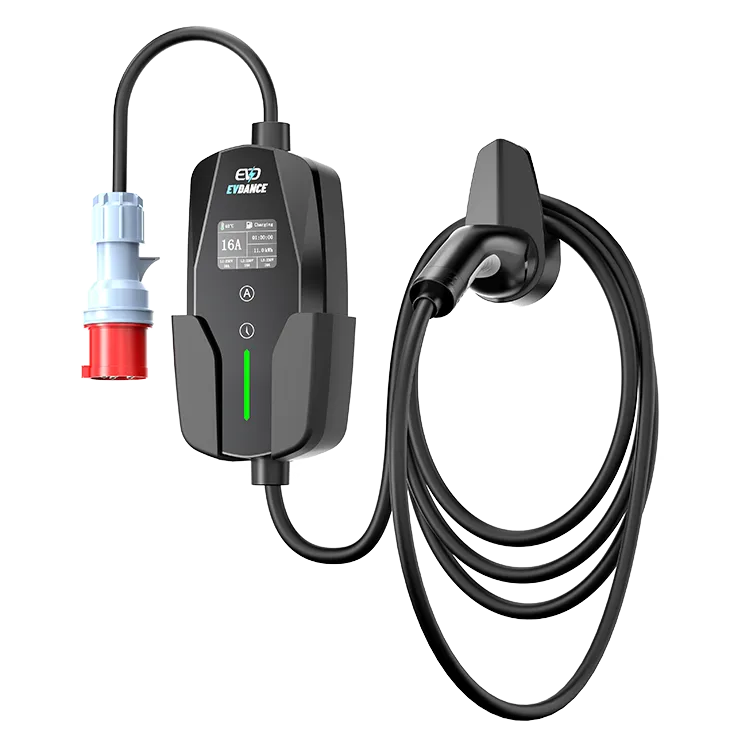
The ACS1605PE is an 11 kW three-phase portable charger: 16 A at 230/400 V, CEE five-pin plug, Type 2 connector, 7.6 m cable, 1.77-inch display, IP66 rating — covered by EVDANCE’s 3-year standard warranty.
Frequently Asked Questions
Will an 11 kW charger charge my plug-in hybrid too fast, or harm its battery?
No. The car controls the session and takes only what its onboard charger accepts; unused headroom is never forced into the car.
My hybrid accepts 7.4 kW. Will it get 7.4 kW from this unit?
Not if that acceptance is single-phase: 7.4 kW single-phase implies about 32 A on one phase; this unit offers 16 A per phase, so the same car draws about 3.7 kW. Check how your car accepts power before you buy.
Should I buy this for the hybrid, or wait for a full EV?
If the socket is already there, the unit serves the hybrid tonight at the car’s pace and is ready for a three-phase EV later. With no socket and no EV on your horizon, a single-phase portable is the simpler buy.
Related Reading
- Do I Need an EV Charger for a Plug-In Hybrid?
- How Long Does It Take to Charge an EV at 7 kW, 11 kW and 22 kW?
- Single-Phase vs Three-Phase EV Charging: 7kW, 11kW and 22kW Explained
- CEE Plugs Explained: Choosing 16A or 32A for a Three-Phase Portable EV Charger

