
If your premises already run three-phase machinery, check the wall before budgeting an installation. Where a 16 A CEE socket already exists, the ACS1605PE turns it into 11 kW staff charging with no installation project at all — plug in, and cars charge at up to 11 kW where the car accepts it. What this portable does not bring is just as definite: its listing names no app, no user accounts and no access control, so records and access are handled the low-tech way, or by stepping up a class.
Key Takeaways
- Where a 16 A CEE socket already exists, this portable adds 11 kW staff charging with no installation project.
- The socket must match natively and be confirmed by an electrician for hours of continuous load — no adapter stacking.
- Records are a written log and an internal estimate; the listing states no app, accounts or billing metering.
- Access is open to whoever holds the cable — card-controlled charging is the EV-ACT3204E / EV-AC03201T step up.
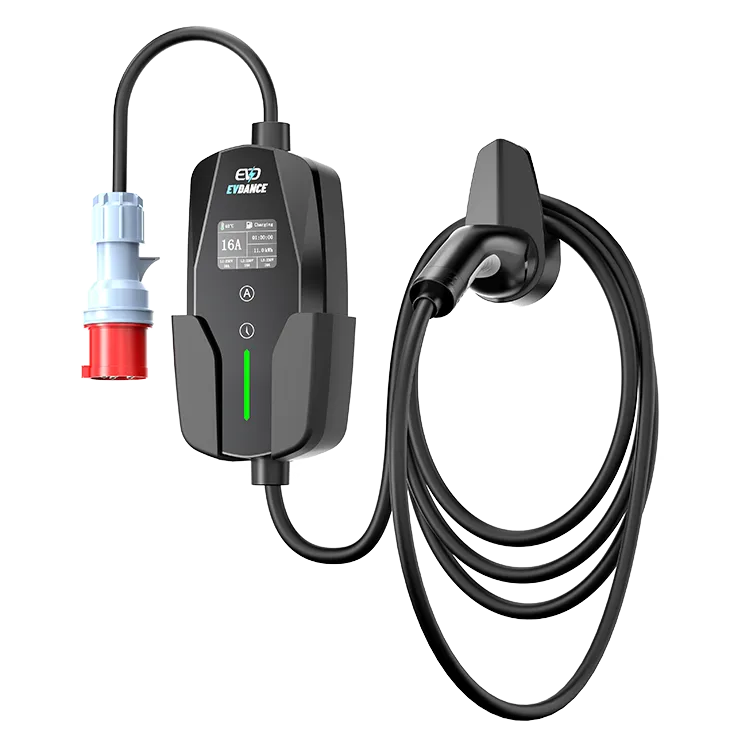
First, the Socket Has to Match
The fit is native or not at all: this unit’s plug is a 16 A CEE five-pin, so the socket it uses is a 16 A CEE five-pin outlet on a three-phase supply — the class covered in our guide to CEE plugs for three-phase portable chargers. Sockets fitted for machinery are the usual source on small-business premises, but verify the rating and pin count on the socket itself rather than assuming. Two checks before the first staff car plugs in:
- Have an electrician confirm the socket and its circuit suit an EV load that runs for hours at full current — a continuous load is a different duty from most machinery cycles.
- No adapter stacking. If the wall offers a different socket class, the answer is a correctly fitted socket or a different charger, not a chain of adapters.
One Portable in the Working Day
Staff cars dwell all day, and dwell is what makes one portable enough. At the full rate the unit adds roughly 10 kWh per hour after losses — labelled arithmetic on its 11 kW rating — so a typical daily top-up is finished in two to three hours, and the unit rotates to the next car. The 7.6 m cable works in the unit’s favour here: it reaches the car as parked, instead of the car queueing for one exact bay. Because nothing is fixed, the same unit can also cover a second site or a yard socket.

Records and Access, Stated Plainly
Plan the admin around what the listing actually states. It names a 1.77-inch display; it does not state an app, session logging or per-user accounts, and which session figures the display presents is a question for the manual — do not build a billing process on an unconfirmed readout. In practice, a small business runs it like this:
| Job | How it works with this unit |
|---|---|
| Records | A written log — date, driver, hours — priced at your own tariff: an internal estimate, never billing-grade metering |
| Access | Open: whoever holds the cable can charge. Acceptable on a small attended site — as a decision, not a discovery |
| Controlled or billed charging | A step up in class: the EV-ACT3204PE wallbox (RFID and app) or the EV-AC03201T station (OCPP 1.6J) |
The Unit for This Job
The ACS1605PE is an 11 kW three-phase portable: 16 A at 230/400 V, Type 2, CEE five-pin plug, 1.77-inch display, IP66, 7.6 m cable. For a small business whose wall already offers the matching socket, it is the shortest route from no charging to staff charging — and its limits, stated above, are the honest boundary of the offer. EVDANCE’s wider commercial charging range covers the fixed and networked steps beyond it.
Frequently Asked Questions
Can we bill staff per kWh from this unit?
Not on its stated features: the listing names no billing metering, app records or user accounts. Keep staff charging free, or allocate costs from a written log as an internal estimate — billing-grade accounting is the step-up class.
How many cars can one unit serve?
It depends on energy per car and dwell time. At roughly 10 kWh added per hour, a working day covers several typical top-ups in rotation; a fleet that returns empty and leaves early is a different calculation, done with your own numbers.
Does an existing machinery socket need checking first?
Yes. Have an electrician confirm the socket and circuit suit hours of continuous EV load before the first session. The plug fitting the socket is the start of the check, not the whole of it.
Related Reading
- What Is the Best EV Charger for a Small Business? How to Choose
- How to Plan a Workplace EV Charging Program
- CEE Plugs Explained: Choosing 16A or 32A for a Three-Phase Portable EV Charger
- Portable EV Charger Types Explained: 10A, 16A, 32A and Three-Phase Models

