
The ACS1605PE is a portable charger that draws 11 kW of three-phase power from a 16 A CEE socket and delivers it to a car through a Type 2 connector — no wallbox, no fixed installation, just a charger that travels to the socket. It does one job: turn an industrial three-phase socket into proper AC charging at up to 11 kW, at a gentler 16 A per phase than the 22 kW class draws. Everything else about it follows from that sentence, including what it does not do.
Key Takeaways
- The ACS1605PE turns a 16 A three-phase CEE socket into up to 11 kW of Type 2 charging, with no fixed installation.
- The car sets the session rate: 11 kW only for cars that accept 11 kW three-phase.
- Its listing claims a display, a 7.6 m cable and IP66 — and no app, RFID or platform features.
- It fits where cars cap at 11 kW and the 16 A socket class is already on the wall.
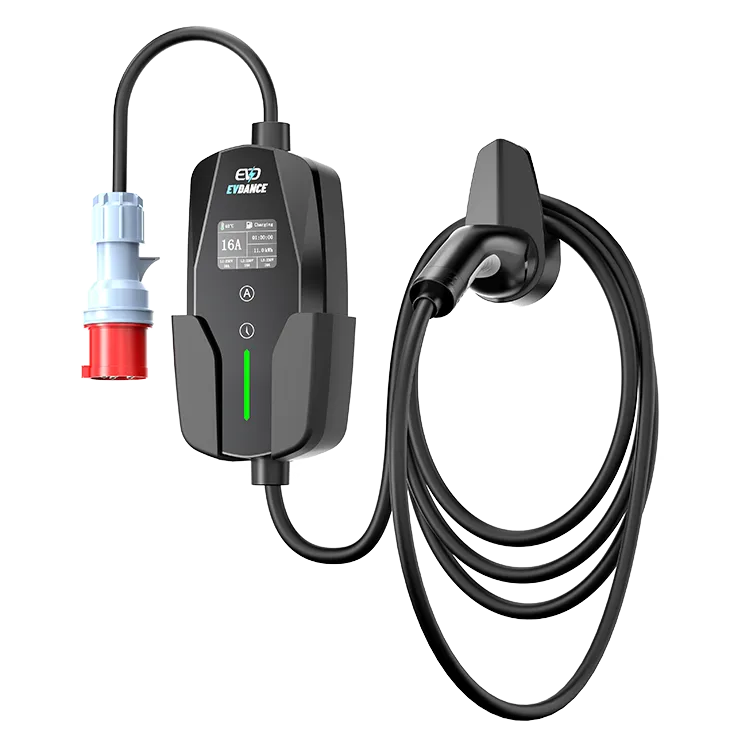
What It Is, Part by Part
| Part | What the listing states |
|---|---|
| Supply side | Three-phase, 230/400 V, drawn at 16 A per phase through a CEE five-pin plug |
| Charging power | 11 kW — the product of the three phases at that current |
| Car side | Type 2 connector, on a 7.6 m cable |
| On the unit | A 1.77-inch display; an IP66 rating for outdoor use |
The fixed part of this setup is the socket, not the charger. Where a 16 A five-pin CEE socket exists — a workshop, a barn, a depot, a three-phase home — the charger plugs in and works. When the job moves, the charger moves with it. Our explainer on single-phase vs three-phase charging covers why three phases are what lift a portable past the roughly 7 kW single-phase ceiling.
What Happens in a Session
The charger offers up to 11 kW; the car decides what it takes. A car whose onboard charger accepts 11 kW three-phase charges at the full rate — about 10 kWh stored per hour once losses are counted. A car capped at 7.4 kW charges at 7.4 kW. A car that accepts only single-phase power draws on one phase of the supply, which at 16 A is roughly 3.7 kW by simple arithmetic. With AC charging the conversion happens inside the car, so the car’s rating is always the ceiling — and the rate tapers as the battery approaches full.
Where 11 kW Sits
| Portable class | Supply it needs | Ceiling |
|---|---|---|
| Single-phase portable, e.g. the EV-ACS3210E | One phase, up to 32 A | About 7 kW |
| ACS1605PE | Three phases at 16 A per phase, CEE five-pin | 11 kW |
| Three-phase 22 kW portable, e.g. the EV-ACS3205PE | Three phases at 32 A per phase, CEE five-pin | 22 kW |
The middle row is the point of the model. Many cars accept exactly 11 kW of AC power, and many buildings already have the 16 A class of socket. For that combination this charger gives up nothing to a bigger unit: the session runs at the car’s full rate. The wider family is mapped in our guide to portable EV charger types.
What It Does Not Do
- It does not run from a household socket. It needs a three-phase supply and the matching CEE socket. No adapter changes the supply behind a domestic outlet.
- Its listing states no app, RFID or network platform. Access control, scheduling apps and managed billing belong to other classes — the wallbox and station ranges — not to this one. If you need them, confirm the right model with EVDANCE before ordering.
- It is not a fixed installation. Nothing stays on the wall, which is the advantage — and the limit: the socket has to exist, or an electrician has to fit one.

Frequently Asked Questions
Will any EV charge at 11 kW on it?
Only a car whose onboard charger accepts 11 kW three-phase. Cars with a lower AC rating charge at their own ceiling, and single-phase cars draw on one phase at roughly 3.7 kW. The car’s specification, not the charger, sets the rate.
Does it have an app or RFID cards?
Its listing states neither. What it states is the unit itself: 11 kW charging, a display, a 7.6 m cable and an IP66 rating. Buyers who need app control or card access should look at the wallbox class.
Why not just buy the 22 kW portable?
If your cars accept 22 kW and your sites have 32 A sockets, the bigger unit is the faster one. Where cars cap at 11 kW, or the sockets are the 16 A class, the extra capacity buys nothing — the session runs at the same 11 kW.
Related Reading
- Portable EV Charger Types Explained: 10A, 16A, 32A and Three-Phase Models
- Single-Phase vs Three-Phase EV Charging: 7kW, 11kW and 22kW Explained
- CEE Plugs Explained: Choosing 16A or 32A for a Three-Phase Portable EV Charger
- How Long Does It Take to Charge an EV at 7 kW, 11 kW and 22 kW?

