
Uncoil the cable before you charge. A cable laid out in wide, loose loops is fine, but a cable left in a tight coil traps heat in its middle turns during a session that runs for hours. The cable is rated to carry its current in free air, and a tight coil takes that free air away.
Key Takeaways
- Charge with the cable uncoiled and laid out; a tight coil traps heat in its centre turns.
- Coiling for storage is fine — the problem is only charging while the cable is bundled, wound or covered.
- Feel the middle of any looped section early in a session; a hot spot means stop and lay the cable out.
- If spare cable stays bundled because of reach, solve the reach with a longer factory lead instead.
Why a Coil Heats From the Inside Out
Any cable carrying current warms up along its length. Stretched out, that warmth escapes into the air. Wound into a coil, each turn sits against its neighbours, and the centre turns are wrapped in warm cable instead of air. The middle is where heat builds — and the part you cannot see or feel without unwinding it.
EV charging makes this worse than most household loads because it does not stop. Charging is a continuous load: the current flows at the same level for hours, so a cable arrangement that only gets slightly warm in ten minutes can keep climbing over a long session. The cable is not faulty; it is being asked to shed heat through a bundle instead of into open air.
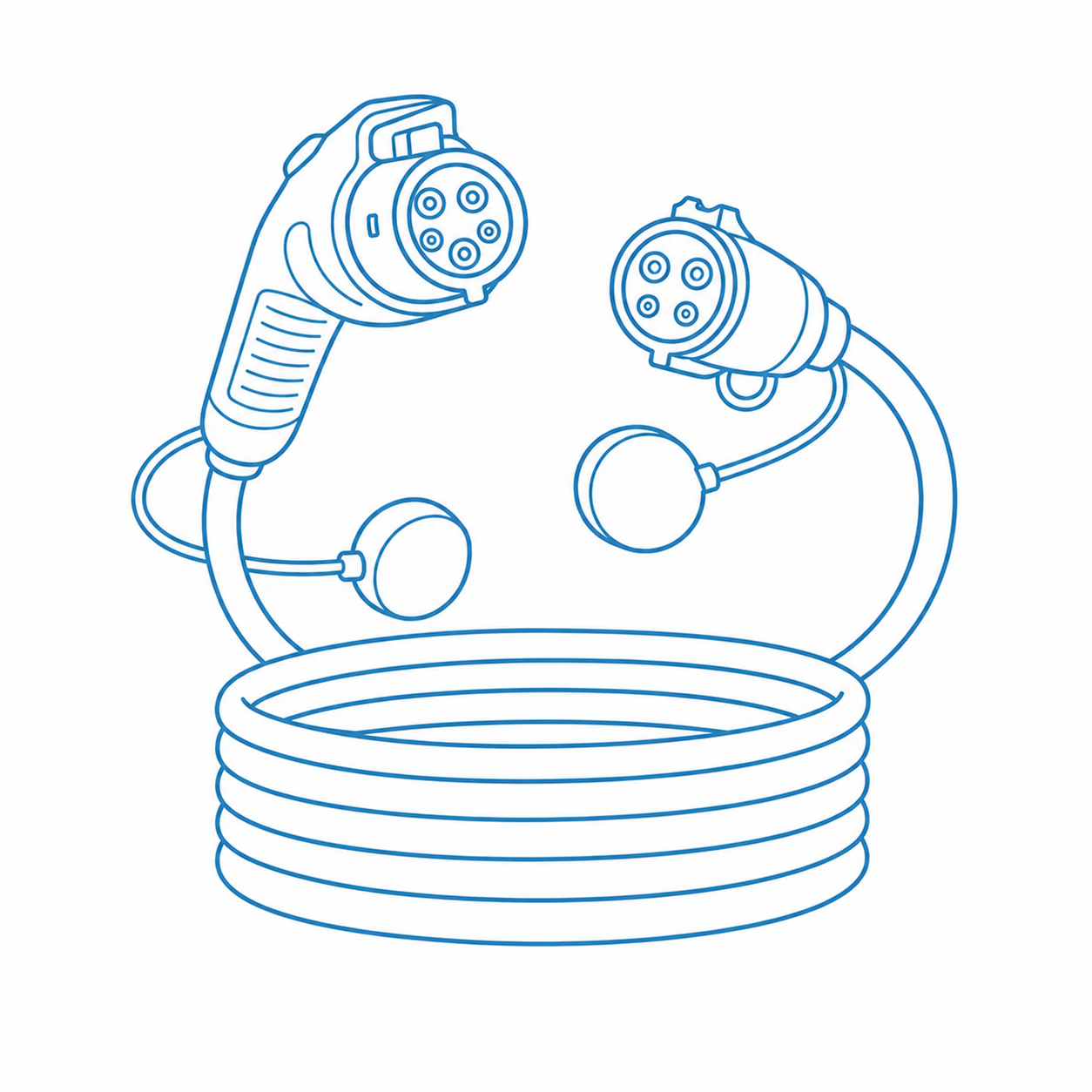
Tight Coil, Loose Loops and Storage Are Three Different Things
Coiling itself is not the problem — charging while the cable is tightly bundled is. How the cable sits decides whether heat can escape:
| How the cable sits | Charging on it? | Why |
|---|---|---|
| Coiled neatly on a hook or holster, car unplugged | Storage only | No current flows, so no heat builds. The right way to store a cable between sessions. |
| Laid out in wide, loose loops on the ground | Yes | Air reaches most of its surface, so warmth escapes as the rating assumes. |
| Still wound on a wall hook, reel or drum while plugged in | No | The centre turns are insulated by the outer turns for the whole session. |
| Bunched in a heap, or covered by a mat, box or car cover | No | Anything that wraps or covers the cable blocks the airflow it needs, coil or not. |
Storing coiled and charging coiled are easy to confuse, because the same hook serves both. Our guide to hiding and managing a charger cable covers the storage side; the rule for a live session is simply that the cable comes off the hook and gets laid out first.
What to Do Instead
- Uncoil fully before you plug in, so the whole length lies on the ground or hangs in open loops, with no tight bundle near the charger.
- Keep loops wide: a few large, lazy loops are fine; small, tight circles stacked up are the pattern to avoid.
- Check the middle early: a few minutes in, feel the centre of any looped section and both connectors. Slight warmth is normal; a clearly hot spot means stop and lay the cable out properly.
- Fix the reach problem instead of bundling the spare. If the cable stays coiled because only part of it reaches the car, the real fix is length in the right place: our cable length guide compares 5 m, 7.5 m and longer leads, and our piece on whether you can extend a charging cable covers the other route.
A longer factory lead removes the temptation to charge off a coil. The EV-ACS4005T 40 A NACS portable charger comes with a 25 or 28 ft cable, and the EV-AC04001U 40 A J1772 portable charger with a 25 ft cable — enough at most homes to reach the car with the rest laid out in open loops.

Frequently Asked Questions
Is it OK to charge with a few loose loops lying on the driveway?
Yes. Wide loops resting on the ground shed heat normally. The problem is a tight bundle — wound on a hook or reel, or piled in a heap — where the inner turns cannot cool.
Does a coiled cable charge more slowly?
No. Coiling is a heat problem, not a speed problem; it does not change the current drawn. The risk is that trapped heat ages the cable and, over repeated sessions, damages it.
My cable always feels slightly warm while charging. Is that a fault?
Mild warmth at full current is normal. A single hot spot — in the middle of a coiled section or at one connector — is the warning sign: stop the session, uncoil everything, and inspect the cable before using it again.
Related Reading
- EV Charger Cable Length Guide: 5 m, 7.5 m or Longer?
- Can You Extend an EV Charging Cable?
- How to Hide and Manage an EV Charger Cable
- Can You Leave an EV Charging Cable Outside?

