
A commando socket is the workshop name for the round industrial socket family (the CEE, or IEC 60309, family) found on building sites, farms, marinas and in workshops — blue for single-phase, red for three-phase, as our guide to CEE plugs explains. Most people asking the question already have one on a wall. For them the live question is not what it is, but whether the one they have is fit to charge a car from.
Key Takeaways
- A commando socket is the industrial CEE socket family: blue single-phase, red three-phase, built for sustained loads.
- Having one on the wall is not the same as it being fit — housing, grip, cleanliness, position and history all count.
- The circuit behind the socket matters as much as its face; unknown wiring is an electrician’s judgement call.
- Warmth, scorch marks or a loose fit end the discussion: the socket is replaced before it is used for charging.
Why These Sockets Suit EV Duty
Industrial sockets exist for equipment that runs hard and long, which is exactly the shape of EV charging: one load, at full draw, for hours. The plug and socket are a matched, keyed pair — the rating is printed on both, a plug only fits the socket of its own rating and phase count, and the connection is made to be seated firmly and stay that way. That is a different world from a household socket asked to do the same job, and it is why portable chargers built for serious power end in a commando plug rather than a domestic one.
The Fitness Check: Five Things Before the First Session
- Housing. Cracks, chips or a missing cover mean the socket has had a life. Weather reaches the contacts through all three.
- Grip. The plug should seat firmly and stay seated. A connection that rocks or sags is a connection that heats.
- Cleanliness. Scorch marks, discolouration or a burnt smell are a verdict, not a warning. Do not use the socket.
- Position. The socket should sit off the ground, with its cover able to close over the plug while it is in use.
- History. Fixed industrial wiring that has never been inspected is an unknown. A licensed electrician’s check is cheap next to the load you are about to put on it nightly.
What You Find Decides What Happens Next
| What you find | What it means |
|---|---|
| Clean, firm, covered, circuit known | Fit to use with a charger whose plug matches its rating |
| Sound socket, unknown circuit | The socket passes; the wiring behind it still needs an electrician’s judgement |
| Warmth at the plug after a session | Stop using it and have it checked — warmth under a steady load is how a worn socket announces itself |
| Cracked housing, scorch marks or a loose fit | Not fit. Replacement comes before any charging, not after an incident |
The middle row is the one most often missed. A commando socket’s presence is not its fitness certificate: the circuit behind it must also be sized and protected for a continuous load, and that is a property of the fixed wiring, which only inspection can confirm. The IET’s code of practice for charging equipment installation is the reference a UK electrician will work to; the same principle — judge the whole run, not just the socket face — applies anywhere.
EVDANCE Chargers Built for Commando Sockets
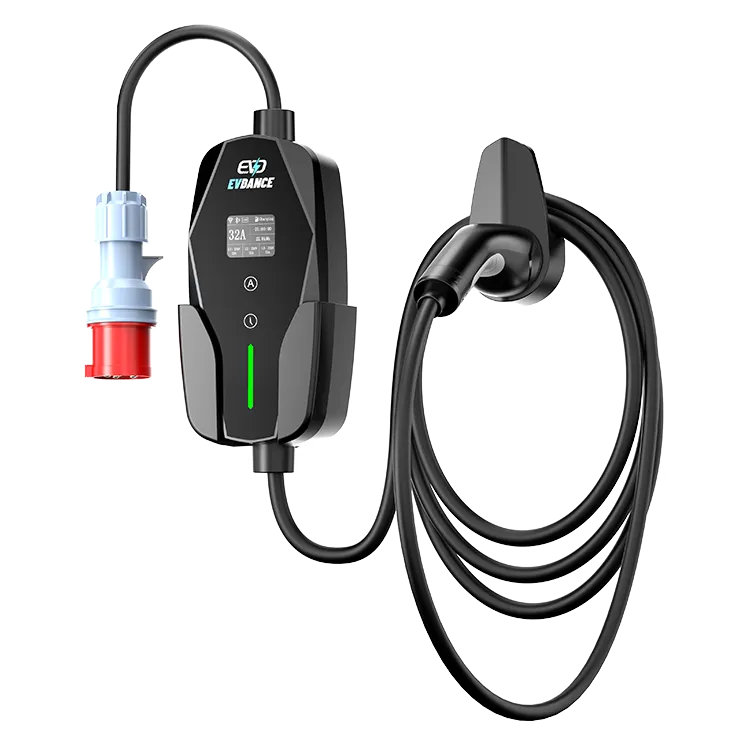
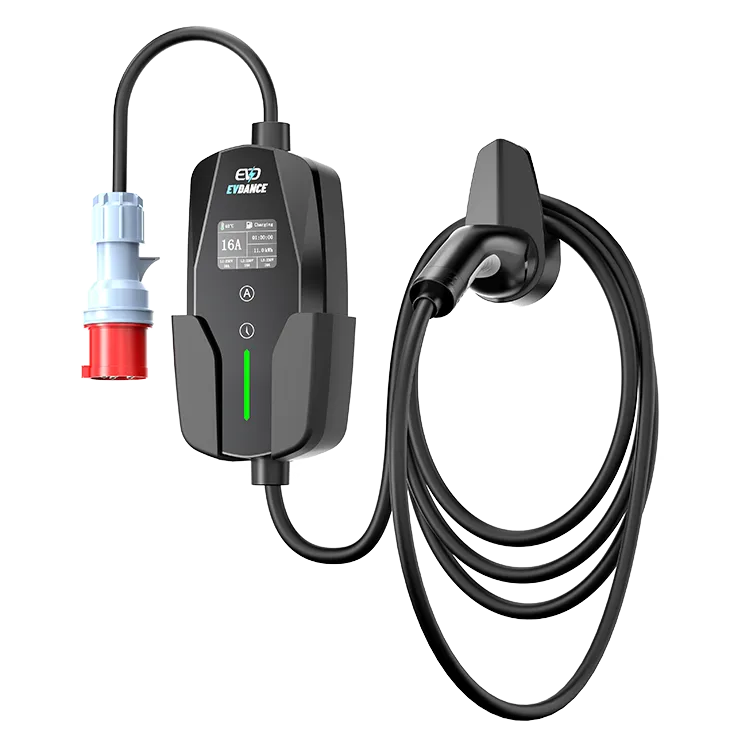
Two EVDANCE portables are made for these sockets. The EV-ACS3205PE is a 22 kW three-phase portable charger with a 32 A CEE plug, Type 2 car connector and IP66 rating. The ACS1605PE is its 11 kW three-phase counterpart on a 16 A CEE 5-pin plug, with a 7.6 m cable and the same IP66 rating. Both assume the socket at the wall has passed the check above — the charger brings its own rating, but the socket brings its own history. For the broader map of portable types, see portable EV charger types explained.
Frequently Asked Questions
Is a commando socket the same thing as a CEE socket?
Yes. Commando is the name used on sites and in workshops; CEE (IEC 60309) is the family name used in catalogues and standards. They describe the same round industrial plugs and sockets.
Can an electrician fit a commando socket at my home?
Where the supply supports it, an electrician can install industrial sockets for charging and judge the circuit in the same visit. The socket is the easy part; the circuit sizing and protection behind it are the professional’s call.
Does a commando socket make any charger faster?
No. The socket is a connection, not a power source. Speed is set by the supply, the circuit and the charger together, and the charger must match the socket’s rating and phase count to use it at all.
Related Reading
- CEE Plugs Explained: Choosing 16A or 32A for a Three-Phase Portable EV Charger
- Portable EV Charger Types Explained: 10A, 16A, 32A and Three-Phase Models
- Which EV Charging Cable Do I Need?
- Are Portable EV Chargers Worth It? Pros, Cons and Who Should Buy One

