
The socket you need is a 32 A, 5-pin CEE outlet on a three-phase supply — the wall socket that matches the EV-ACS3205PE‘s plug, commonly the red 32 A industrial socket. Three observable checks identify it: five pins, a marked rating of 32 A, and a three-phase supply behind it. If that socket is not already fitted, a licensed electrician fits one where the building’s supply allows. No adapter turns a household socket into this supply, and this article does not treat one as an option.
Key Takeaways
- The matching socket is a 32 A, 5-pin CEE outlet on a three-phase 380–400 V supply — identified by pins and printed rating, not colour.
- 16 A CEE sockets, blue single-phase commando sockets and household sockets all fail at least one of the three checks.
- Adapters never convert a household supply into a three-phase one; they are not an option for this charger.
- Where no matching socket exists, a licensed electrician fits one — that is the whole fixed installation behind this portable charger.
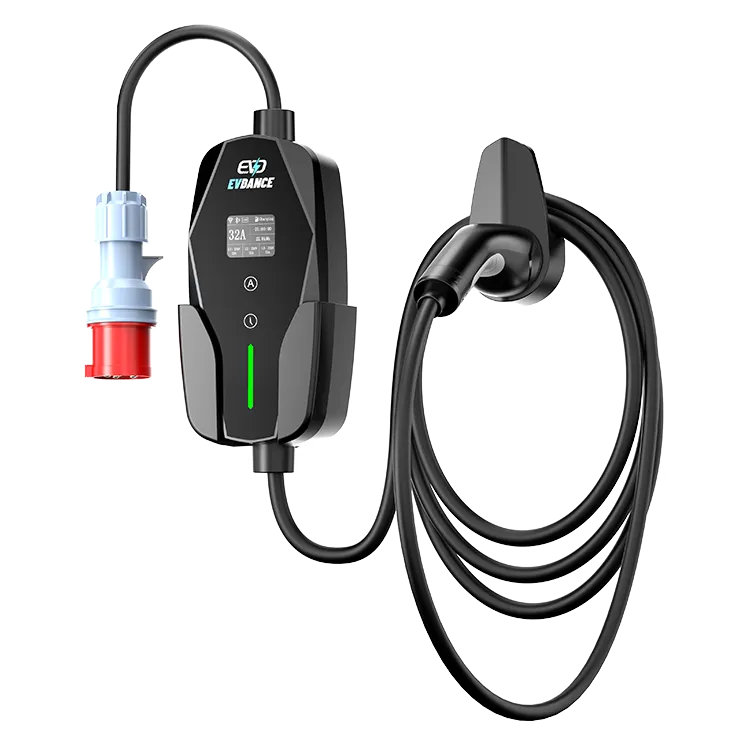
Identifying the Right Socket: Pins, Rating, Phases
| Check | What you are looking for |
|---|---|
| Pin count | Five pins/sockets — the three-phase CEE form this plug is built for |
| Marked current rating | 32 A printed on the socket — the identifier that matters, read from the socket itself |
| Supply behind it | Three-phase, 380–400 V — a single-phase circuit cannot feed a three-phase charger |
| Form and colour | CEE industrial pattern; this class is commonly red. Treat colour as a convention that helps you look — the printed rating and pin count are the identification, not the paint |
Our guide to CEE plugs, 16 A vs 32 A, covers the family in full. The short version: match all three checks before the first session, not just the plug’s shape.
The Sockets That Do Not Match
- A 16 A CEE socket. Same family, smaller rating — it is the matching socket for an 11 kW unit such as the ACS1605PE, not for a charger that draws 32 A. A socket must never be asked to carry more than its marked rating.
- A blue single-phase commando socket. A different class: one phase, sized for single-phase chargers. The phase count fails the check even where the plug could be adapted.
- Household sockets, with or without adapters. A domestic socket is not a three-phase supply, and stacking an adapter between it and a 22 kW charger does not change the circuit behind the wall. For continuous EV loads, the supply must match the charger — see our article on charging from a normal socket for what those sockets are actually for.
No Matching Socket Yet? That Is the Electrician’s Job
Fitting the socket is fixed electrical work, and it belongs to a licensed electrician — this article deliberately stops at the decision level. The electrician confirms whether a three-phase supply reaches the building, specifies the circuit and its protection, and fits the matching 32 A 5-pin CEE socket where the car will stand. The questions worth asking before that visit:
- Is there a three-phase supply at this building, and capacity to spare alongside its existing loads?
- Where should the socket sit so the car’s charge port is in easy reach?
- What does the circuit need, and is any of it affected by local rules you work under?
Once fitted, the charger’s side is simple: the EV-ACS3205PE plugs in and offers up to 22 kW, with the car’s onboard charger setting the actual session rate.

Frequently Asked Questions
My CEE socket is red but marked 16 A. Will it work?
No. Red is a convention, not the rating — the printed 16 A is. This charger draws 32 A, so a 16 A socket is the wrong socket, whatever its colour. It suits an 11 kW three-phase unit instead.
Can I use an adapter from a household socket?
No. An adapter changes the plug’s shape, not the supply behind the wall: a household circuit is single-phase and rated well below this charger’s draw. EV charging is a continuous load, and adapters do not create phases.
There is no three-phase socket here. What are my options?
Ask a licensed electrician whether the building has a three-phase supply that can take a fitted 32 A CEE socket. If it does not, this is the wrong charger for the site — a single-phase model matched to the supply is the honest alternative.
Related Reading
- CEE Plugs Explained: Choosing 16A or 32A for a Three-Phase Portable EV Charger
- Portable EV Charger Types Explained: 10A, 16A, 32A and Three-Phase Models
- Single-Phase vs Three-Phase EV Charging: 7kW, 11kW and 22kW Explained
- Can I Charge an Electric Car From a Normal Socket?

