
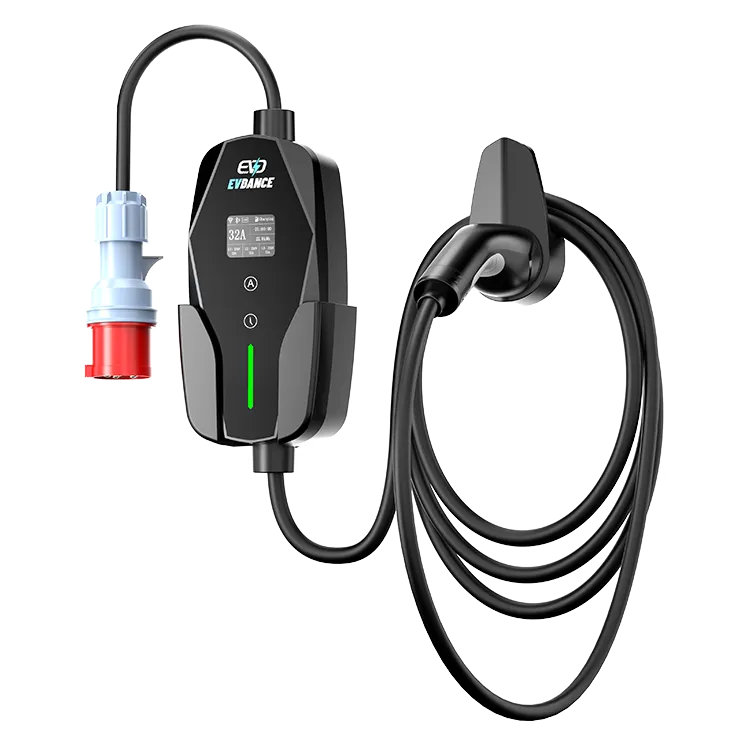
If your workshop already has a red 32A five-pin CEE socket on a three-phase supply, a portable charger like the EV-ACS3205PE plugs straight into it and can deliver up to 22 kW to a Type 2 car — no wallbox installation, no fixed position. The work is in the planning: the charger draws 32 A per phase for hours, so the socket, the circuit behind it and everything else on the same supply need a check first.
Key Takeaways
- A red 32A five-pin CEE socket on three-phase is the whole installation this portable needs.
- Check the socket’s condition and the supply behind it before the first long session.
- Treat the charger as a continuous 32 A-per-phase block in the shop’s load planning.
- If the socket is the 16A class, the matching portable is the 11 kW ACS1605PE.
The Socket Is There. What Still Needs Checking
A red CEE socket on the wall is the starting point, not the finish line. Three things decide whether a session is straightforward. First, the rating: this charger needs the 32A five-pin class — the smaller 16A class is a different socket and a different charger. Our guide to CEE plugs for three-phase portable chargers shows how to tell the sizes apart. Second, the socket’s condition: worn, loose or discoloured contacts are a stop sign, because a continuous 32 A load finds weak points quickly. Third, the supply behind the socket: what the building’s three-phase feed can carry in total is an electrician’s assessment — have it confirmed before the first long session, not after the first tripped breaker.
One More Continuous Load on the Shop’s Supply
Workshops already run heavy loads, and a charger is not a light one. It draws its full current for the whole session, alongside whatever the shop is doing. The planning question is simply what runs at the same time:
| Load on the same supply | How it behaves | Planning response |
|---|---|---|
| The charger at 22 kW | 32 A per phase, continuous, for as long as the car is plugged in | Count it as a fixed block while a session runs |
| Lifts, compressors, machine tools | Heavy but intermittent — they start, run and stop | Charge between heavy jobs, or accept that the two rarely peak together by luck — better to schedule |
| Heating, lighting, office loads | Steady background draw | Include them in the total the electrician checks |
If the supply cannot carry the shop and the charger together, the honest answers are scheduling — charge while heavy machinery is idle — or an electrician’s load assessment. Assuming the headroom is there because the socket is does not work.
Working With a Portable in a Busy Shop
The reason to choose a portable here is movement. The unit goes to the vehicle — the ramp, the yard, the corner where a car waits for collection — instead of every car coming to one wall. A 1.77-inch screen on the unit shows the session in progress, and when the job moves, the charger moves with it. Care is basic but real: the unit is rated IP66, sealed against dust and powerful water jets, which suits a shop floor; still keep the connector capped when it is not in a car, wipe grit off the plug before it goes into a socket, and keep the cable out of oil patches and drive-over paths.

The EV-ACS3205PE in This Scene
The EV-ACS3205PE is EVDANCE’s 22 kW three-phase portable: 32 A on a 380–400 V supply, a CEE five-pin plug on the wall side, Type 2 to the car, a 1.77-inch screen and an IP66 rating. There is no installation to book — any fixed work is the socket and its circuit, and that belongs to an electrician. Where the shop’s sockets are the 16A class instead, the smaller ACS1605PE is the 11 kW portable built for them.
Frequently Asked Questions
Can I plug in and charge at 22 kW straight away?
Only if three gates all pass: the socket is the 32A five-pin class on a three-phase supply, the circuit and supply behind it are confirmed able to carry a continuous 32 A per phase, and the car itself accepts 22 kW of AC power. The lowest gate sets the rate.
Will it run at the same time as our machinery?
That depends on your supply’s total capacity, which only an assessment of your installation can answer. Many shops solve it by scheduling: charge between heavy jobs, not during them.
Our sockets are the smaller red ones. Does this charger fit?
No — the 16A class is a different socket size, and the plug must match it natively. That class is the ground of the 11 kW ACS1605PE. An electrician can also tell you what fitting a 32A socket would involve.
Related Reading
- CEE Plugs Explained: Choosing 16A or 32A for a Three-Phase Portable EV Charger
- Portable EV Charger Types Explained: 10A, 16A, 32A and Three-Phase Models
- Single-Phase vs Three-Phase EV Charging: 7kW, 11kW and 22kW Explained

