
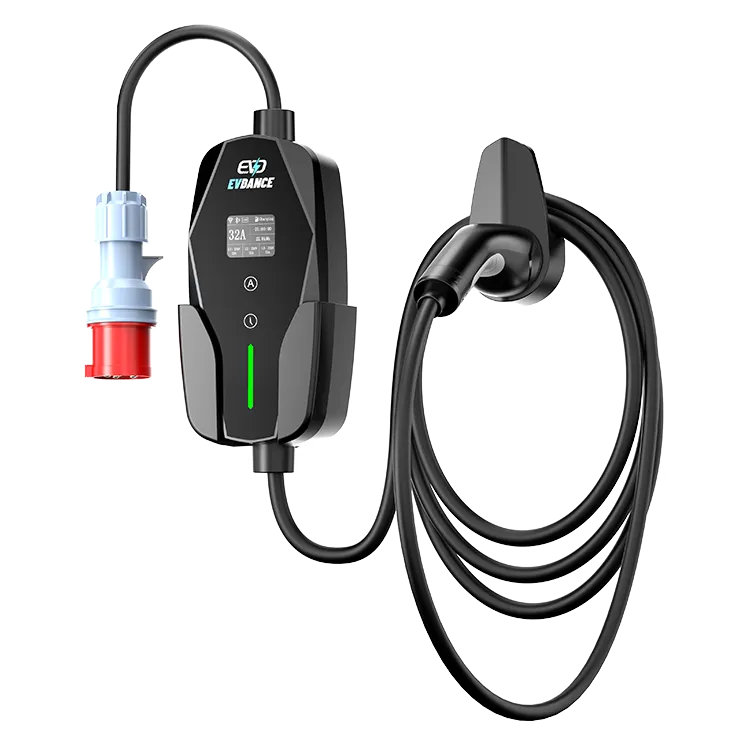
Where a farm already has a 32 A five-pin CEE socket on a three-phase supply — the class fitted for machinery — the EV-ACS3205PE uses it as it stands: plug in, charge at up to 22 kW, then unplug and take the charger to the next building. Everything here is conditional on that socket existing — the first job is confirming what your own buildings actually have.
Key Takeaways
- Everything is conditional on a 32 A five-pin CEE socket on three-phase already existing — check class, condition and supply first.
- 16 A sockets are a different class with their own matching portable, the 11 kW ACS1605PE.
- A farm’s seasonal rhythm is the portable’s case: one unit follows the vehicles between buildings.
- Machinery and charger share one supply — an electrician assesses the total, and timing does the rest.
Start With the Socket You Already Have
Three checks decide whether the charger can work on your farm today:
- The class. This charger needs the 32 A five-pin socket on a three-phase supply. Many farms also have the smaller 16 A five-pin class for lighter machinery — a different socket, which the plug will not fit and must not be adapted to. Our guide to CEE plug classes shows how to tell them apart.
- The condition. A socket that has spent years in a barn earns a look first: worn, loose or discoloured contacts are a stop sign, and replacement is an electrician’s job.
- The supply behind it. What the property’s three-phase feed already carries — and what it can spare — is an electrician’s assessment, made once, before the first long session.
If your sockets are the 16 A class, the matching unit is the 11 kW ACS1605PE, built for exactly that socket. If a building has no three-phase supply at all, that is a different conversation — about a fixed installation — not something a portable charger solves.
A Farm’s Duty Pattern Is Seasonal
A workshop runs the same day all year; a farm does not. That rhythm is where a portable three-phase charger earns its place:
| Season pattern | What it means for charging |
|---|---|
| Peak work periods (harvest, lambing, planting) | Vehicles and machinery run long days; charging fits the overnight window and the charger lives at the yard where the vehicles sleep |
| Quiet periods | The unit moves to wherever the work is — the barn, the workshop building, an outbuilding — because nothing ties it to one wall |
| Machinery peaks on the same supply | One more continuous load among pumps, dryers and tools; schedule around the busiest hours, on the electrician’s assessment of the total |
One portable unit can therefore serve a house car and a farm vehicle at different buildings across the year, provided each socket passes the checks above. A fixed wallbox serves one wall well; it cannot follow the season.
Care in an Agricultural Building
The unit is rated IP66 — sealed against dust and powerful water jets — which suits barn dust and yard weather as a starting point. The rating does not cover handling: cap the connector when it is out of the car, keep the cable out of machinery routes, wipe the plug before it enters a dusty building’s socket, and store the unit dry indoors between seasons. A socket damaged by stock or machinery goes back to the electrician — not into service.
The EV-ACS3205PE in This Scene
The EV-ACS3205PE is EVDANCE’s 22 kW three-phase portable: 32 A on a 380–400 V supply, CEE five-pin plug, Type 2 to the car, a 1.77-inch screen and an IP66 rating. The vehicle still decides the real session rate — a car or van whose onboard charger accepts less than 22 kW charges at its own limit, so check the vehicle before planning around the ceiling. It sits in our residential charging range as the flexible counterpart to a fixed wallbox.
Frequently Asked Questions
Does every farm have the right socket?
No. Three-phase supply and 32 A five-pin sockets vary by property and country; a farm is no more guaranteed to have them than any other building. Confirm your own — from the socket’s rating and an electrician — before choosing a three-phase charger.
Can one unit serve the house and the barn?
Yes, if both buildings have a suitable 32 A five-pin socket on three-phase — that is the point of a portable. It charges where it is plugged in, and moves with you between sessions.
Will charging clash with farm machinery?
The charger draws up to 32 A per phase continuously while it runs, on the same supply as your machinery. Whether your feed carries both at once is the electrician’s assessment; most farms solve it with timing — charge in the quiet hours, not at the machinery peak.
Related Reading
- CEE Plugs Explained: Choosing 16A or 32A for a Three-Phase Portable EV Charger
- Single-Phase vs Three-Phase EV Charging: 7kW, 11kW and 22kW Explained
- Portable EV Charger Types Explained: 10A, 16A, 32A and Three-Phase Models

