
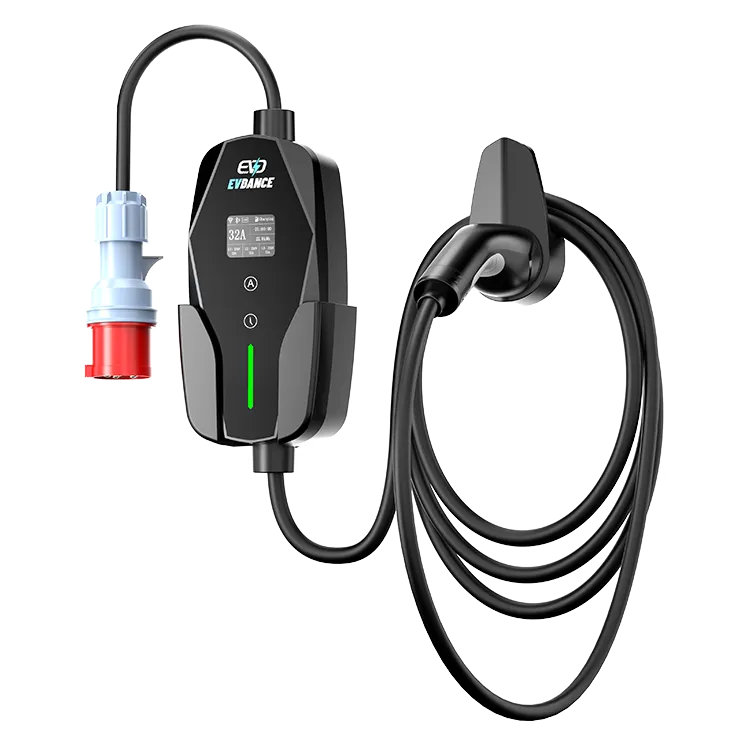
A ferry port or marina with shore-side 32 A CEE supplies can put a portable 22 kW charger to work for its own vehicles, staff cars and — where the port designates a point — visiting drivers. The charger is the easy part: the EV-ACS3205PE plugs into a 32 A five-pin CEE socket and delivers up to 22 kW three-phase. What decides the project is the port: which supplies can carry a continuous 32 A load, and on what terms.
Key Takeaways
- The port’s supply and the port’s terms decide marina charging — the plug fitting is only the starting point.
- Only a 32 A five-pin CEE socket matches this charger; adapters between classes are not a workaround.
- IP66 means weather tolerance, not marine certification — connector care stays in the routine.
- No app or RFID in the specification: port access control is a procedure, not a feature.
The Shore Side Belongs to the Port
Marina and port power was installed for boats and buildings, not cars. Berth pedestals feed loads that switch on and off; EV charging draws heavily and continuously for hours, which is why operators treat it as their decision. CEE outlets on a ferry port’s service quay likewise belong to the port’s electrical plan, and a session has to fit inside it. Our guide to CEE plugs for three-phase portable chargers sets out the classes; the port’s electrician confirms which outlets can carry the load.
Which CEE Supplies Can Carry It
The match is made at the socket, and only one class fits this charger:
| Shore-side supply | Fit for the EV-ACS3205PE? |
|---|---|
| 32 A five-pin CEE socket on a three-phase supply | Yes — the socket this charger’s plug is built for; up to 22 kW where the car accepts it |
| 16 A CEE socket (common at berths) | No — a different class; the plug must match natively. The 16 A class belongs to smaller chargers such as the ACS1605PE 11 kW portable |
| Domestic-style socket on a pedestal | No — this charger has no plug for it, and adapters are not a workaround for a continuous load |
If spare capacity sits only at 16 A sockets, the options are the smaller class or a proper installation — not adapters.
The Conversation With the Harbourmaster or Port Operator
Four questions settle it before the first session:
- Which point? The port designates the socket and the parking position — where a cable never crosses a walkway or a fuelling area.
- Whose cars? Port vehicles and staff are the simple case. Visitor charging is a separate decision, on the port’s own terms for access and payment, agreed in writing first.
- What limit? The port may cap current or hours to protect the rest of its supply. The port’s number governs.
- What if it trips? A named contact and a simple rule: the session ends, it is reported, and the port’s electrician decides what happens next.
Salt Air, Wet Decks and an IP66 Rating
The EV-ACS3205PE is rated IP66: protection against dust and powerful water jets, the right family of rating for equipment living outdoors near water. Read it precisely, though: IP66 is an ingress rating, not a marine certification, and the specification claims no corrosion resistance and no special materials for salt air. Care is therefore routine: capped in storage, off wet decks in use, spray wiped off, warm plugs reported. The rating buys weather tolerance; it does not retire the inspection habit.

The EV-ACS3205PE on Port Duty
The EV-ACS3205PE is a 22 kW three-phase portable: 32 A at 380–400 V, a CEE five-pin plug, a Type 2 connector, a 1.77-inch display and an IP66 enclosure. Its specification lists no app, RFID or network features, so port access control is procedural — a designated point, a booking or key routine — rather than something the charger enforces. The same unit can serve the yard on weekdays and a visitor point at weekends. EVDANCE is a Shenzhen manufacturer founded in 2011, exports to more than 30 countries, and the model carries its 3-year standard warranty.
Frequently Asked Questions
Can a visiting driver just plug into a marina CEE socket?
Not on the strength of the plug fitting. The socket is the port’s infrastructure, on the port’s terms. Unless the port designates a visitor point, ask first — and if it says no, use the public network in our guide to where to find EV charging stations.
Does IP66 make this a marine-certified charger?
No. IP66 covers dust and powerful water jets. The specification states no marine certification and no corrosion-resistance claim, and this article makes none on its behalf. Treat the rating as weather tolerance and keep the inspection routine.
Can it charge electric boats?
No. This is a Type 2 AC charger for road vehicles; boat shore power is a separate system with its own connectors.
Related Reading
- CEE Plugs Explained: Choosing 16A or 32A for a Three-Phase Portable EV Charger
- Single-Phase vs Three-Phase EV Charging: 7kW, 11kW and 22kW Explained
- Where to Find EV Charging Stations: Maps, Apps and Tips

