
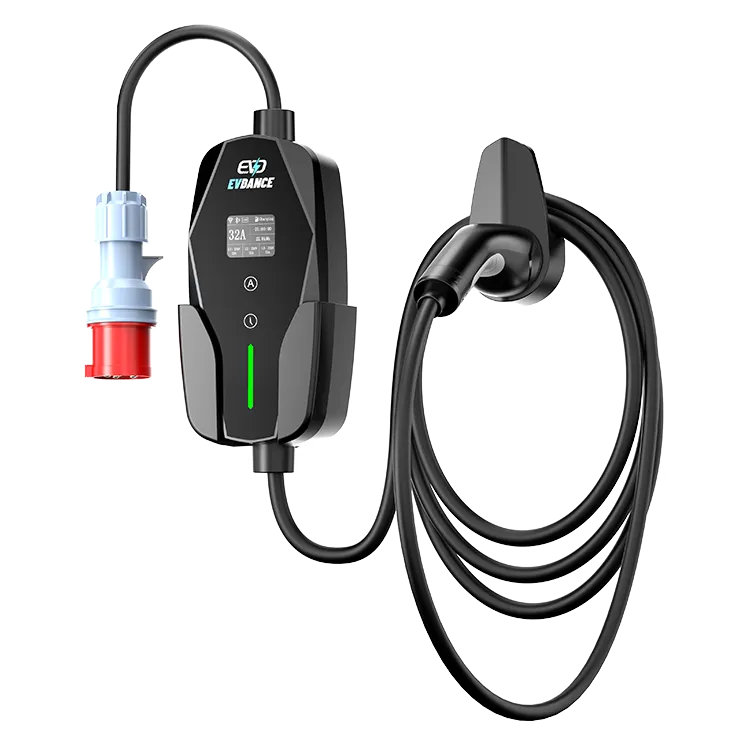
On a shared depot unit, the cable takes the damage: driven over in the yard, dragged across concrete, shut in a door. The check that catches it takes about a minute, before each use: walk the EV-ACS3205PE from CEE plug to Type 2 connector, eyes and hands only — nothing opened, nothing tested with instruments. Any item that fails takes the unit out of service until a qualified person has assessed it.
Key Takeaways
- One minute, before each use: plug, unit, full cable run, connector, and the cable’s route.
- Eyes and hands only — nothing opened, nothing instrument-tested, nothing repaired on the spot.
- Shared yard equipment takes its damage between sessions, which is why the rhythm is per-use, not weekly.
- Any fail means out of service: tag it, report it, and leave the assessment to a qualified person.
The Walk, in Order
Start where the power does — at the wall plug — and finish at the car.
| Stop on the walk | Look and feel for | A fail looks like |
|---|---|---|
| CEE plug — pins and body | Straight, clean pins; body uncracked; the cable sits firm in the plug, not pulling loose | Bent or pitted pins, cracks, a cable grip that gives |
| Unit body and display | Housing whole, no cracks; display glass intact and lighting normally | Cracked housing, a dead or damaged display |
| Cable jacket — the full run | Run your hand along it: no cuts, crush flats or worn-through patches; extra attention at both ends, where bending concentrates | Any cut, flat spot or exposed inner layer |
| Type 2 connector — the car end | Pins visibly straight and clean; the latch moves freely and clicks home; housing uncracked | Bent pins, a latch that will not hold, cracks |
| The run you are about to make | The cable’s path to the car crosses no traffic lane it can avoid, no door line, no sharp edge | The only route puts the cable under yard traffic — reroute, or charge elsewhere |
Why Before Each Use, Not Once a Week
A fixed wallbox is checked on a maintenance rhythm because its world barely changes between visits. A shared portable’s world changes every session: a different driver and bay, a forklift that crossed the yard an hour ago. That damage happens between sessions, not during them — a tyre over the cable at noon is invisible to a check done on Monday.
The person plugging in is also the person standing there. Putting the check at the plug-in moment means it is done by someone looking at the actual cable, in its actual state, every time.
A Fail Is a Stop, Not a Repair
The routine has exactly one outcome for a failed item, and it is not a fix:
- Unplug the unit and take it out of service.
- Mark it — a tag or the depot’s own system — so the next driver does not pick it up.
- Report it to the depot’s responsible person the same shift.
- Leave the assessment to a qualified person: the site electrician for anything on the installation side, EVDANCE support for the unit itself — it carries a 3-year standard warranty.
Never tape a cut jacket and carry on: tape hides the damage without repairing what is underneath, a point our guide to how long EV charging cables last and whether they can be repaired covers in full. And the run itself is part of the discipline — driving over a charging cable is how the next fail gets made.
The EV-ACS3205PE in a Checked Routine
The EV-ACS3205PE is a 22 kW three-phase portable charger: 32 A at 380–400 V, Type 2 connector, CEE five-pin plug, a 1.77-inch display, IP66 housing. The IP66 rating covers the sealed unit against dust and water; it does not cover a cut cable — a breached jacket ends the weather story exactly where the damage is. That is why the jacket gets the longest stop on the walk.

Frequently Asked Questions
The jacket has a small nick but the charger still works. Can I keep using it?
No — a visual check cannot see what a cut has reached underneath the jacket. A breach is a fail: out of service, reported, and assessed by a qualified person before the unit charges again.
Can I tape over damage to finish the week?
No. Tape is not a repair; it conceals the damage from the next person’s check while changing nothing underneath. The order is fixed: stop, tag, report, assessment — then back into service only when it is cleared.
Who is allowed to assess a failed cable?
A qualified person — the operator’s electrician for site-side questions and EVDANCE support for the unit, via our contact page. The checker’s job ends at spotting, stopping and reporting; it never extends to opening or mending the unit.
Related Reading
- How Long Do EV Charging Cables Last, and Can They Be Repaired?
- Can You Drive Over an EV Charging Cable?
- Commercial EV Charger Maintenance Checklist
- Do EV Charging Cables Get Hot?

