
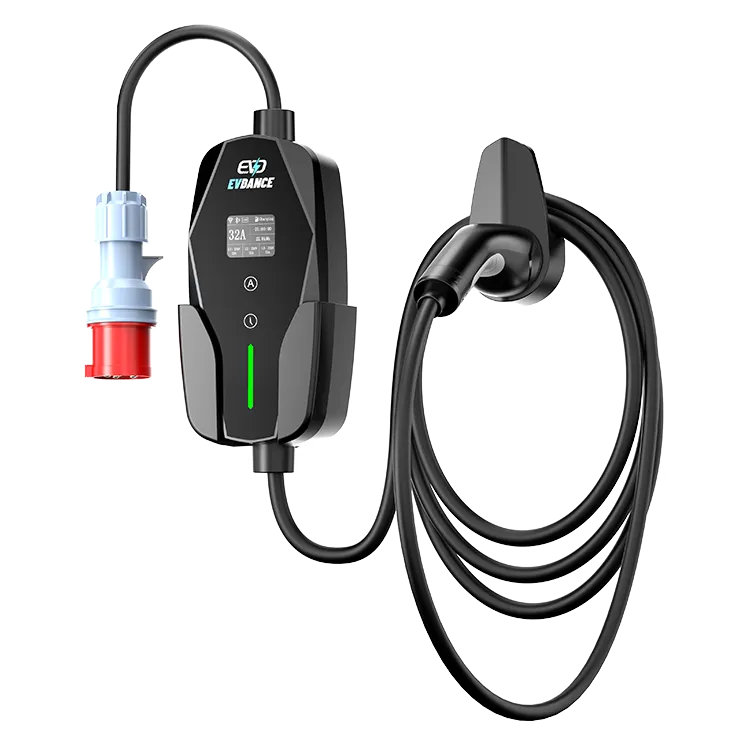
A depot’s bad day is a working vehicle and a dead charge point. A portable charger kept as the spare answers it the same shift: it plugs into any sound 32 A five-pin CEE socket and delivers the same 22 kW AC class as a fixed wallbox, with no installation wait. The EV-ACS3205PE is built for that role — but the spare only works if the plan around it was written before the bad day.
Key Takeaways
- A portable 22 kW spare deploys in minutes from any sound 32 A CEE socket — the socket, not the charger, is the precondition.
- Write the plan before the bad day: storage place, approved sockets, who deploys, scheduled test runs.
- The spare covers a dead point, a wrong bay and a new site — one vehicle at a time, at AC speed.
- Backup complements fixed capacity sized from nightly energy and dwell; it never replaces it.
The Three Calls a Spare Answers
| Situation | What the spare does | What must already be in place |
|---|---|---|
| A fixed charge point is down, waiting on repair | Its vehicles keep their overnight schedule from a socket in another bay | A sound 32 A CEE socket within cable reach of a parking bay |
| A vehicle is in the wrong bay, or a visitor vehicle needs a charge | It charges where the vehicle stands, instead of moving vehicles around a dead post | A socket near the overflow or visitor parking |
| A new site or overflow yard opens before fixed points are fitted | Full-rate AC charging from day one | A three-phase supply, with sockets fitted by an electrician |
Notice what every row shares: the charger is never the missing piece. The socket is. A backup plan that starts by buying the portable and stops there has the easy half done.
The Continuity Plan Is a Document, Not a Hope
The operators who get value from a spare write four things down while everything still works:
- Where the unit lives. A named storage place, known to every shift — a spare nobody can find at midnight is not a spare.
- Which sockets it may use. A short, marked list of the depot’s 32 A five-pin CEE sockets, agreed with the site electrician. A worn or damaged socket is off the list until replaced.
- Who may deploy it. Named roles, so the decision to move the spare does not wait for a manager who is off shift.
- How it is exercised. The plan schedules short test runs and a look over the cable and connector, so the spare’s condition is known. An untested spare is a hope, not a plan.
What Backup Does Not Do
The limits are plain. The spare charges one vehicle at a time, at AC speed; it is a stand-in for a charge point, not a fast charger. It cannot create a socket — where no suitable CEE socket exists, the fix is an electrician, not the portable. And in a power outage it does nothing at all.
Nor is it a reason to under-build the fixed installation. The fixed count still comes from nightly energy and dwell — our guide to sizing AC chargers for fleet depots works through that calculation. The spare covers the gaps in that system; it does not replace the system.
The EV-ACS3205PE as the Depot Spare
The EV-ACS3205PE is a 22 kW three-phase portable charger: 32 A at 380–400 V, Type 2 connector, CEE five-pin plug, a 1.77-inch display, and an IP66 housing suited to depot and yard conditions. As a spare it carries EVDANCE’s 3-year standard warranty of its own. Depots that later standardise on managed fixed charging step up to units like the EV-AC03201T dual-connector station, which lists OCPP 1.6J and RFID — the portable’s job stays the same: flexible cover behind the fixed row.

Frequently Asked Questions
How often should the spare be tested?
On a rhythm your plan sets — regularly enough that its condition is never a surprise. A short scheduled run confirms the unit starts, the connector latches and the vehicle takes power. Faults found on a quiet afternoon are routine; found during an outage, they are a crisis.
Can the spare stand in for a fixed charger for weeks?
It can carry a bay’s duty at the same AC rate for weeks. But a portable working front-line duty every night leaves the depot with no spare behind it — treat a long substitution as the prompt to finish the repair or replace the fixed point, not as the new arrangement.
Does the spare need its own circuit?
It needs a sound 32 A five-pin CEE socket on a suitable circuit each time it is deployed. Which of the depot’s sockets qualify belongs in the written plan, settled with your electrician — not decided at midnight.
Related Reading
- Fleet Depot Charging: How to Size AC Chargers for Vans and Light Commercial Vehicles
- Commercial EV Charger Maintenance Checklist
- CEE Plugs Explained: Choosing 16A or 32A for a Three-Phase Portable EV Charger
- How Do Commercial EV Charging Stations Work?

