
A CEE socket wears where you cannot see it: at the contact surfaces inside. As those contacts loosen, pit and oxidise, the same 32 A must squeeze through a smaller, rougher contact patch — and resistance at a poor contact becomes heat. A charging session holds that current for hours, so a worn socket that survives short machinery runs can overheat badly.
Key Takeaways
- Worn contacts raise resistance at one small point; under a 32 A continuous load that becomes heat — a loop that worsens every session.
- Charging exposes wear that short loads forgive, because it holds full current for hours.
- Warmth, discoloration, looseness, smell and repeated trips are stop signs, not monitoring items.
- Replacement is the electrician’s job — and this charger has no reduced setting to work around a bad socket.
The Wear-and-Heat Loop
A sound socket grips each pin firmly, metal to metal, and resistance at the joint stays negligible. Wear attacks both halves of that bargain. Repeated plugging relaxes the contact springs, so pressure falls. Dust, moisture and arcing pit the surfaces, and oxidation coats them. The current now crosses a smaller, dirtier bridge — one with higher resistance.
Resistance under load becomes heat, in proportion to the current squared. Worse, the process feeds itself: heat speeds oxidation, oxidation raises resistance, and higher resistance makes more heat. The loop does not stabilise — it accelerates, session by session, until the plastic around the contacts discolours, softens or smells. It is the ordinary physics of a tired contact, given an unusually demanding load.
Why Charging Finds Wear That Other Uses Miss
The same socket may have served a workshop for years without drama, because most loads forgive it. A welder, a kettle or a power tool draws heavily for minutes, then rests — the contact warms slightly and cools again. EV charging is treated as a continuous load precisely because it does the opposite: full current, held steady, for hours.
Shared sockets wear fastest: CEE outlets in workshops and venues accumulate hundreds of plug cycles and grit, each costing the contacts a little pressure. Our guide to charging from a normal socket makes the same point at household scale.
Signs a Socket Is Worn — and What Each One Means
| Sign you can observe | What it points to | What to do |
|---|---|---|
| Plug or socket face clearly warm or hot after a session | Contact resistance is already heating the joint | Stop using that socket; an electrician replaces it |
| Brown or black discoloration, distorted plastic | Heat damage has already happened | Do not use it at all; electrician first |
| Loose, wobbly fit; the plug sags | Worn contacts no longer grip the pins | Stop; the grip will not recover |
| Burning or sharp chemical smell at the socket | Overheating plastic or insulation | End the session; call the electrician or site owner |
| Sessions stopping, or a breaker tripping repeatedly | The circuit is complaining — the symptom alone proves no cause | Stop; have it diagnosed — do not reset and retry |
None of these is a “keep an eye on it” item. Wear does not heal between sessions, and every further charge runs the loop again from a worse start.

The Plug Side, and the Charger’s Honest Limits
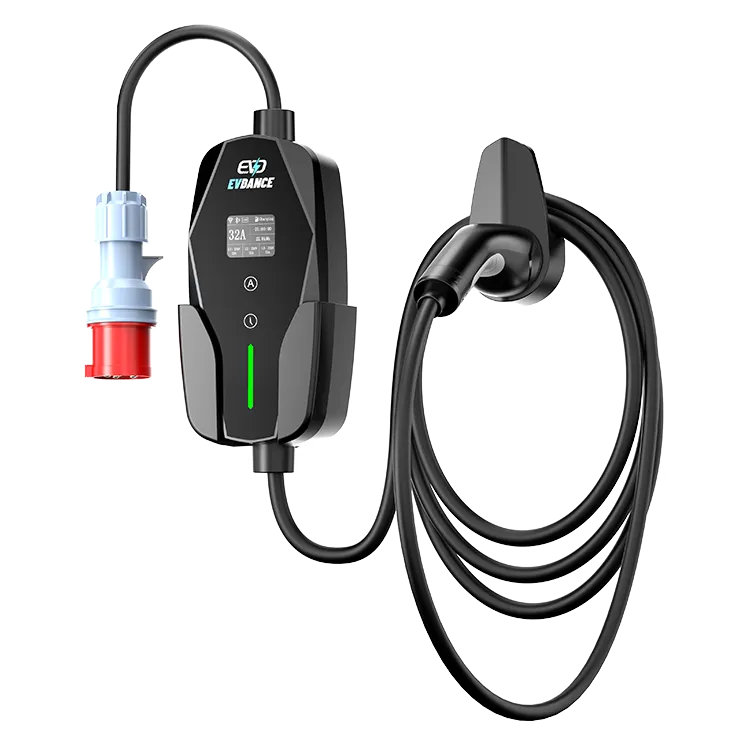
The joint has two halves, so look at the charger’s own plug before you push it in: straight, clean pins sliding in with firm, even resistance are the healthy pattern. Bent, pitted or dirty pins, or a plug that needs force, are stop signs — never force a plug into a socket that resists it. Plug-side damage is a support question for EVDANCE via our contact page, not a home repair.
Two limits deserve stating plainly. The charger’s IP66 rating seals the charger against weather; it says nothing about the socket’s condition, and a sealed charger will happily draw 32 A through a dying socket. And the listing states no reduced-current setting for this model to fall back on — there is no “run it gently on the bad socket” option. The fix comes first: a sound socket, then normal charging.
Frequently Asked Questions
Is any warmth at the plug normal?
Slight warmth on sound equipment under a long, heavy load can occur. The stop signs are different: heat that is clearly growing, discoloration, smell, or a loose fit. If you are deciding whether what you feel counts as “slight”, stop and have the socket checked — the check is cheap; guessing is not.
Can I clean or tighten the socket contacts myself?
No. The socket is fixed wiring, its contacts are not user-serviceable, and a worn socket is replaced, not revived. Cleaning or bending contacts makes a bad joint worse.
Can I just charge in shorter sessions until the socket is replaced?
No — shorter sessions restart the same heat loop at the same worn contact. Stop using the socket, have it replaced, then charge normally.
Related Reading
- Can I Charge an Electric Car From a Normal Socket?
- CEE Plugs Explained: Choosing 16A or 32A for a Three-Phase Portable EV Charger
- Hot-Climate EV Charging: Protecting Chargers From Desert Heat and Sun

