
Yes — by hand. Rooftop output rises toward midday and falls away in the morning and evening, so a charger drawing its full 7.7 kW will take more than many arrays are producing for much of the day, with the grid filling the gap. The EV-ACS3210T adjusts from 10 to 32 A in six steps — about 2.4 to 7.7 kW at 240 V — so you pick a step at or below what your roof is producing while the car charges. It has no automatic solar-tracking feature: the matching is a setting you make, not a mode the charger runs.
Key Takeaways
- Matching a rooftop is a manual step choice: pick the highest of the six steps at or below your current surplus.
- The surplus is production minus the house’s own use — read it from your inverter, not from the array’s nameplate.
- The charger does not track the sun; on a grid-tied home the grid covers dips and the session continues.
- Stepping down costs time, not energy — the same miles take the same kilowatt-hours.
The Six Steps, in Rooftop Terms
The powers below are arithmetic — current × 240 V — not ratings of your array. What your panels are producing at any moment is read from your own inverter or its app. The steps are the fixed side of the match:
| Setting | Charging power at 240 V (arithmetic) | When it fits |
|---|---|---|
| 10 A | About 2.4 kW | Morning or late-afternoon surplus on a small array |
| 12 A | About 2.9 kW | A modest mid-morning surplus |
| 16 A | About 3.8 kW | A typical late-morning surplus, house loads already covered |
| 20 A | About 4.8 kW | Strong sun, or a larger array off its peak |
| 24 A | About 5.8 kW | Near midday on a larger array |
| 32 A | About 7.7 kW | Full sun on a large array — or any time you accept the grid helping |
How to Match in Practice
- Read the surplus, not the production. What the car can take from the roof is what the panels produce minus what the house is using at that moment. Your inverter app usually shows both.
- Pick the highest step at or below the surplus. Example, labelled as such: if the system shows about 4 kW of surplus at 11 a.m., the 16 A step (about 3.8 kW) keeps the session on the roof, with the grid covering brief dips.
- Decide how often you will re-set. Re-check when the sun moves, or set once for the weakest hour you plan to charge through and accept a slower session.
- Let the overnight charge be a grid charge. After dark there is no rooftop output to match; the low steps then serve a different purpose — fitting a small circuit — covered in our guide to what size charger a panel can support.

What Stepping Down Does Not Do
Three limits keep this honest. The charger does not follow the sun: if a cloud crosses, a grid-tied home simply draws the difference from the grid and the session continues — nothing adjusts itself. Stepping down does not change the energy the car needs; the same miles take the same kilowatt-hours, delivered over more hours. And matching is approximate by design — you are choosing a step for an hour, not metering electron by electron. Our guide to solar panels and EV chargers covers the grid-tied picture around this routine. A charger without adjustable current cannot do this at all: it takes its full draw or nothing.
The Charger in This Routine
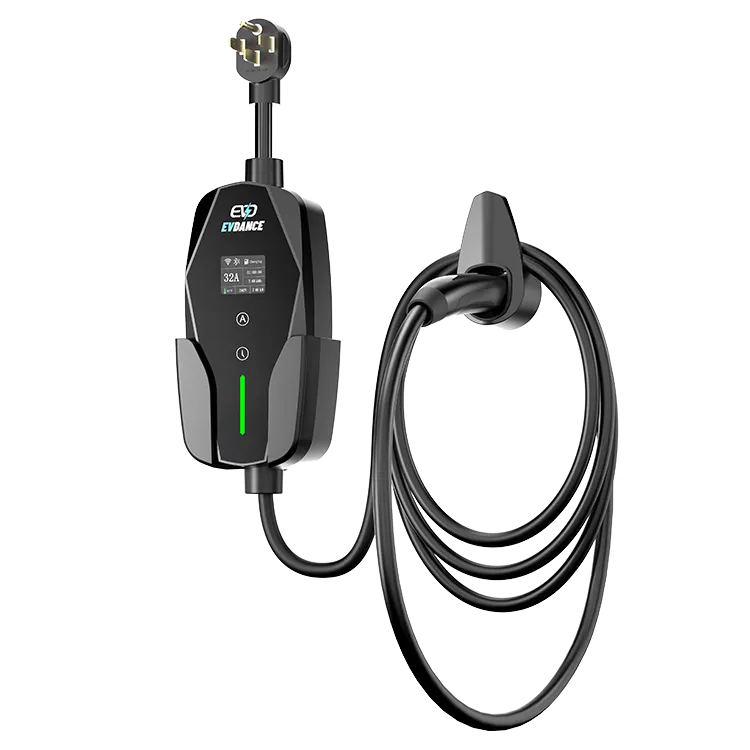
The EV-ACS3210T is a 32 A NACS portable charger: NEMA 14-50P plug, current adjustable from 10 to 32 A in six steps, a 1.77-inch display that shows the step you set — so the match can be checked at the car — and an IP66 enclosure for a driveway or carport under the array. Level 2 spans 7–19 kW in the U.S. DOT’s typical bands at full power; this routine deliberately runs below that, at the pace the roof sets. The unit carries a 3-year standard warranty.
Frequently Asked Questions
Does the EV-ACS3210T follow the solar output automatically?
No. There is no solar-tracking mode on this unit. You read your surplus and set the step yourself; the grid covers any momentary shortfall on a grid-tied home.
Is charging at 10 A wasteful?
No. The car takes about the same total energy for the same miles; a lower step spreads it over more hours. The cost of matching is time, not energy.
What if I need the car full by a set time?
Then the deadline outranks the roof: set the step the deadline needs and let the grid supply the rest. Matching is for the sessions where the car can sit through the sunny hours.
Related Reading
- Solar Panels and EV Chargers: How to Charge Your Car With Sunshine
- What Size EV Charger Can I Have at Home? Panel Capacity Explained
- EV Charger Hardwired vs Plug-In: Which Should You Choose?

