
If your household runs a NACS car and a J1772 car, the usual question is which single charger to pick — or which adapter bridges the gap. There is a third answer: run both portables, one native charger per inlet, and let the two cars take turns on the home supply. The EV-ACS4005T and the EV-AC04001U are the same class of machine — 40 A, 9.6 kW, NEMA 14-50P, IP66 — so a pair of them behaves like one system with two different noses.
Key Takeaways
- Same machine, two inlets: both units are 9.6 kW, 14-50P and IP66, so the pair runs as one system.
- On one outlet the cars take turns; at full rate, four hours stores roughly 35 kWh with losses allowed for.
- Parallel charging needs a second circuit per unit — an electrician’s load assessment, not a splitter.
- Give the adjustable EV-ACS4005T the weaker circuit; the fixed-rate EV-AC04001U takes the proven 50 A one.

The Pair on Paper
| EV-ACS4005T | EV-AC04001U | |
|---|---|---|
| Car connector | NACS | J1772 |
| Current | Adjustable: 16 / 24 / 32 / 40 A | Fixed 40 A |
| Output | 9.6 kW | 9.6 kW |
| Wall plug | NEMA 14-50P | NEMA 14-50P |
| Cable | 25 or 28 ft | 25 ft |
| Rating | IP66 | IP66 |
| Session readouts | 1.77-inch display on the unit | Read on the car’s display instead |
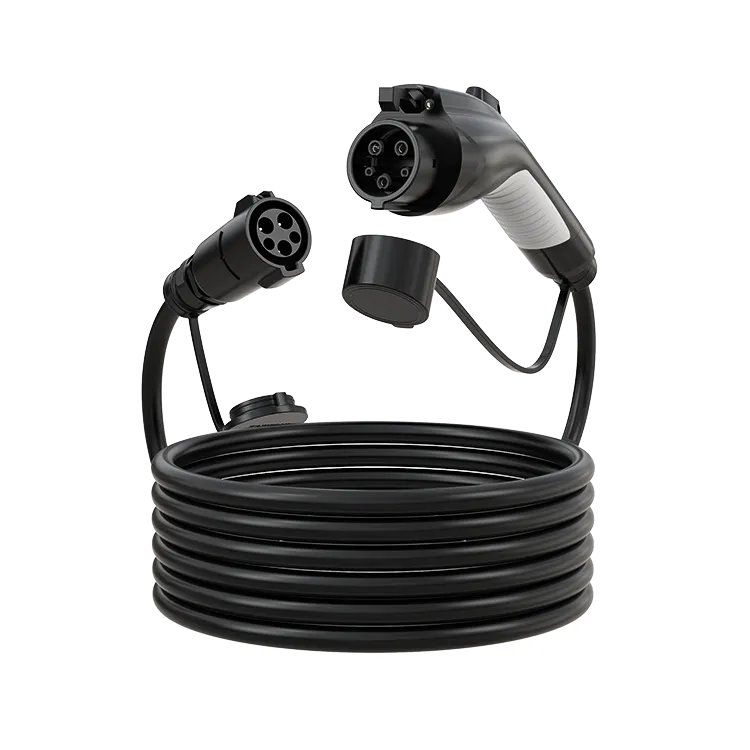
Two differences do the work in a shared home. The EV-ACS4005T can step its current down; the EV-AC04001U cannot — it delivers its fixed 40 A or nothing. Scheduling differs too: the fixed-rate unit relies on the car’s own charge timer. Neither unit needs an adapter in its own car’s session, which is the point of owning both. The background on the two inlets is in our explainer on what J1772 is.
One Outlet, Used in Turns
A single NEMA 14-50 outlet serves one car at a time, so the pair’s first routine is a rotation. As labelled arithmetic at the full 9.6 kW, with about 10% allowed for losses: four hours stores roughly 35 kWh, and five hours roughly 43 kWh. Most two-car households do not need two full windows — a typical night is one car taking the long session and the other topping up. Agree the order once (the car that leaves first charges first), set each car’s own timer where it has one, and the swap becomes a habit rather than a negotiation.
When a Second Circuit Changes the Picture
Rotation stops mattering when each unit gets its own outlet on its own circuit: both cars charge in parallel, all night. Each circuit is sized by the NEC continuous-load rule — 125% of the charger’s current, so 40 A of charging wants a 50 A breaker — and whether the panel can carry two such circuits at once is a load assessment only a licensed electrician should make. This is also where the pair’s one asymmetry earns its keep: if one of the two circuits is the weaker one, give it the EV-ACS4005T, whose 16 / 24 / 32 A steps can be set to what the circuit supports; the fixed-rate EV-AC04001U belongs on the proven 50 A circuit.
When One Unit Plus an Adapter Is Honestly Enough
Two units are the answer to a nightly problem. If the second car charges twice a week, one native charger plus an approved adapter for the other inlet covers it: EVDANCE’s JT02 takes a NACS charger to a J1772 car, AC charging only and up to 80 A, used where the car maker approves — the mirror case for a Tesla on a J1772 charger is covered in our guide to whether a Tesla can use J1772 chargers. Buy the second unit when the nightly swap becomes the thing you resent, not before.
Frequently Asked Questions
Can both units plug into one outlet at the same time with a splitter?
No. One outlet carries one continuous charging load, and a splitter is not a way around that. If both cars need to charge at once, the answer is a second outlet on its own circuit, fitted by a licensed electrician after a load assessment.
Which car should get the adjustable unit?
The one whose circuit is weaker or shared. The EV-ACS4005T’s steps let it run at 32 A or below where the supply calls for it; the fixed-rate EV-AC04001U should sit on the circuit proven for a full 40 A.
Our second car is a plug-in hybrid. Is the second unit wasted?
Not wasted, but easier to justify last. A PHEV’s small battery fills in a short session even at these rates, so its turn in the rotation is brief — and for many PHEV households the adapter bridge is enough. Decide by how often the hybrid charges, not by its battery size alone.
Related Reading
- Can a Tesla Use J1772 Chargers?
- What Is J1772? The North American EV Plug Explained
- Type 2 vs J1772 vs NACS: Which EV Charger Connector Does Your Market Need?
- Do Portable EV Chargers Work? How Speed Depends on the Outlet

