
An EV parking spot announces itself in three layers: the sign at the bay, the paint on the ground, and the charger at its head. Paint and symbols are not standardised, so the sign is the layer that counts: it says who may park there, whether you must be charging, how long you may stay and what it costs.
Key Takeaways
- The sign, not the paint, is the reliable guide to what an EV parking spot allows.
- Read for four things: who may park, time limit, payment, and enforcement.
- Match the bay number to the connector before starting a session.
- Accessible bays are wider with step-free access and clear aisles; keep them that way.
The Four Things Every Bay Sign Tells You
| Sign element | What it tells you | What to do |
|---|---|---|
| Who may park | “EV only” or “EV charging only”, sometimes with the network’s name | The second wording means you must be plugged in, not just driving an EV |
| Time limit | Maximum stay, often 1 to 4 hours at Level 2 posts, less at fast chargers | Set your plans by the limit, not by your battery |
| Payment | App, RFID card or contactless, and whether parking itself is also charged | Sort payment before plugging in; US corridor sites take contactless cards with no membership |
| Enforcement | Fine or towing wording, plus the operator’s name and number | It shows the bay is managed, and whom to call if it is blocked |
The small print lower on the post covers what drivers miss: whether the limit applies overnight, whether the bay reverts to general parking out of hours, and whether a parking fee runs on top of the charging fee.
Paint, Symbols and Bay Numbers
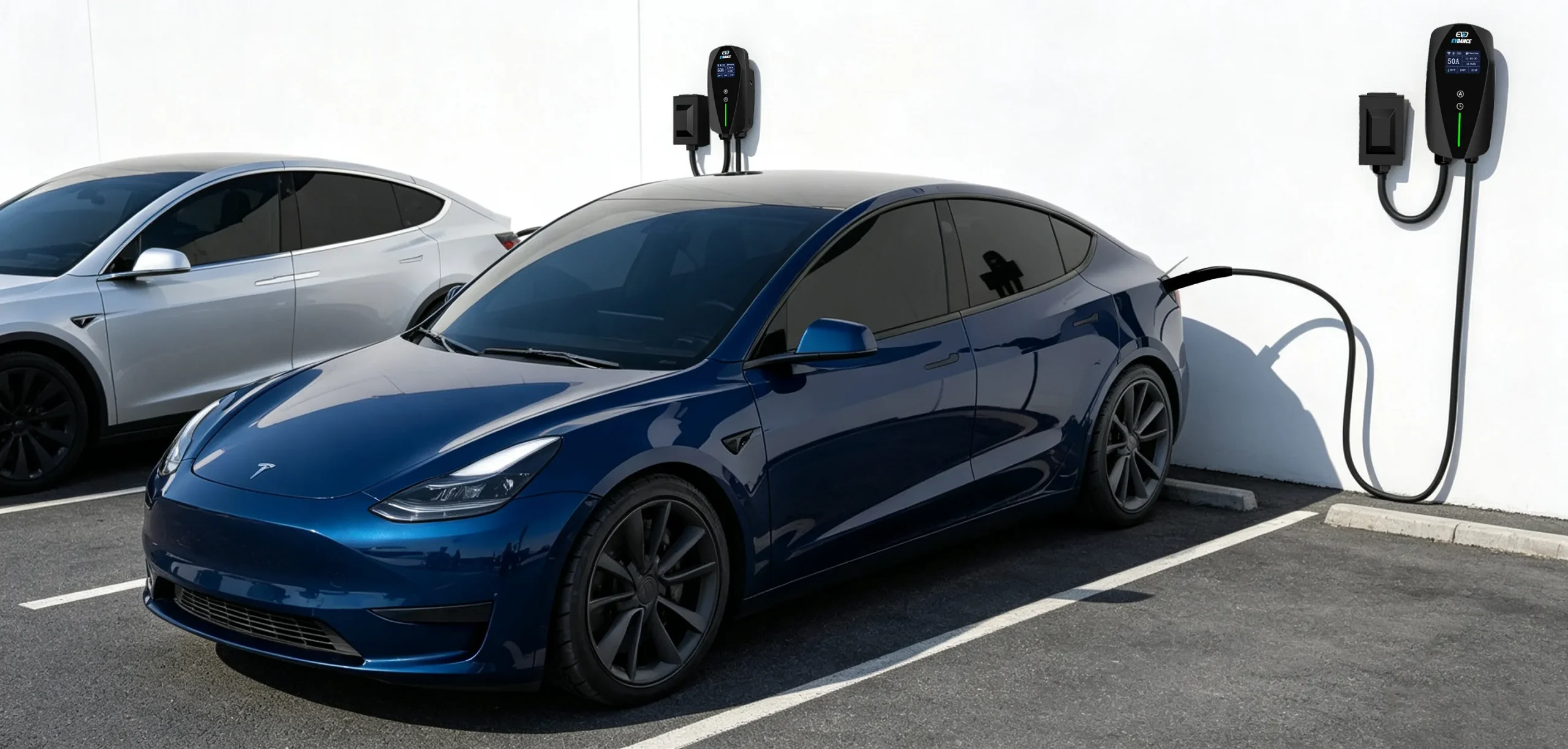
Ground paint is a hint, not a rulebook. Many sites paint charging bays green or blue, or stencil a battery symbol in the space, but plenty use ordinary white lines, and the same colour can mean a car-share bay elsewhere. If the symbol is there but no charger and no sign, you are probably looking at an EV-only space rather than a charging bay, and different terms apply.
Bay numbers matter more than colours. At larger sites each space is numbered to match a connector, and the app or charger screen asks for that number to start your session. Check the number at your wheels against the one on the post before confirming; starting a session on the neighbouring bay’s connector is a common mistake. Paired bays on one post may also share the unit’s power between two cars.
Accessible Charging Bays: What Makes Them Different
Some bays carry the wheelchair symbol, and they are built, not just painted, differently:
- A wider bay with a marked access aisle beside it, for getting out and moving around the car.
- Level ground and a step-free route to the charger, no kerb to cross carrying a cable.
- Controls, connector and payment terminal within seated reach.
- Room to handle the cable: DC fast charging cables are heavy and stiff.
Treat these bays like any other accessible space: use one if you need the access, keep the hatched aisle clear, and leave it free when a standard bay would do. Shared sites mark them the same way, as our guide to apartment and condo charging in shared parking shows.
If the Sign and the Paint Disagree
Follow the sign; it is what the operator and any enforcement officer will point to. If a bay has a charger but no sign, assume it works like other charging bays: park to charge, plug in promptly, move on when full. If the sign is damaged, the charger’s screen and app usually restate the time limit and price before you start, one more reason to start the session properly, as our DC fast charger walkthrough sets out.
The Hardware Behind the Signs
Bay marking is part of what a site buys. A shared post such as the EV-AC03201T dual-connector AC station (two Type 2 connectors, up to 43 kW shared, OCPP 1.6J, RFID access, IP54) serves two numbered bays and can limit use to registered drivers, which the signage then states. Layouts and signage options are on our commercial EV charging page.

Frequently Asked Questions
Does green paint mean the same thing at every EV bay?
No. Colours and symbols are chosen by the site or local authority and are not standardised. Green paint is a strong hint; the sign decides what the space is.
There is a charger but no sign. Can anyone park there?
Treat it as a charging bay: park to charge, plug in, leave when finished. The operator’s terms still apply where signage is poor.
What does the wheelchair symbol at a charging bay mean?
An accessible bay: wider, step-free, controls in reach, a clear access aisle. Use it if you need those features.
Related Reading
- How to Use a DC Fast Charger: Step by Step
- Apartment and Condo EV Charging: Solutions for Shared Parking
- Level 1 vs Level 2 vs DC Fast Charging: A Practical Comparison

