
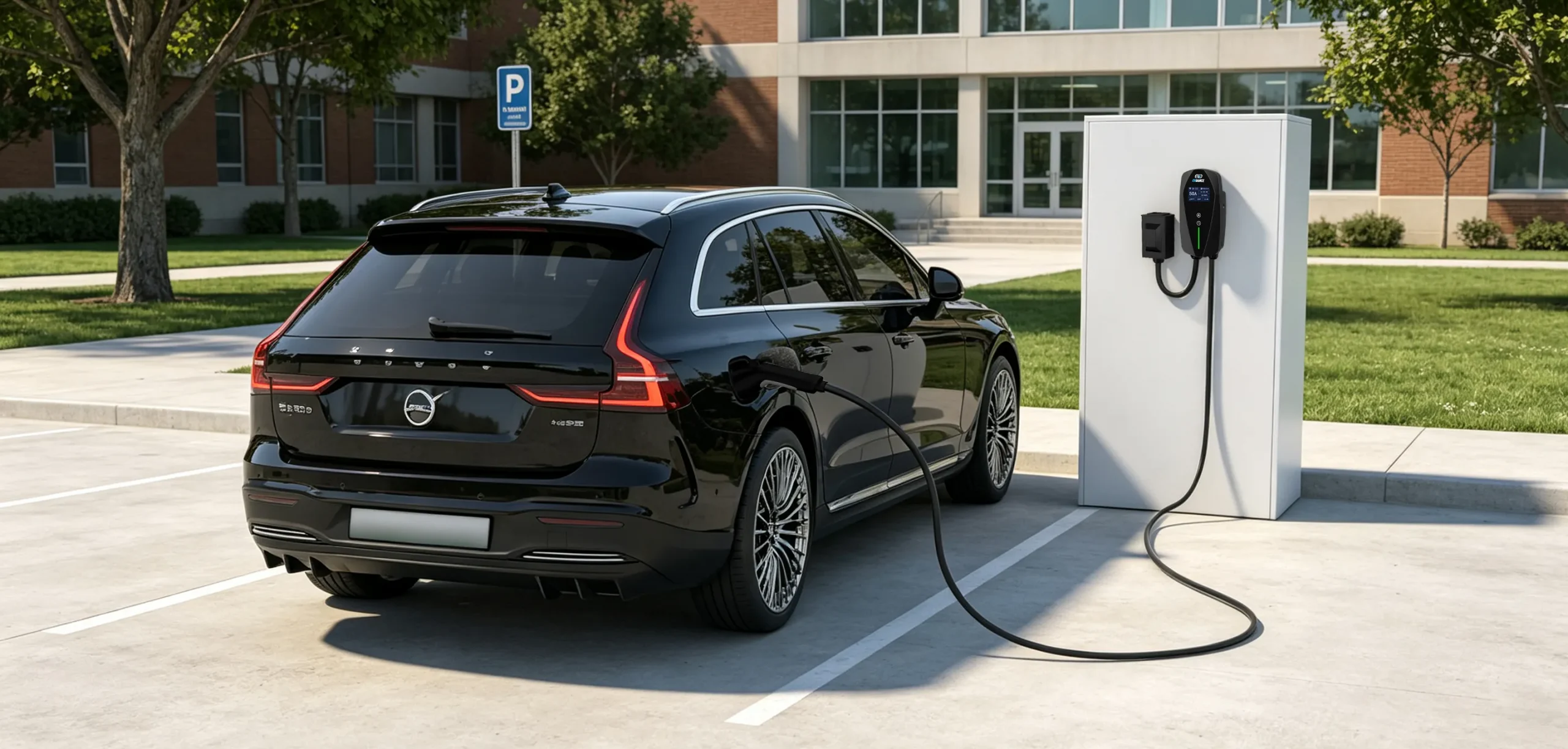
A school charging site serves three different users at once: staff parked for the whole teaching day, parents and visitors stopping briefly, and the school’s own vehicles — a minibus or maintenance van — that must leave charged. The mix, not the building, decides how many chargers you need and how access should work. Most schools start with shared Level 2 charging and grow from there.
Key Takeaways
- A school serves staff, short-stop visitors and its own vehicles, each with a different dwell time; the mix sets the charger count.
- Long parked hours favour shared Level 2 bays over speed.
- Decide access (closed or open) and pricing (benefit or cost recovery) before choosing hardware — funding terms can constrain both.
- Phase the build: today’s bays now, conduit for the next row.
Three Users, Three Patterns
| User | How long they stay | What they need |
|---|---|---|
| Staff | The full teaching day | A reliable bay, simple access, a full battery by home time |
| Parents and visitors | Minutes to an hour | A bay near the entrance that works without an account or an induction |
| School vehicles | Overnight, or between runs | A guaranteed charge — these vehicles cannot start the day empty |
Long dwell is the school’s advantage. Staff cars that sit for six or more hours do not need speed; they need enough bays. That makes a school closer to a workplace than to a public station — the planning logic in how to plan a workplace EV charging program transfers directly, with the parent and visitor traffic added on top.
Access and Payment: Decide Who the Chargers Are For
The first decision is whether the chargers are a closed benefit or an open service. A closed site gives staff access by RFID card or app and keeps the bays for the school community. An open site lets any driver pay and charge, which suits schools whose facilities serve the neighbourhood in the evenings. Both are legitimate, and they mix bay by bay: signed visitor bays near the entrance, card-controlled bays in the staff park, and one reserved point for the school’s own vehicles.
Whether to charge money is the second decision. Free charging is a staff benefit with a real cost to the school; cost recovery keeps it neutral. No rule decides it for a private site — but funding can. Grants and incentives sometimes carry conditions on access or pricing, so check the terms of any programme before setting a tariff; DSIRE lists current U.S. incentives. The benefit-versus-revenue trade-off is the same one hotels weigh in hotel EV charging that pays off.

Siting and the School Day
- Keep charging bays out of the drop-off flow. Morning and afternoon peaks are the worst places for parked-all-day cars.
- Build near existing electrical capacity. Short cable runs from the site’s supply keep installation costs down — the DOE’s infrastructure guidance makes the same point for any site.
- Light and sign the bays. Staff arrive and leave in the dark for much of the school year.
- Start small, wire for growth. Conduit laid in the first installation makes the second row of bays cheap when staff EV numbers climb.
Expect use to swing with the calendar: full bays in term time, a quiet car park in the holidays. That swing is normal for schools and argues for phasing the installation rather than building for the busiest week. Whether any site earns its keep comes back to use, as the charging-station profitability question sets out.
Hardware that fits this pattern is a dual-connector unit such as the EV-AC03201T dual-connector AC station: two Type 2 connectors sharing up to 43 kW (22 kW per connector), OCPP 1.6J for management and RFID for staff access. For a small staff-only park, the EV-ACT3204PE 22 kW wallbox adds RFID and app control in a wall-mounted unit. Both sit within our commercial charging solutions.
Frequently Asked Questions
Do school chargers have to be open to the public?
No. A private school site can restrict its chargers to staff and its own vehicles. The exception is funding: some incentive programmes attach public-access conditions, so read the terms of any grant before accepting it.
Should parents and visitors pay for charging?
That is the school’s choice. Many sites keep short visitor stops simple — free, or at the standard rate with card payment and no account. Decide before installation: the choice shapes the hardware and signage.
How many chargers does a school need?
Start from the count of staff already driving EVs and the hours their cars sit parked. Long dwell means fewer, slower chargers go further than at a public site; a phased start with wiring for more bays is the usual answer.
Related Reading
- How to Plan a Workplace EV Charging Program
- Hotel EV Charging: How to Plan Guest Charging That Pays Off
- Is an EV Charging Station Business Profitable?
- How to Open an EV Charging Station: Step by Step

