
EV charging means transferring electricity from a power supply into an electric car’s battery, through equipment that matches the supply to what the car can accept. Every other term hangs off that sentence: equipment words, speed-and-amount words, and the words on apps and bills. This glossary takes them in that order.
Key Takeaways
- EV charging is electricity moving from a supply into the car’s battery.
- The wall unit is EVSE; on AC charging, the car’s onboard charger does the converting and sets the limit.
- kW is speed, kWh is amount, SoC is the battery’s percentage — most spec sheets use only these.
- Session, network, roaming and idle fee are the four words that explain any public charging bill.
Words for the Equipment
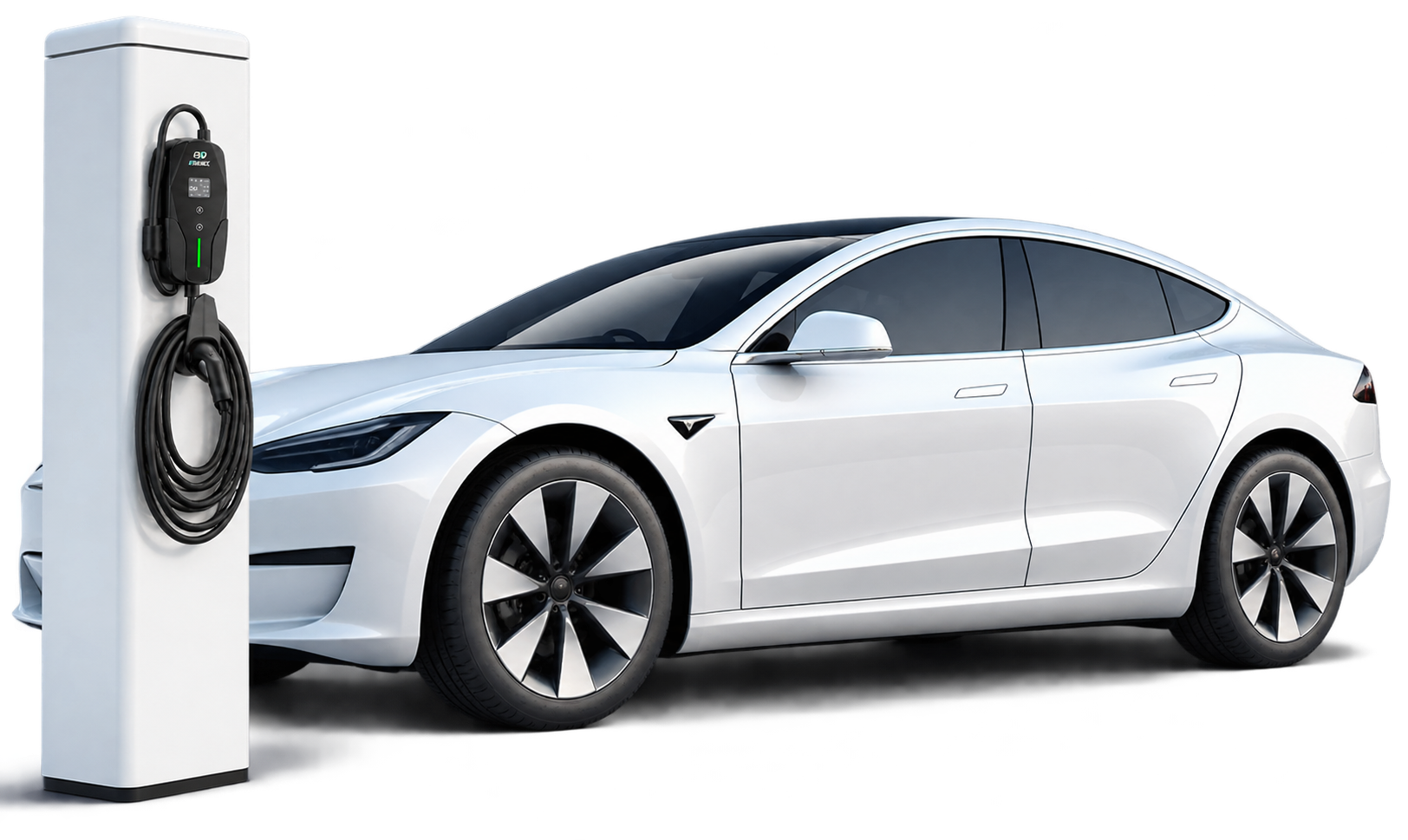
EVSE. Electric Vehicle Supply Equipment — the formal name for the wall or post unit that delivers power and tells the car how much it may take.
Onboard charger. The charger inside the car. On AC charging it converts the wall unit’s alternating current to DC for the battery — which is why the car, not the wallbox, sets the AC speed limit.
Connector. The plug shape joining charger to car. In North America the common AC connector is J1772, with NACS spreading across new models; Europe uses Type 2. It must match the car’s inlet, or an approved adapter must bridge them.
Portable charger and wallbox. A portable charger plugs into an existing outlet and travels with the car; a wallbox is fixed to the wall. Both are EVSE — the difference is installation, not kind.
Words for Speed and Amount
| Term | What it means | Where you meet it |
|---|---|---|
| kW (kilowatt) | The rate power flows — the speed of charging | On the charger and the station screen |
| kWh (kilowatt-hour) | An amount of energy — one kW flowing for one hour | On your bill and your car’s battery size |
| Level 1 | About 1 kW from an ordinary outlet; 2–5 miles of range per hour | Overnight top-ups |
| Level 2 | 7–19 kW; about 10–20 miles of range per hour | Home wallboxes and most public posts |
| DC fast charging | 50–350 kW; about 180–240 miles of range per hour | Highway and corridor stations |
| SoC (state of charge) | The battery’s charge level as a percentage | Your dashboard and charging app |
| Taper | The normal slowing of charging as the battery nears full | The last part of a fast-charging session |
The speed bands are the U.S. DOT’s typical figures; our explainer on slow, fast, rapid and ultra-rapid chargers maps the marketing words onto them.
Words on Apps, Stations and Bills
Charging session. One continuous period of charging, from plug-in to unplugging. Bills and app histories are organised by session.
Network. The company operating a group of chargers under one app, card and payment system. The network decides how you start and pay.
Roaming. Using one account across several networks — why one app sometimes works at chargers owned by different companies.
Idle fee. A per-minute charge for staying plugged in after charging finishes, separate from the price of the energy. It exists to free the charger for the next driver.
Scheduled charging. Telling the car or charger to charge later — usually overnight, when electricity is cheaper — instead of at plug-in.

Words for Smart and Two-Way Charging
Smart charging. Charging controlled by schedule, price signal or grid need, rather than simply on or off — the umbrella term behind most app features.
V2L, V2H and V2G. Vehicle-to-load, vehicle-to-home and vehicle-to-grid: sending power back out of the car to devices, a house, or the grid. Our guide to bidirectional charging explains the three.
Plug and Charge. The car identifies itself to the charger automatically, so no app or card is needed to start and pay.
Read a Spec Sheet With This Page Open
Spec sheets compress this glossary into one line: the EV-ACT3204PE 22 kW wallbox is a three-phase Type 2 unit with RFID and app control — every word defined above. With the terms familiar, our residential charging page takes two minutes to compare.
Frequently Asked Questions
Is the charger in the car or on the wall?
The wall unit (the EVSE) supplies and controls the power; on AC charging, the car’s onboard charger converts it for the battery. DC fast charging bypasses the onboard unit and feeds the battery directly — which is why it is far faster.
Which is the speed — kW or kWh?
kW is the speed, kWh is the amount. A 7 kW charger running for two hours delivers about 14 kWh. Chargers are rated in kW; energy is billed in kWh.
Why does my app show two percentages for the battery?
Usually only one is SoC — the charge level. A second figure is likely state of health: how much of the battery’s original capacity remains.
Related Reading
- What Is a Rapid EV Charger? Slow, Fast, Rapid and Ultra-Rapid Explained
- What Is J1772? The North American EV Plug Explained
- Single-Phase vs Three-Phase EV Charging: 7kW, 11kW and 22kW Explained
- Bidirectional Charging Explained: V2L, V2H and V2G

