
A workplace can add fast top-ups without a corridor charger’s grid upgrade, because a compact DC unit draws in the 22 kW class — the same supply conversation as one 22 kW AC post, not the 50–350 kW conversation. What it buys is time: visitors, pool cars and shift changes get a useful charge inside an hour instead of across a working day. Whether your site has the spare capacity is your electrician’s call — but the ask is modest.
Key Takeaways
- A compact DC unit draws in the 22 kW class — one large AC post’s supply conversation, not a corridor charger’s.
- Its workplace job is the exceptions: visitors, pool cars and shift turnarounds that leave within the hour.
- The layout is one DC bay beside the AC row; bay discipline and access are the employer’s policy on the platform.
- Spare capacity is never promised in an article — your electrician’s load assessment settles it.

Why the Grid Ask Is Small
Grid upgrades follow the load you add. Corridor DC fast charging asks for a connection in the U.S. DOT’s 50–350 kW band, and U.S. DOE-cited figures put that class at about $38,000–$90,000 of equipment plus $20,000–$60,000 of installation per unit — U.S. figures quoted to show where the money sits: much of it is supply scale. A compact DC unit asks for roughly one 22 kW-class load instead: your installer runs the site’s load calculation, and the capacity conversation with the utility is about one modest charger, where one is needed at all. No article can promise your site’s spare capacity; the point is the size of the question.
The Top-Up Patterns a Workplace Actually Has
Staff cars parked for eight hours do not need DC. The DC bay exists for the cars that do not stay:
| Workplace pattern | The gap | What an hour at 22 kW DC does |
|---|---|---|
| A visitor arrives mid-morning for a meeting | The car leaves in one to two hours | Stores roughly 20 kWh before taper — a real departure charge, where AC may cap the same car at half that or less |
| A pool car comes back between bookings | Thirty to sixty minutes on site | Tops up about 10–20 kWh (labelled, before taper) — enough for the next booking, without touching the overnight plan |
| A double-shift or late-finish day | The car is needed again the same evening | Resets it inside the gap, instead of sending it home low or holding a second car |
Each pattern is the operator’s own scheduling picture, not a statistic.
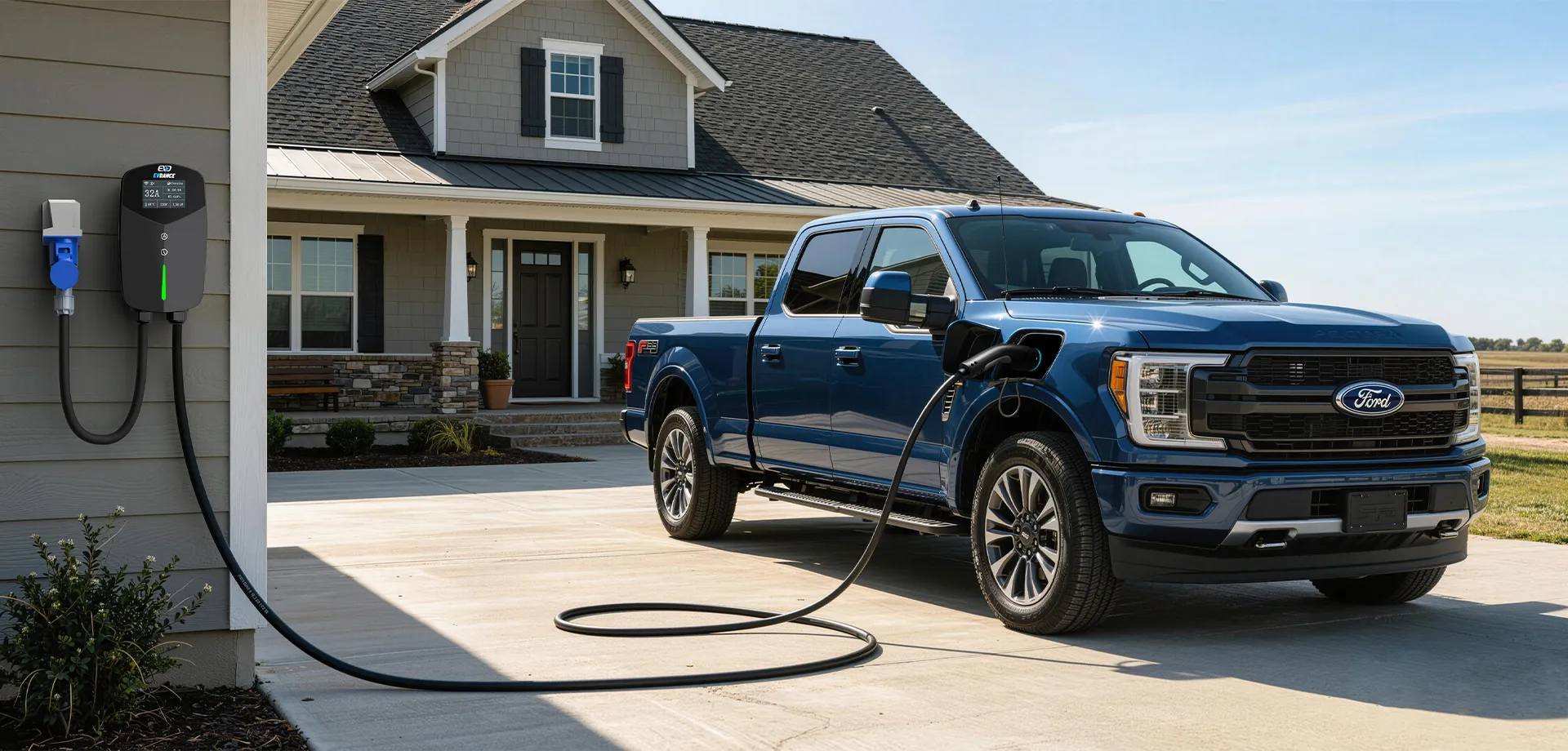
One DC Bay Beside the AC Row
The layout is a division of labour, matching how a workplace charging programme is usually planned:
- AC points carry the day. Staff and fleet cars parked for hours charge on AC — the lowest cost per point, and no time pressure.
- One DC bay takes the exceptions. Sign it for top-ups and keep sessions short by policy: one connector serves one car at a time.
- Access runs through the platform. The unit speaks OCPP 1.6J as listed, so who may charge, and how sessions are recorded, is set in the platform arrangement — the employer’s policy, not the hardware’s.
Installation pricing for commercial sites generally is covered in our guide to commercial charging station installation costs.
The EV-RHDC30K-L at Work
The EV-RHDC30K-L is the unit sized for this job: 22 kW DC on its product page, floor-standing, single connector, an LCD, OCPP 1.6J, and an IP54 enclosure for an outdoor car park. Its listing does not name the DC connector standard fitted, so confirm in writing before ordering that it matches your fleet and your visitors’ cars. EVDANCE is a Shenzhen manufacturer founded in 2011, and the unit carries its 3-year standard warranty. The wider commercial charging range covers the AC row beside it.
Frequently Asked Questions
Will it definitely avoid a grid upgrade on our site?
No honest answer promises that. It depends on your board’s spare capacity, which only your electrician’s load assessment settles. What can be said: the ask is one load in the 22 kW class, so many sites that could never host a corridor charger can host this.
Why not just add more 22 kW AC posts?
For cars parked all day, do exactly that — AC is cheaper per point and speed buys them nothing. The DC bay earns its place only where the car leaves within the hour or two, because there the car’s onboard AC charger is a limit no AC post can cross.
Who gets to use the DC bay — staff, visitors, everyone?
That is the employer’s arrangement, set through the charging platform the unit connects to over OCPP 1.6J: staff only, visitors by arrangement, or open access are policy choices; the hardware contributes the session records.
Related Reading
- How to Plan a Workplace EV Charging Program
- How Much Does It Cost to Install a Commercial EV Charging Station?
- How Do Commercial EV Charging Stations Work?
- Level 1 vs Level 2 vs DC Fast Charging: A Practical Comparison

