
An OEM or private-label charger project with EVDANCE follows a clear sequence: choose a base model, define branding and configuration, plan certification for your market, approve a pre-production sample, run production, inspect and ship. Private label starts from 100 units. The biggest variables in timing are certification and custom packaging, so settle those early.
Key Takeaways
- Start from a proven base model close to your needs.
- Settle certification and packaging early.
- Approve a tested pre-production sample before production.
- Plan spares, warranty and reorders from the start.
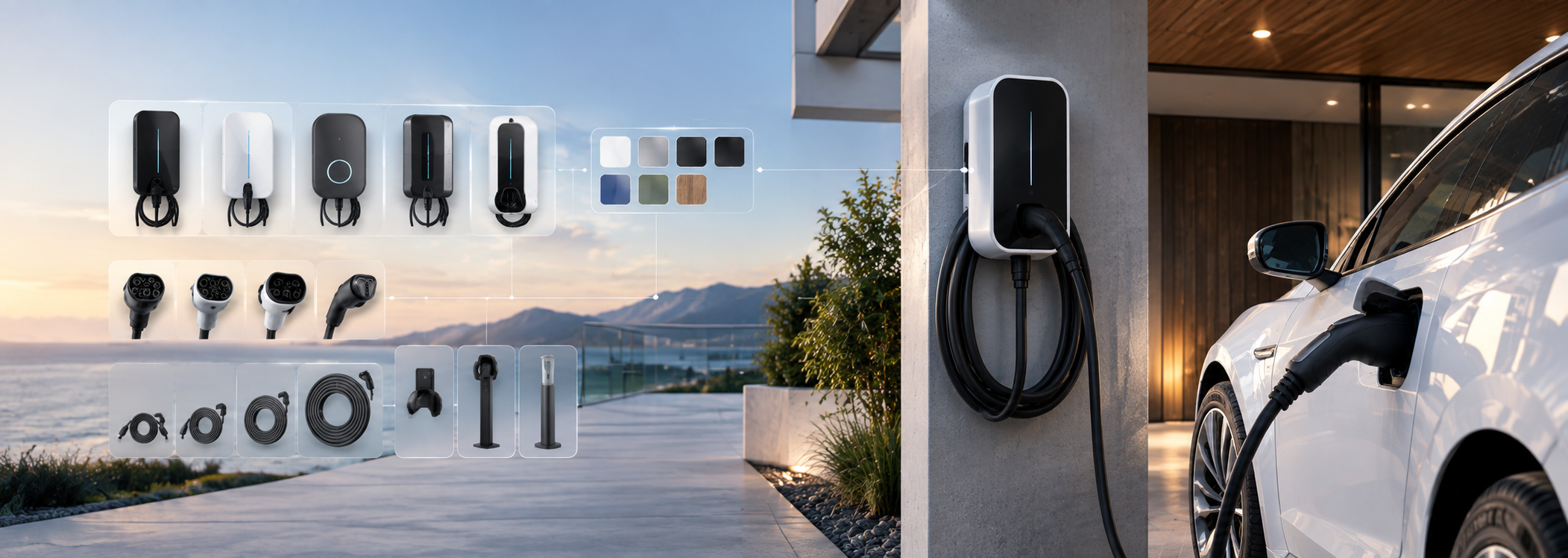
The Project Steps
| Step | What happens | Your decisions |
|---|---|---|
| 1. Brief | Share market, volumes, connectors and target price | Which markets and channels |
| 2. Base model | Choose from the range, such as portable, wallbox or station | Connector, current, cable length |
| 3. Branding | Logo, colours, labels, manual, packaging | Artwork and languages |
| 4. Certification plan | Identify required marks and who holds them | Certificate ownership |
| 5. Sample | Pre-production sample built and tested | Approve or request changes |
| 6. Production | Order produced on the factory line | Final quantity and delivery date |
| 7. Inspection | Pre-shipment checks against agreed standards | Inspection method and AQL |
| 8. Shipping | FOB or DDP, documents prepared | Incoterm and logistics |
Choosing a Base Model
Start from a proven model close to what you need. For North American home charging, that might be the EV-ACS4005T or EV-ACT5006T; for Europe, the EV-ACS3210E or EV-ACT3204E; for commercial projects, the EV-AC03201T. Changing hardware substantially adds engineering and certification time. Read OEM vs ODM and the private-label guide.
Certification and Ownership
Decide which market marks are needed and whose name appears on certificates. This affects cost, time and what happens if you change suppliers later. Our guide on certificate ownership explains the options.

Sample, Production and Inspection
Test the pre-production sample in real conditions before approving. Check the branding, the label, the manual and the packaging as carefully as the electrical performance, because a misprinted label or a manual in the wrong language can hold up customs clearance or a retail launch. Use real vehicles and real outlets from your market, run long sessions, and note anything that confuses a first-time user. Agree inspection criteria in writing.
What a Good Brief Contains
The more complete your first brief, the faster the project moves. Include target markets and channels, expected annual volumes, the connectors and supply plugs you need, cable lengths, whether you need app or OCPP features, branding files, languages for manuals, and the certifications your customers will ask for. Share any retailer or marketplace requirements, such as barcode formats or packaging drop tests, at the start rather than after samples are made. Read a typical OEM timeline for planning.
After the First Shipment
Plan spare parts, warranty handling and reorders. EVDANCE has made chargers since 2011, exports to more than 30 countries and offers a 3-year standard warranty. Start a project through the EVDANCE OEM program.
Frequently Asked Questions
What is the minimum order for an EVDANCE private-label charger?
Private label starts from 100 units.
What usually takes longest in an OEM project?
Certification for the target market and custom packaging approvals.
Can I change the hardware design?
Yes through ODM work, but substantial changes add engineering and certification time.
Related Reading
- OEM vs ODM EV Chargers: How Private-Label Charging Works
- OEM and Private-Label EV Chargers: A Complete Guide for Brands
- Who Owns the Certificate in a Private-Label EV Charger?
- How an OEM EV Charger Project Works, Step by Step
