
Car dealers need charging in three distinct zones: the stock lot, where cars must be kept topped up; the showroom and delivery bay, where new owners are shown how charging works; and customer and service parking. A sensible EVDANCE setup uses AC stations or wallboxes for the lot, a portable charger as a demonstration and delivery tool, and a compact DC unit where customers or service vehicles need a faster top-up.
Key Takeaways
- Plan charging for the lot, delivery bay, service and customers separately.
- Dual-connector AC stations suit rows of stock cars.
- A portable charger makes handovers practical.
- Compact DC helps return serviced cars with charge.
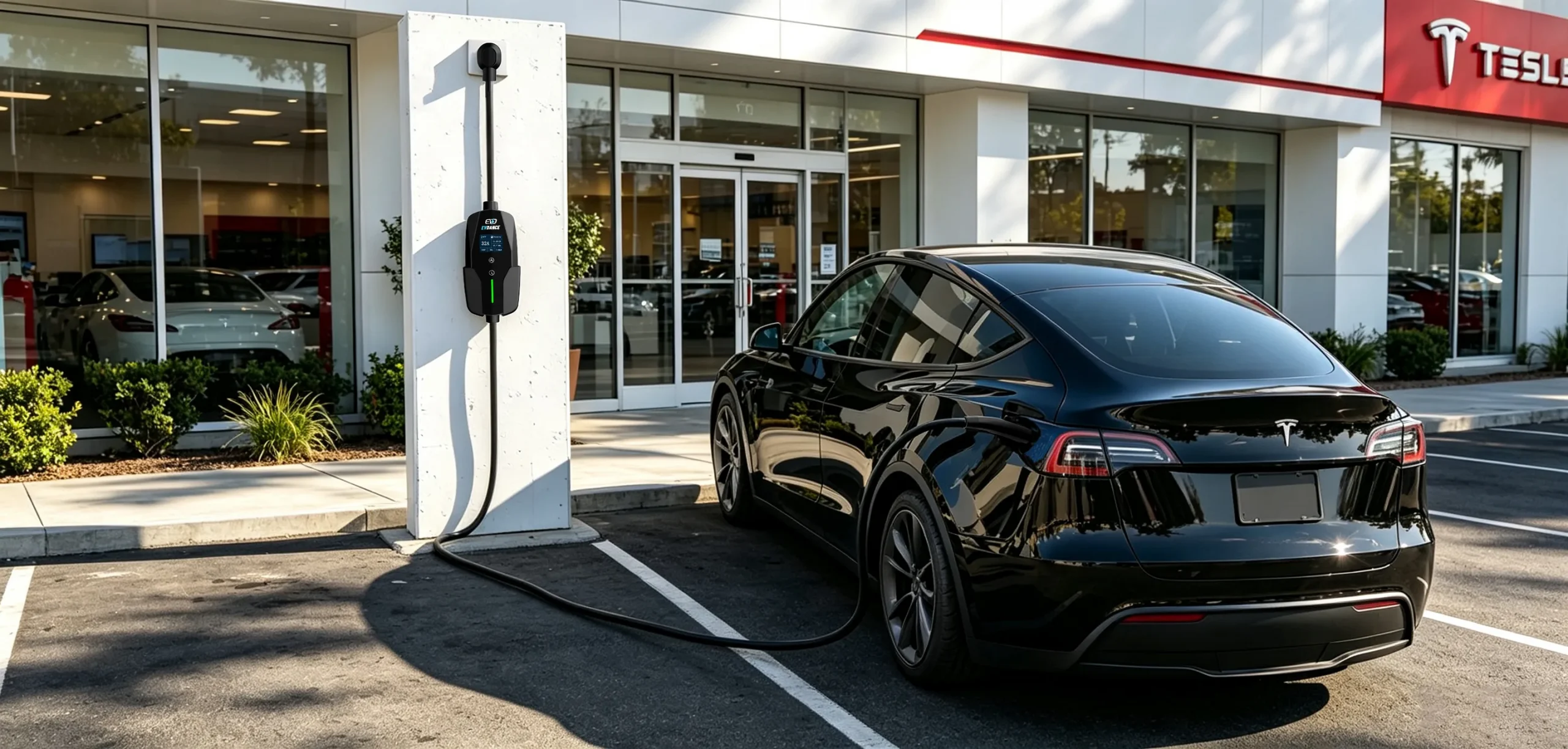
Charging by Zone
| Zone | Need | Suggested EVDANCE model |
|---|---|---|
| Stock lot | Keep many cars at a sensible state of charge | EV-AC03201T 22 kW wallboxes, one per bay |
| Delivery bay | Show new owners how home charging works | EV-ACS4005T or EV-ACS3210E portable charger, by market |
| Service area | Return serviced cars with charge | EV-RHDC30K-L compact DC |
| Customer parking | Courtesy top-ups during visits | AC station with RFID or app |
The Stock Lot
Stock cars need gentle, regular charging, not speed. Dual-connector AC stations serve two cars per pedestal and share power, which suits rows of vehicles. Rotate cars on a schedule and keep a log so none sit at very low charge for long. Our guide on what dealerships install and why covers the business case, and whether batteries drain when parked explains why stock needs attention.
The Delivery Experience
A handover is the moment a new owner learns how to charge. Demonstrating a portable charger on a real outlet and showing the car’s schedule and charge-limit settings answers the questions that otherwise become phone calls a week later. Some dealers also offer a charger as part of the sale, which a private-label programme can support.

Service and Customer Charging
Service customers appreciate getting their car back with more charge than they left it. A compact 22 kW DC unit can add meaningful energy during a service visit, while AC charging suits longer stays. RFID or app authorization keeps access under control, and session records show how much energy each department or customer used.
Power and Planning
Dealers often have large lots and limited spare electrical capacity. Ask an electrician for a load assessment and use load management across stations. Plan cable routes and future bays together, since new models keep arriving. A dealer that sells only a few EVs today may sell many more in a few years, and trenching once with spare ducts is far cheaper than digging up the lot again.
EVDANCE supports dealerships and automakers with its OEM and dealership program, including private-label chargers from 100 units and a 3-year standard warranty.
Frequently Asked Questions
What chargers does a car dealership need?
AC charging for the stock lot and customers, a portable charger for handovers, and often a compact DC unit for service.
How often should stock EVs be charged?
Follow the automaker’s storage guidance and keep a rotation log so cars do not sit at very low charge.
Can dealers sell chargers under their own brand?
Yes, through private-label programmes, subject to certification and labelling requirements.
Related Reading
- EV Charging for Car Dealerships: What to Install and Why
- Does an EV Battery Drain When Parked?
- What Is a Dual Port EV Charger? How It Works and How to Choose
- OEM and Private-Label EV Chargers: A Complete Guide for Brands

